Written and reviewed by A Pomsky Editorial Team. Published 2026-07-25; last reviewed July 25, 2026.
This guide is educational and is not veterinary advice. Use a veterinarian for diagnosis, medication, treatment, and individual health decisions. In an urgent situation, contact the appropriate veterinary or public-safety service. Read our health disclaimer and editorial policy.
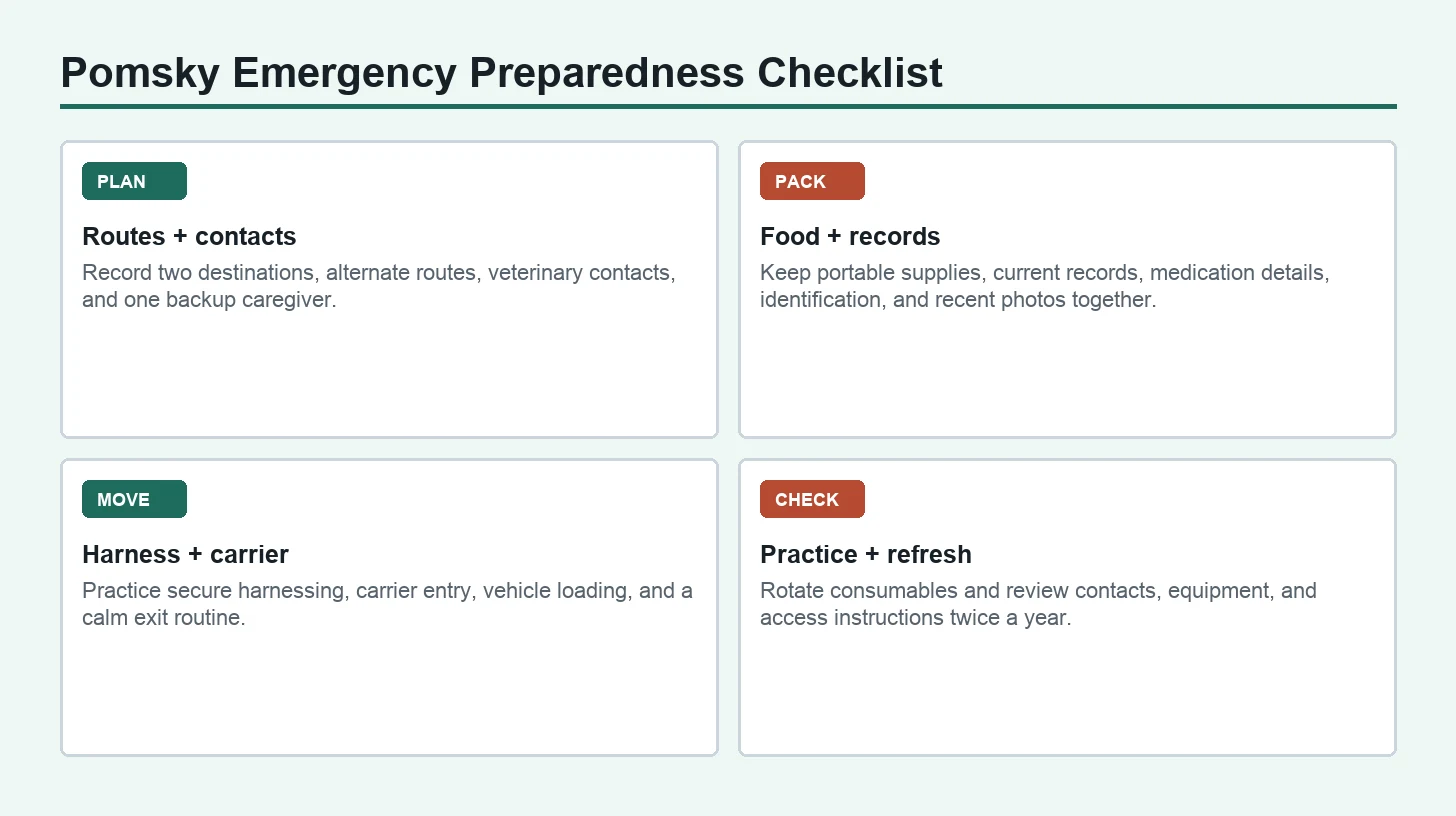
Quick answer: A Pomsky emergency plan should include identification, current records and medications, a transport setup, food and water, sanitation supplies, veterinary and poison contacts, an evacuation destination, and a backup caregiver. Practice the plan before a disaster.
Quick checklist
| Identification | Current collar tag, microchip registration, recent photos, and ownership details. |
|---|---|
| Transport | A fitted harness, leash, secure carrier or crate, and a known loading routine. |
| Supplies | Water, food, bowls, waste bags, bedding, sanitation items, and familiar comfort items. |
| Health file | Veterinary contacts, records, medication names and instructions, and insurance details if applicable. |
| Destination plan | Two pet-friendly destinations, alternate routes, and a trusted backup caregiver. |
| Practice | Short calm drills that include leashing, loading, leaving, and checking the kit. |
Six-step action plan
- Create one portable kit. Store essential food, water, sanitation, first-aid supplies, records, and handling equipment in waterproof containers that one adult can move.
- Update identification. Check the collar tag, microchip registration, phone numbers, emergency contacts, and recent identifying photos.
- Choose evacuation destinations. Record at least two pet-friendly options outside the immediate area and confirm their rules before an emergency.
- Assign a backup caregiver. Give a trusted person written access instructions, veterinary details, and permission information appropriate to your situation.
- Practice transport. Rehearse calm harnessing, carrier entry, vehicle loading, and one alternate exit without creating panic.
- Review on a schedule. Check food, water, medication, batteries, documents, and contact information at least twice a year and after any household change.
Start with risks, not a generic shopping list
List the emergencies that could realistically affect your home: wildfire, flood, severe weather, extended power loss, evacuation order, house fire, or a caregiver becoming unavailable. The supplies and route for a fast fire evacuation are different from the plan for sheltering through a winter outage. A short local risk list keeps the kit practical and prevents important decisions from being buried under unnecessary gear.
Write a one-page action sheet with your Pomsky's name, photo, microchip number, veterinarian, emergency clinic, feeding routine, medications, behavior notes, and two destinations. Store a printed copy with the kit and a digital copy that can be reached if your phone or home computer is unavailable. Do not place passwords, financial credentials, or other sensitive account details in an exposed kit.
Build a kit that can leave with the dog
Use a waterproof tote, backpack, or divided container that is light enough to carry with the dog. Include food and water appropriate for your plan, collapsible bowls, waste bags, paper towels, cleaning supplies, a spare leash and harness, bedding, a familiar toy, and copies of records. Rotate consumables before they expire. The AVMA preparedness guide recommends planning a substantial food and water reserve; adapt the amount to your dog's diet, storage conditions, transport capacity, and veterinarian's advice.
Medication planning requires more than placing bottles in a bag. Keep the medication name, strength, schedule, prescribing clinic, refill information, and storage needs with the health file. Ask the prescribing veterinarian how much reserve is appropriate and how temperature-sensitive products should be handled. Never change a dose or substitute a product because an emergency kit is incomplete.
Make transport boring and repeatable
A frightened dog may avoid a doorway, pull out of loose equipment, or refuse a carrier that only appears during stressful events. Use a properly fitted harness and secure carrier or crate, then practice in short, rewarded sessions. Keep the primary leash or carrier near the exit without blocking the route. Every person who may move the dog should know which equipment fits and how the doors latch.
Plan for the vehicle as well as the front door. Decide where the secured crate or restraint will go, keep the loading area clear, and avoid placing the dog where airbags or loose cargo create additional danger. The separate Pomsky car travel checklist covers restraint, acclimation, temperature, and motion-sickness observations in more detail.
Choose destinations before an evacuation
Do not assume a public shelter, hotel, relative, or boarding facility will accept pets during a regional emergency. Record two options in different directions and confirm their current policies. Include the address, phone number, route, fee or vaccination requirements, and a backup contact. A boarding facility may require records that are difficult to retrieve during an outage.
A buddy system is useful when household members are away. Choose someone who already knows the dog, can enter the home safely, understands the handling plan, and has written contact information. Review how that person will communicate and where the dog should be taken. Update the plan whenever locks, phone numbers, veterinary clinics, or household routines change.
Shelter-in-place without losing an exit path
If authorities direct you to remain home, move the kit, carrier, leash, and shoes to the safe area. Keep water available and preserve a clear path to leave if instructions change. Maintain ventilation and temperature appropriate for your dog, and prevent access to damaged rooms, contaminated water, chemicals, broken glass, or exposed wiring.
Noise, alarms, unfamiliar people, and disrupted routines can change behavior. Use a secure indoor zone and supervise doors closely. Familiar bedding, predictable feeding, calm reward-based handling, and short toilet opportunities can reduce avoidable stress, but they do not replace evacuation when officials say to leave.
After the immediate danger
Keep your Pomsky leashed or contained even in a familiar neighborhood. Landmarks, scents, fencing, and wildlife patterns may have changed. Check paws and coat for debris, contaminated water, burns, cuts, ice melt, or other hazards without delaying veterinary care for serious injury or illness.
Contact a veterinarian or emergency clinic for breathing difficulty, collapse, uncontrolled bleeding, suspected poisoning, severe burns, repeated vomiting, inability to urinate, marked disorientation, or any rapid deterioration. This list is not exhaustive. When uncertain, call a veterinary professional and describe what happened, what you observe, and any known exposure.
Example: use the checklist as a control loop
Before the task, record the conditions and the dog's starting state. During the task, watch a small set of observable signs rather than relying on breed appearance or a fixed rule. Afterward, record recovery and any problem. Use that feedback to adjust the next attempt, and route medical, medication, or urgent safety decisions to a veterinarian. This process makes the checklist useful for a puppy, adult, senior, newly adopted dog, or Pomsky with a changing health history.
A checklist is not a promise of safety. Equipment can be fitted incorrectly, conditions can change, and an individual dog can respond differently from the previous outing. Stop when the situation leaves the planned safety boundary. In a possible emergency, contact the appropriate veterinary or public-safety service instead of continuing the activity to complete the list.
Common mistakes to avoid
- Using a Pomsky's coat, size, confidence, or previous tolerance as a guarantee.
- Waiting for severe signs before ending an avoidable exposure.
- Changing medication, diet, restraint, or protective equipment without appropriate instructions.
- Relying on one phone, one route, one caregiver, or one piece of equipment without a backup.
- Collecting photos or completing a checklist when urgent care or evacuation should come first.
- Failing to record what happened, which makes the next plan depend on memory and guesswork.
Frequently asked questions
How much emergency food and water should I keep for a Pomsky?
Use local emergency guidance and your dog's actual diet to plan a portable reserve, then rotate it before expiration. The AVMA preparedness guide discusses planning up to two weeks of food and water, but storage, medication needs, transport limits, and veterinary instructions may change the practical amount.
Should a Pomsky wear identification indoors during an emergency?
Current visible identification and microchip registration improve reunification options, but collars can also catch on objects. Choose and supervise equipment for the situation, and keep a recent photo and ownership information in the emergency file.
Can I take my Pomsky to any emergency shelter?
No. Pet acceptance and documentation rules vary. Identify pet-friendly destinations and backup care before an emergency, then verify policies periodically.
What should a backup caregiver know?
They should know safe entry, handling equipment, feeding and medication instructions, veterinary contacts, destinations, behavior risks, and how to reach you. Provide only the access and personal information that is necessary.
How often should I update the plan?
Review it at least twice a year and after a move, new medication, changed phone number, new caregiver, vehicle change, or local hazard update.
Related Pomsky guides
- Pomsky health guides
- Pomsky training guides
- Pomsky supplies guide
- Pomsky crate size guide
- Health disclaimer
- Editorial policy
- Affiliate disclosure
- Pomsky car travel safety
- Pomsky vet visit preparation
- Pomsky cold weather safety
Sources reviewed
These sources were reviewed for general pet-safety and veterinary-care principles. They do not create a diagnosis or an individual treatment plan.
- CDC: Pet safety in emergencies
- CDC: Pet emergency checklist
- AVMA: Saving the whole family disaster guide
Evidence and related Pomsky guides
These sources support only their stated claim scopes; they do not guarantee an individual Pomsky outcome.
Sources reviewed for this page
- U.S. Centers for Disease Control and Prevention: Pet Emergency Preparedness
- U.S. Centers for Disease Control and Prevention: Pet Emergency Checklist
- ASPCA: Animal Poison Control