Written and reviewed by A Pomsky Editorial Team. Published 2026-07-25; last reviewed July 25, 2026.
This guide is educational and is not veterinary advice. Use a veterinarian for diagnosis, medication, treatment, and individual health decisions. In an urgent situation, contact the appropriate veterinary or public-safety service. Read our health disclaimer and editorial policy.
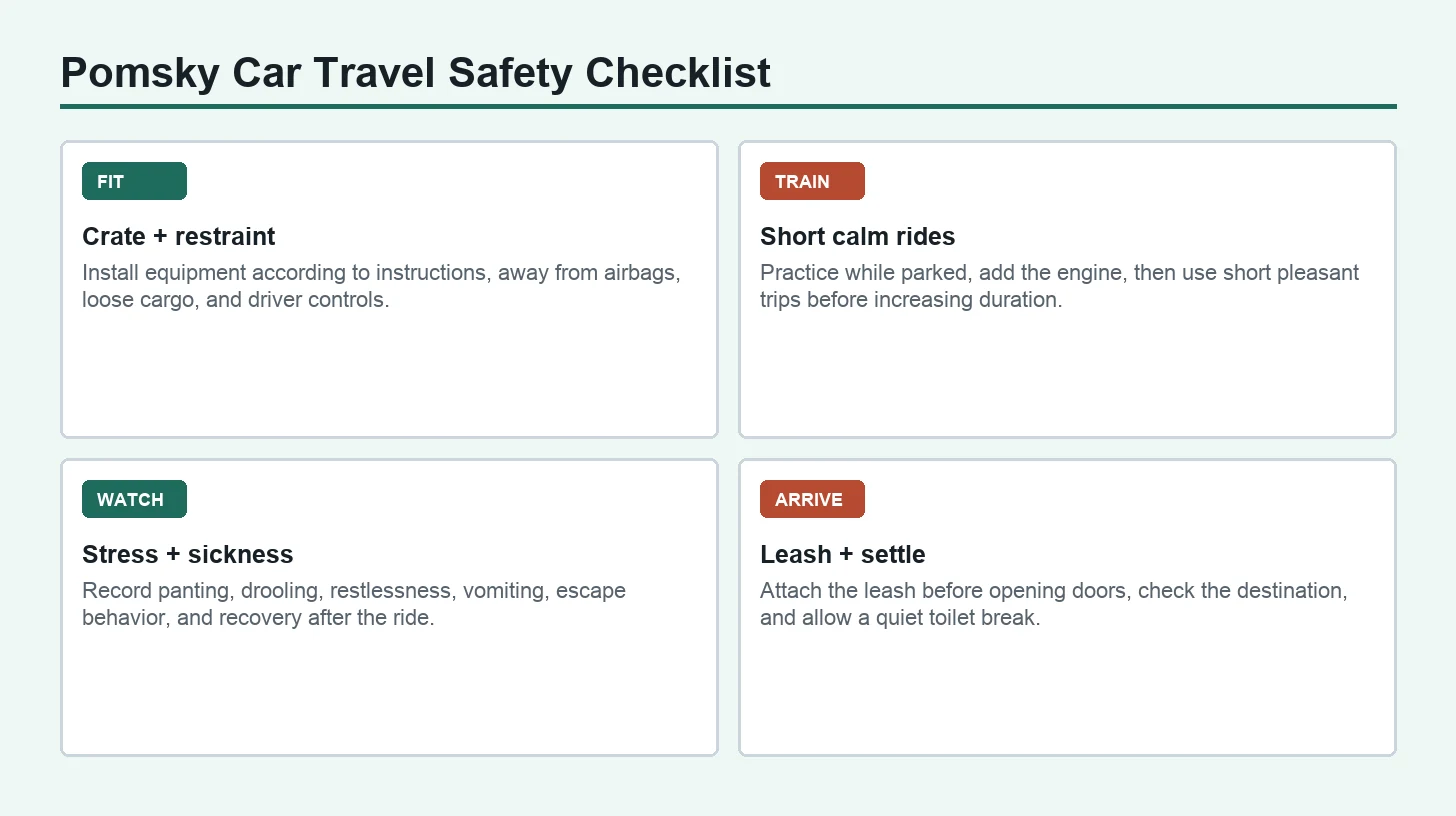
Quick answer: Safe Pomsky car travel uses a secured crate or crash-tested restraint, identification, planned breaks, climate control, and no unattended time in the vehicle. Build comfort with short trips and ask a veterinarian about severe motion sickness or anxiety.
Quick checklist
| Restraint | A secured crate or vehicle restraint fitted and used according to its instructions. |
|---|---|
| Position | Away from airbags, loose cargo, open windows, and the driver's controls. |
| Practice | Stationary car sessions, engine-on sessions, then short trips to neutral or pleasant places. |
| Cabin | Comfortable temperature, ventilation, water plan, and no unattended hot or cold vehicle time. |
| Breaks | Planned stops in secure locations with leash control and waste supplies. |
| Observation | A log of drooling, panting, restlessness, vomiting, fear, recovery, and trip conditions. |
Six-step action plan
- Choose the travel zone. Select a back-seat or cargo position that avoids airbags and can hold the restraint securely.
- Fit and install restraint. Follow the manufacturer instructions for the crate, harness, anchor points, and weight range.
- Practice while parked. Reward calm entry, settling, doors closing, and brief restraint before starting the engine.
- Add motion gradually. Use short, smooth trips and increase duration only while the dog remains comfortable.
- Plan the route. Schedule secure breaks, check weather and traffic, and identify veterinary help along longer routes.
- Review each trip. Record stress or sickness signs and adjust training or contact the veterinarian before the next journey.
Restrain the dog before the vehicle moves
A loose dog can distract the driver, reach an open door, collide with occupants, or be thrown during sudden braking. Use a secured crate or a vehicle restraint designed for dogs, installed according to its current instructions. Fit matters: equipment that is too loose can permit escape, while an unsuitable attachment can place force on the neck or fail under load.
Choose a position away from active airbags and driver controls. Secure the crate so it cannot slide or become loose cargo. Remove heavy objects that could strike the dog. Because vehicle layouts and restraint products differ, consult the vehicle and product instructions instead of relying on a universal attachment method.
Teach the car as a sequence of small skills
Start with the vehicle parked and the engine off. Reward approaching, entering, settling on the travel surface, wearing the restraint, and waiting while a door closes. Continue with the engine running, then a very short smooth trip. Some trips should end at a pleasant or neutral place rather than every ride predicting a clinic or groomer.
Progress depends on the individual dog. Stop before mild concern becomes frantic escape behavior, persistent panting, repeated vocalizing, shutdown, or refusal to take a normally valued reward. Forcing a long trip may strengthen the association between the car and distress.
Separate motion sickness from training difficulty
Drooling, lip licking, restlessness, repeated swallowing, vomiting, or marked quietness can occur with motion sickness, fear, or both. Record when signs begin, the road conditions, meal timing, temperature, restraint position, and recovery after the trip. This information helps the veterinarian distinguish patterns and advise on next steps.
Do not give human motion-sickness products, sedatives, supplements, or leftover medication without veterinary direction. A veterinarian can consider age, health, other medications, and the travel plan. Training remains useful, but repeated nausea is not solved by asking the dog to tolerate longer rides.
Control temperature and airflow
Check the cabin where the dog is positioned, not only the dashboard setting. Sunlight through glass, stopped traffic, rear cargo areas, and limited airflow can create a different temperature from the driver's seat. Keep air moving safely without allowing the dog to place its head or body through an open window.
Never rely on a quick errand or cracked window as protection for a dog left in a vehicle. Heat and cold can become dangerous, and mechanical climate control can fail. Plan stops so one adult can remain with the dog or use a verified pet-friendly alternative.
Make every stop an escape-control checkpoint
Before opening a vehicle door, attach the leash in the closed cabin or create a two-step barrier with the crate. Stop in a location away from traffic when possible. Check the collar, harness, ID, paw condition, water needs, and behavior before walking. Do not allow an off-leash break in an unfamiliar area.
For longer trips, carry water, bowls, food appropriate to the schedule, waste bags, towels, cleaning supplies, records, medication details, and a recent photo. The emergency preparedness checklist provides a broader portable kit and destination plan.
Plan arrival and return
Keep the Pomsky secured until the destination door, gate, other animals, and people are controlled. Offer a quiet toilet break and time to decompress. Maintain familiar feeding and rest patterns when practical, and prevent immediate high-intensity activity after a stressful or nauseating ride.
After the trip, note what worked and where signs appeared. Contact a veterinarian for repeated vomiting, severe distress, collapse, breathing difficulty, injury, suspected overheating or cold stress, or symptoms that continue after travel. Urgent signs should not wait for the next training session.
Example: use the checklist as a control loop
Before the task, record the conditions and the dog's starting state. During the task, watch a small set of observable signs rather than relying on breed appearance or a fixed rule. Afterward, record recovery and any problem. Use that feedback to adjust the next attempt, and route medical, medication, or urgent safety decisions to a veterinarian. This process makes the checklist useful for a puppy, adult, senior, newly adopted dog, or Pomsky with a changing health history.
A checklist is not a promise of safety. Equipment can be fitted incorrectly, conditions can change, and an individual dog can respond differently from the previous outing. Stop when the situation leaves the planned safety boundary. In a possible emergency, contact the appropriate veterinary or public-safety service instead of continuing the activity to complete the list.
Common mistakes to avoid
- Using a Pomsky's coat, size, confidence, or previous tolerance as a guarantee.
- Waiting for severe signs before ending an avoidable exposure.
- Changing medication, diet, restraint, or protective equipment without appropriate instructions.
- Relying on one phone, one route, one caregiver, or one piece of equipment without a backup.
- Collecting photos or completing a checklist when urgent care or evacuation should come first.
- Failing to record what happened, which makes the next plan depend on memory and guesswork.
Frequently asked questions
Should a Pomsky ride loose in the back seat?
No. Use an appropriately fitted and installed dog restraint or secured crate so the dog cannot distract the driver, escape through a door, or become loose during sudden movement.
Is a collar enough for a dog seat belt?
Attach only as directed by the restraint manufacturer. Many travel systems are designed for a body harness rather than the neck; fit and installation instructions matter.
How do I know whether my Pomsky gets carsick?
Drooling, repeated swallowing, restlessness, lip licking, vomiting, or marked quietness may suggest sickness, fear, or both. Record the pattern and discuss repeated signs with a veterinarian.
Can my Pomsky put its head out the window?
It is safer to keep the dog fully inside and secured. Open-window travel adds eye, debris, fall, escape, and airflow risks.
How long can a Pomsky stay in a parked car?
There is no universal safe time. Vehicle temperature can change quickly and climate systems can fail, so plan not to leave the dog unattended.
Related Pomsky guides
- Pomsky health guides
- Pomsky training guides
- Pomsky supplies guide
- Pomsky crate size guide
- Health disclaimer
- Editorial policy
- Affiliate disclosure
- Car training your Pomsky
- Pomsky emergency preparedness
- Pomsky vet visit preparation
Sources reviewed
These sources were reviewed for general pet-safety and veterinary-care principles. They do not create a diagnosis or an individual treatment plan.
- AVMA: Traveling with your pet
- VCA: Air and car travel with dogs
- AKC: Teach a dog to ride in the car
- AKC: Helping a dog feel comfortable in cars
Evidence and related Pomsky guides
These sources support only their stated claim scopes; they do not guarantee an individual Pomsky outcome.
Sources reviewed for this page
- U.S. Centers for Disease Control and Prevention: Pet Emergency Preparedness
- American Animal Hospital Association: AAHA-AVMA Canine Preventive Healthcare Guidelines