Written and reviewed by A Pomsky Editorial Team. Published 2026-07-25; last reviewed July 25, 2026.
This guide is educational and is not veterinary advice. Use a veterinarian for diagnosis, medication, treatment, and individual health decisions. In an urgent situation, contact the appropriate veterinary or public-safety service. Read our health disclaimer and editorial policy.
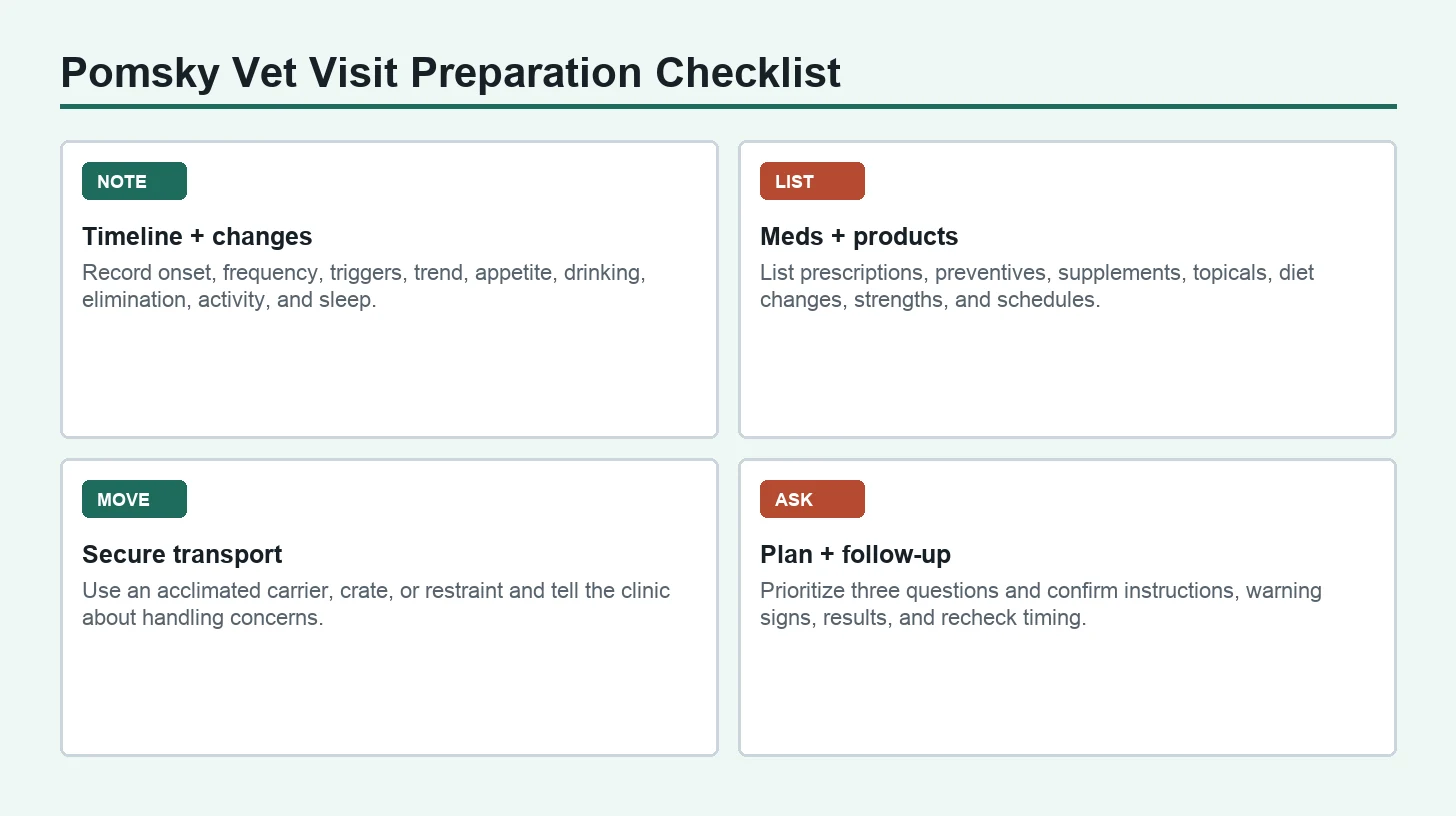
Quick answer: Prepare a Pomsky for a vet visit by sending records and concerns in advance, listing medications and diet, using secure transport, bringing high-value rewards, practicing cooperative handling, and telling the clinic about fear, pain, or bite risk before arrival.
Quick checklist
| Reason for visit | One sentence explaining the main concern or the wellness goal. |
|---|---|
| Timeline | When the change began, frequency, triggers, trend, and what has already been tried. |
| Evidence | Relevant photos, videos, stool or urine instructions from the clinic, and prior records. |
| Medication list | Names, strengths, doses, schedules, supplements, preventives, and recent changes. |
| Transport | Secure restraint or carrier, familiar mat, treats if allowed, and a quiet waiting plan. |
| Follow-up | Diagnosis or working possibilities, tests, treatment instructions, warning signs, and recheck date. |
Six-step action plan
- Call before the visit. Confirm the appointment purpose, records needed, sample instructions, fasting rules, and any fear or handling concerns.
- Write a short timeline. Record onset, frequency, duration, triggers, appetite, drinking, elimination, activity, sleep, and progression.
- List all products. Include prescription medication, preventives, supplements, topical products, and recent diet changes.
- Prepare safe transport. Use an acclimated carrier, crate, or restraint and keep the dog leashed or contained at the clinic.
- Prioritize questions. Put the three most important decisions first so they are covered even if the visit is busy.
- Repeat back the plan. Before leaving, confirm instructions, warning signs, test follow-up, medication use, and the recheck schedule.
Turn observations into a useful timeline
Veterinary teams make better use of a short, specific history than a long collection of unorganized impressions. Note when the concern started, how often it occurs, how long it lasts, what seems to trigger it, and whether it is improving or worsening. Add changes in appetite, water intake, urination, stool, sleep, activity, breathing, mobility, grooming, and behavior when relevant.
Photos or videos can capture an intermittent cough, gait change, episode, skin pattern, or behavior that is absent in the examination room. Record the date and context. Do not delay urgent care while trying to collect perfect evidence, and never provoke a symptom for a video.
Bring complete medication and prevention details
List prescription drugs, preventives, supplements, dental products, shampoos, topical treatments, and recent diet changes. Include the label name, strength, amount, schedule, last dose, and reason for use. A photograph of the current label can prevent transcription errors, but it should not replace the clinic's medical record.
Do not fast your Pomsky, stop medication, give a sedative, or collect a sample unless the clinic has provided instructions for this visit. Pre-visit medication can be appropriate for some fearful dogs, but it must be selected and prescribed by the veterinarian for that patient. Tell the clinic about previous reactions, difficulty handling, motion sickness, or escape behavior before arrival.
Reduce transport and waiting-room stress
Acclimate the carrier, crate, or vehicle restraint during calm days. Pair short entries and rides with rewards and end before distress escalates. At the clinic, keep the dog securely leashed or contained and ask whether you can wait outside or in the vehicle when a crowded lobby increases fear. Never leave a dog unattended in a vehicle where temperature can become unsafe.
Bring small high-value treats if the clinic says food is allowed, plus a familiar nonslip mat or towel. Calm handling practice at home can include brief touches to paws, ears, mouth, shoulders, and body, followed by a reward. Stop when the dog is struggling; forceful rehearsal can make future handling harder.
Use the appointment for decisions
Put your questions in priority order. For a wellness visit, ask about body condition, nutrition, dental care, vaccination and parasite prevention, behavior, exercise, grooming, and age-specific screening. For a problem visit, ask what possibilities are being considered, what each test can clarify, what can be monitored, and which changes require faster reassessment.
Shared decision-making means the plan should make sense for the dog and household. Tell the veterinarian about budget, administration difficulty, travel, other pets, and schedule constraints that affect follow-through. Ask for alternatives when a step is not feasible instead of silently abandoning the plan.
Leave with written next steps
Before leaving, repeat back medication instructions, feeding or activity limits, home monitoring, sample collection, test-result timing, and the recheck date. Confirm who will contact whom and what to do if the clinic is closed. Save the written summary with the health record and add the next task to a calendar.
Track response using the same observable measures you brought to the visit: appetite, episode frequency, mobility, stool quality, sleep, or another agreed measure. Contact the clinic if instructions are unclear, a dose is missed, side effects appear, the condition worsens, or the expected improvement does not occur.
Know when preparation should not delay care
Breathing difficulty, collapse, severe trauma, uncontrolled bleeding, suspected poisoning, repeated unproductive retching, inability to urinate, seizures, or rapid deterioration may require immediate veterinary direction. Call the clinic or emergency service while arranging safe transport. Do not spend time completing a routine checklist first.
This page supports communication and organization; it does not diagnose disease or replace examination. A Pomsky's age, size, health history, medications, and current signs change the appropriate response. When uncertain, describe the signs directly to a veterinary professional.
Example: use the checklist as a control loop
Before the task, record the conditions and the dog's starting state. During the task, watch a small set of observable signs rather than relying on breed appearance or a fixed rule. Afterward, record recovery and any problem. Use that feedback to adjust the next attempt, and route medical, medication, or urgent safety decisions to a veterinarian. This process makes the checklist useful for a puppy, adult, senior, newly adopted dog, or Pomsky with a changing health history.
A checklist is not a promise of safety. Equipment can be fitted incorrectly, conditions can change, and an individual dog can respond differently from the previous outing. Stop when the situation leaves the planned safety boundary. In a possible emergency, contact the appropriate veterinary or public-safety service instead of continuing the activity to complete the list.
Common mistakes to avoid
- Using a Pomsky's coat, size, confidence, or previous tolerance as a guarantee.
- Waiting for severe signs before ending an avoidable exposure.
- Changing medication, diet, restraint, or protective equipment without appropriate instructions.
- Relying on one phone, one route, one caregiver, or one piece of equipment without a backup.
- Collecting photos or completing a checklist when urgent care or evacuation should come first.
- Failing to record what happened, which makes the next plan depend on memory and guesswork.
Frequently asked questions
What records should I bring to a first Pomsky vet visit?
Bring available vaccination, testing, treatment, medication, diet, microchip, and prior clinic records, plus adoption or breeder health documents if they are relevant and reliable.
Should I fast my Pomsky before a vet appointment?
Only if the clinic gives specific instructions. Fasting is not appropriate for every patient or visit and can interact with age, illness, medication, or planned testing.
Can I give calming medication before the visit?
Use only medication prescribed or explicitly directed by the veterinarian for your dog. Contact the clinic in advance if fear, aggression, motion sickness, or handling difficulty is expected.
Are photos and videos useful?
They can document intermittent signs and context, but do not delay urgent care or provoke a symptom to record it.
What should I write down after the visit?
Record the working assessment, tests, medication instructions, home monitoring, warning signs, result timeline, clinic contact plan, and recheck date.
Related Pomsky guides
- Pomsky health guides
- Pomsky training guides
- Pomsky supplies guide
- Pomsky crate size guide
- Health disclaimer
- Editorial policy
- Affiliate disclosure
- Pomsky emergency preparedness
- Pomsky car travel safety
- Places for a healthier Pomsky
Sources reviewed
These sources were reviewed for general pet-safety and veterinary-care principles. They do not create a diagnosis or an individual treatment plan.
- AAHA: Preparing for a successful veterinary visit
- AAHA: Tips for efficient wellness visits
- AAHA: Canine life-stage checklist
- AAHA: Why regular veterinary visits matter
Evidence and related Pomsky guides
These sources support only their stated claim scopes; they do not guarantee an individual Pomsky outcome.
Sources reviewed for this page
- American Animal Hospital Association: AAHA-AVMA Canine Preventive Healthcare Guidelines
- American Veterinary Society of Animal Behavior: Humane Dog Training Position Statement