Written and reviewed by A Pomsky Editorial Team. Originally published 2026-07-26; substantively reviewed July 26, 2026.
Training boundary: Use humane, reward-based methods and protect safety with management. Pain, panic, aggression, a bite history, or serious handling risk requires a veterinarian or qualified behavior professional. Read the editorial policy.
Direct answer: First prevent repeated access to the triggering view with a secure lower-window barrier, closed room, or furniture change. Place a comfortable station far enough away that the Pomsky can notice household sounds and still disengage. Reward turning away, returning to the station, or settling. Do not punish barking at the glass; reassess distance and seek professional help when the dog cannot recover safely.
A window can turn passing people, animals, vehicles, and reflections into hundreds of rehearsals. The first job is not to demand silence while the trigger remains fully available. It is to redesign access so the Pomsky can rest, notice a manageable event, and disengage. A visual barrier works best as part of a wider plan that includes distance, a predictable station, and reward-based practice.
Map Every Trigger Window
Observe from outside the barking episode and list the exact windows, times, sight lines, reflections, sounds, and household routines that predict a rush to the glass.
A second capable adult can verify the boundary during early practice or higher-risk situations. That person should follow the same sequence and avoid adding prompts, handling, or access that changes the task. The shared standard remains less access to the triggering view and a repeatable turn-away or return-to-station response. For this page, step 1 is specifically the map every trigger window check.
Stop when the expected condition is absent or the situation begins to depend on force, luck, or an open boundary. Specifically avoid leaving a barrier insecure, trapping the dog near the window, punishing barking, or rehearsing at an intensity that prevents recovery. The follow-up record should cover window, trigger category, distance, number of rehearsals, recovery time, and management failures. Record the outcome of map every trigger window separately before moving on.
Prevent Unsupervised Rehearsal
Close the room, use a secure interior barrier, or change furniture access whenever an adult cannot actively manage the environment.
Perform this check before adding the next variable. The target remains less access to the triggering view and a repeatable turn-away or return-to-station response. Work in a room where the lower view can be safely blocked and the dog can rest several feet from the glass. If the setup cannot preserve that condition, simplify it or stop rather than relying on speed or physical control. For this page, step 2 is specifically the prevent unsupervised rehearsal check.
Do not convert this step into a stress test. The principal avoidable risks are leaving a barrier insecure, trapping the dog near the window, punishing barking, or rehearsing at an intensity that prevents recovery. Write down window, trigger category, distance, number of rehearsals, recovery time, and management failures; a short factual note is more useful than a reassuring guess. Record the outcome of prevent unsupervised rehearsal separately before moving on.
Choose a Safe Visual Barrier
Use a stable lower-window covering that preserves required ventilation and exits, cannot be pulled down, and does not create cords or climbable furniture.
Use an observable pass condition: the relevant item is checked, the boundary is closed, and the Pomsky can remain safe without being used as a test. This protects the main objective, less access to the triggering view and a repeatable turn-away or return-to-station response, while leaving a clear point at which the caregiver can step back. For this page, step 3 is specifically the choose a safe visual barrier check.
If the Pomsky cannot remain comfortable or the equipment and environment cannot remain controlled, end the attempt. Do not proceed through leaving a barrier insecure, trapping the dog near the window, punishing barking, or rehearsing at an intensity that prevents recovery. Capture window, trigger category, distance, number of rehearsals, recovery time, and management failures before deciding what changes next. Record the outcome of choose a safe visual barrier separately before moving on.
Move the Resting Station Back
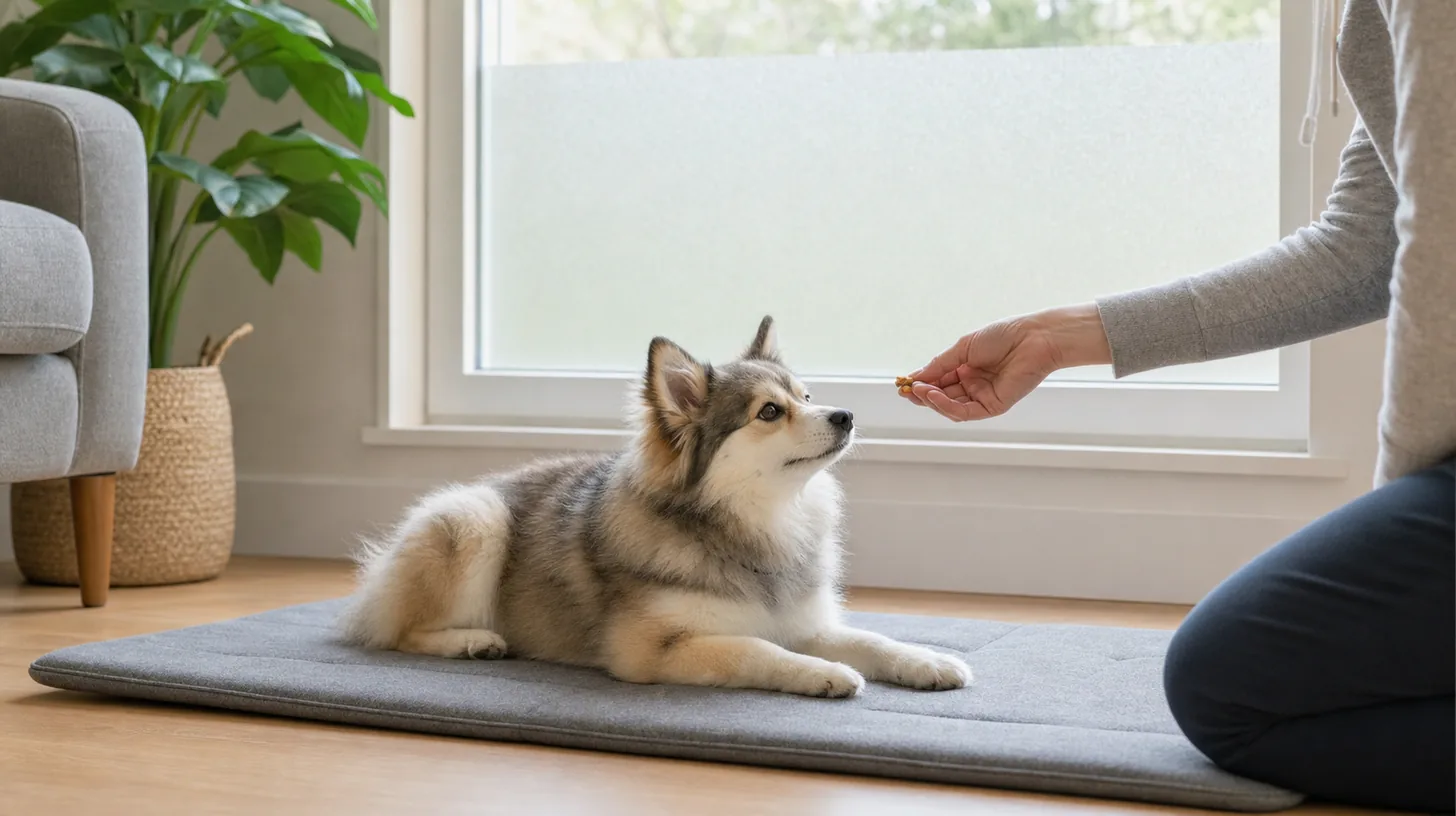
Place a mat or bed where the Pomsky can settle without guarding the window and where rewards can be delivered away from the glass.
Keep the sequence repeatable across caregivers. Say what is being checked, complete it, and return equipment and people to neutral before continuing. In this page's context, success means less access to the triggering view and a repeatable turn-away or return-to-station response; it does not mean proving that a known risk can be tolerated. For this page, step 4 is specifically the move the resting station back check.
The absence of an incident is not proof that the arrangement is sound. Recheck for leaving a barrier insecure, trapping the dog near the window, punishing barking, or rehearsing at an intensity that prevents recovery. Document window, trigger category, distance, number of rehearsals, recovery time, and management failures so a later caregiver can distinguish a passed step from one that was skipped. Record the outcome of move the resting station back separately before moving on.
Reward Disengagement
When the dog notices a mild event and turns away, mark that choice and place the reward at the station rather than beside the window.
Treat this as one part of the complete routine, not an isolated trick. The surrounding setup is a room where the lower view can be safely blocked and the dog can rest several feet from the glass. A clean transition reduces ambiguity and makes it easier to notice when the dog, equipment, environment, or records differ from the previous attempt. For this page, step 5 is specifically the reward disengagement check.
Stop when the expected condition is absent or the situation begins to depend on force, luck, or an open boundary. Specifically avoid leaving a barrier insecure, trapping the dog near the window, punishing barking, or rehearsing at an intensity that prevents recovery. The follow-up record should cover window, trigger category, distance, number of rehearsals, recovery time, and management failures. Record the outcome of reward disengagement separately before moving on.
Separate Sound From Sight
If barking continues after the view is blocked, test whether footsteps, doors, engines, or voices are the active cue and manage that cue at a lower level.
Pause long enough to inspect the result rather than assuming the action worked. Look at the dog, the physical boundary, and the next movement available to the caregiver. Continue only when the arrangement still supports less access to the triggering view and a repeatable turn-away or return-to-station response. For this page, step 6 is specifically the separate sound from sight check.
Do not convert this step into a stress test. The principal avoidable risks are leaving a barrier insecure, trapping the dog near the window, punishing barking, or rehearsing at an intensity that prevents recovery. Write down window, trigger category, distance, number of rehearsals, recovery time, and management failures; a short factual note is more useful than a reassuring guess. Record the outcome of separate sound from sight separately before moving on.
Practice With Predictable Setups
Use a helper at a known distance only after ordinary management works, and end the setup before arousal accumulates.
A second capable adult can verify the boundary during early practice or higher-risk situations. That person should follow the same sequence and avoid adding prompts, handling, or access that changes the task. The shared standard remains less access to the triggering view and a repeatable turn-away or return-to-station response. For this page, step 7 is specifically the practice with predictable setups check.
If the Pomsky cannot remain comfortable or the equipment and environment cannot remain controlled, end the attempt. Do not proceed through leaving a barrier insecure, trapping the dog near the window, punishing barking, or rehearsing at an intensity that prevents recovery. Capture window, trigger category, distance, number of rehearsals, recovery time, and management failures before deciding what changes next. Record the outcome of practice with predictable setups separately before moving on.
Handle Surprise Events
Keep rewards and a clear retreat route available so a sudden close passerby can be followed by movement away from the window, not a confrontation at it.
Perform this check before adding the next variable. The target remains less access to the triggering view and a repeatable turn-away or return-to-station response. Work in a room where the lower view can be safely blocked and the dog can rest several feet from the glass. If the setup cannot preserve that condition, simplify it or stop rather than relying on speed or physical control. For this page, step 8 is specifically the handle surprise events check.
The absence of an incident is not proof that the arrangement is sound. Recheck for leaving a barrier insecure, trapping the dog near the window, punishing barking, or rehearsing at an intensity that prevents recovery. Document window, trigger category, distance, number of rehearsals, recovery time, and management failures so a later caregiver can distinguish a passed step from one that was skipped. Record the outcome of handle surprise events separately before moving on.
Coordinate the Household
Give every caregiver the same rule for curtains, room access, reward placement, visitor arrival, and what to do when the dog is already barking.
Use an observable pass condition: the relevant item is checked, the boundary is closed, and the Pomsky can remain safe without being used as a test. This protects the main objective, less access to the triggering view and a repeatable turn-away or return-to-station response, while leaving a clear point at which the caregiver can step back. For this page, step 9 is specifically the coordinate the household check.
Stop when the expected condition is absent or the situation begins to depend on force, luck, or an open boundary. Specifically avoid leaving a barrier insecure, trapping the dog near the window, punishing barking, or rehearsing at an intensity that prevents recovery. The follow-up record should cover window, trigger category, distance, number of rehearsals, recovery time, and management failures. Record the outcome of coordinate the household separately before moving on.
Protect the Physical Window Area
Inspect glass, screens, sills, cords, furniture, and balcony access because behavior management does not replace fall and collision prevention.
Keep the sequence repeatable across caregivers. Say what is being checked, complete it, and return equipment and people to neutral before continuing. In this page's context, success means less access to the triggering view and a repeatable turn-away or return-to-station response; it does not mean proving that a known risk can be tolerated. For this page, step 10 is specifically the protect the physical window area check.
Do not convert this step into a stress test. The principal avoidable risks are leaving a barrier insecure, trapping the dog near the window, punishing barking, or rehearsing at an intensity that prevents recovery. Write down window, trigger category, distance, number of rehearsals, recovery time, and management failures; a short factual note is more useful than a reassuring guess. Record the outcome of protect the physical window area separately before moving on.
Measure Recovery Instead of Silence
Track whether the Pomsky can turn, eat, return to the station, and resume normal activity after an event rather than counting only vocalizations.
Treat this as one part of the complete routine, not an isolated trick. The surrounding setup is a room where the lower view can be safely blocked and the dog can rest several feet from the glass. A clean transition reduces ambiguity and makes it easier to notice when the dog, equipment, environment, or records differ from the previous attempt. For this page, step 11 is specifically the measure recovery instead of silence check.
If the Pomsky cannot remain comfortable or the equipment and environment cannot remain controlled, end the attempt. Do not proceed through leaving a barrier insecure, trapping the dog near the window, punishing barking, or rehearsing at an intensity that prevents recovery. Capture window, trigger category, distance, number of rehearsals, recovery time, and management failures before deciding what changes next. Record the outcome of measure recovery instead of silence separately before moving on.
Review the Plan After Changes
Reassess after moving, construction, seasonal foliage, new neighbors, schedule changes, or any event that changes the view or sound pattern.
Pause long enough to inspect the result rather than assuming the action worked. Look at the dog, the physical boundary, and the next movement available to the caregiver. Continue only when the arrangement still supports less access to the triggering view and a repeatable turn-away or return-to-station response. For this page, step 12 is specifically the review the plan after changes check.
The absence of an incident is not proof that the arrangement is sound. Recheck for leaving a barrier insecure, trapping the dog near the window, punishing barking, or rehearsing at an intensity that prevents recovery. Document window, trigger category, distance, number of rehearsals, recovery time, and management failures so a later caregiver can distinguish a passed step from one that was skipped. Record the outcome of review the plan after changes separately before moving on.
When to Escalate
This routine has a defined boundary. Stop when the Pomsky, caregiver, equipment, records, or environment no longer supports less access to the triggering view and a repeatable turn-away or return-to-station response. Do not improvise through leaving a barrier insecure, trapping the dog near the window, punishing barking, or rehearsing at an intensity that prevents recovery. Seek a veterinarian or qualified behavior professional for sudden change, severe fear, redirected aggression, self-injury risk, or failure to recover. Bring the concise observations already recorded rather than recreating the event.
Before the next attempt, review window, trigger category, distance, number of rehearsals, recovery time, and management failures. Reopen the task only after the physical setup, instructions, and responsible person are clear. A conservative stop is useful information: it prevents a manageable problem from becoming an emergency and gives the appropriate professional a factual starting point.
Sources reviewed
Each source is used only for the claim scopes listed below. None establishes a guaranteed Pomsky outcome or replaces individual professional assessment.
- Cornell University College of Veterinary Medicine: Anxious Behavior: How to Help Your Dog Cope With Unsettling Situations - Supports: anxiety signs; separation-related vocalization; gradual desensitization; reward-based professional help. Limit: Howling alone does not diagnose separation anxiety; sudden or severe distress needs veterinary assessment.
- American Veterinary Society of Animal Behavior: Humane Dog Training Position Statement - Supports: reward-based training; aversive-method risk; behavior change principles. Limit: Does not guarantee outcomes for an individual dog.