Written and reviewed by A Pomsky Editorial Team. Originally published 2026-07-26; substantively reviewed July 26, 2026.
Training boundary: Use humane, reward-based methods and protect safety with management. Pain, panic, aggression, a bite history, or serious handling risk requires a veterinarian or qualified behavior professional. Read the editorial policy.
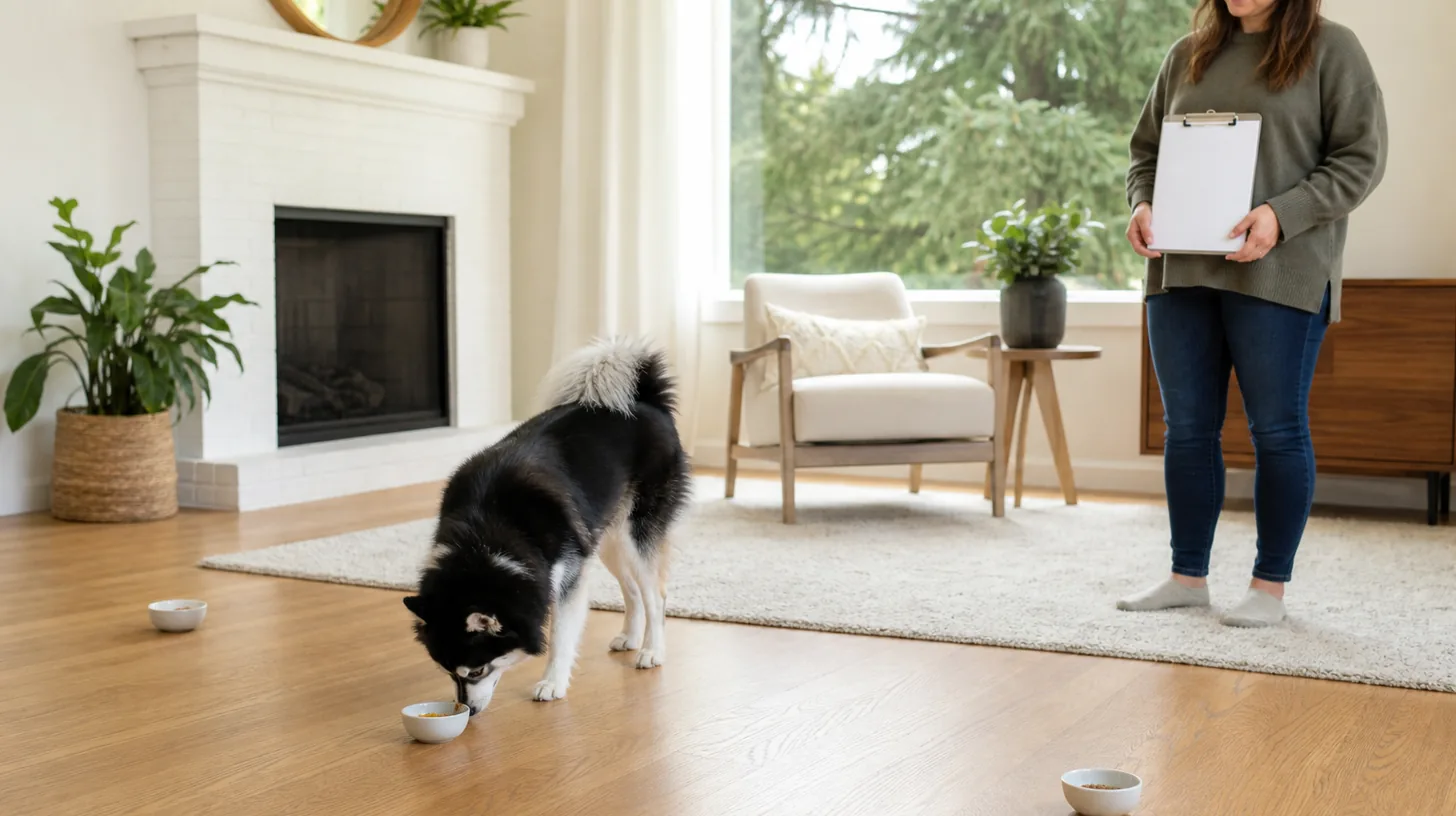
Direct answer: Inspect and close one safe room, place two or three counted familiar rewards in visible accessible locations, release the Pomsky with a consistent search cue, and supervise without directing every move. Increase only one difficulty variable at a time, count every find, clear the room afterward, and stop before frustration, fatigue, guarding, or unsafe container handling.
An indoor search game can give a Pomsky a structured opportunity to investigate with the nose without turning the house into an uncontrolled scavenging area. The useful version is bounded: one inspected room, a small number of familiar rewards, accessible hiding places, active supervision, and clear stop rules. Difficulty grows slowly and never depends on unsafe containers or frustration.
Choose One Safe Search Area
Use a quiet room with nonslip footing, comfortable temperature, and enough space for the Pomsky to turn freely. Remove medication, food packages, cords, plants, small objects, sharp edges, unstable furniture, children's toys, and anything the dog could swallow or knock over.
Close doors to other rooms and separate other animals. The search boundary should be obvious to the caregiver even if the dog does not understand it yet. Avoid stairs, crowded kitchens, workshops, and rooms where missed rewards could create later scavenging.
Select Appropriate Rewards
Use tiny portions of a familiar food already tolerated and included in the Pomsky's daily feeding plan. Count training and enrichment rewards together. Do not introduce a new ingredient, supplement, or high-fat food merely to make the game exciting.
Rewards can be placed openly on a clean washable surface or in a safe holder designed for supervised dog use. Avoid plastic bags, string, paper that may be swallowed, glass, sharp tins, closed containers the dog might crush, or improvised objects that resemble household hazards.
Start With Visible Placements
With the Pomsky outside the room, place two or three rewards in easy, visible locations at floor level. Bring the dog to the entry, release with a consistent search cue, and allow voluntary movement. Stay quiet enough for the dog to investigate rather than follow constant pointing.
Mark or praise each find if that helps the Pomsky, but do not rush the dog from one location to another. End after the known number of rewards is found. Show an empty hand, use a consistent finish cue, and leave the room together.
Build the Search Cue
Say the cue immediately before the Pomsky enters the prepared area. The words should predict permission to search only in that bounded setup. Do not use the cue around dropped medication, outdoor litter, another animal's food, or unknown objects.
After several easy sessions, the dog may begin searching on the cue. Keep the setup simple until the Pomsky moves comfortably and disengages when the game ends. A cue is not permission to consume anything found outside the planned search.
Increase One Variable at a Time
Difficulty can change through distance, angle, partial visual cover, room size, or a small increase in the number of placements. Change only one factor and keep every reward reachable without climbing, jumping, opening furniture, or putting the head into a trap.
Do not hide food near electrical outlets, under heavy furniture, inside shoes, in bags, beside trash, or on counters. Those choices can teach exactly the household searching pattern caregivers want to prevent.
Supervise Body Language
Look for comfortable sniffing, flexible movement, voluntary pauses, and the ability to leave the area. Slow the game if the Pomsky scratches surfaces, bites holders, races frantically, vocalizes persistently, freezes near a find, or cannot stop searching after the finish cue.
Dogs differ in confidence and scenting style. Do not compare speed between dogs or demand a universal search time. A short, calm session can be more useful than a difficult puzzle that produces frustration.
Prevent Guarding and Competition
Run the game with one dog at a time. Keep children and other pets outside the search room. Retrieve holders only after the Pomsky has moved away, and avoid reaching toward the mouth or crowding the dog over a find.
If the Pomsky stiffens, covers a find, growls, snaps, or carries items away, stop increasing difficulty and improve management. A qualified reward-based behavior professional can help with a safer plan. Do not provoke guarding to assess its severity.
Keep an Exact Placement Count
Write down the number and location of rewards before releasing the Pomsky. Count every find and inspect the room afterward. A forgotten reward can encourage unsupervised searching later and can attract another pet or child.
Use a simple sketch or numbered list for more complex setups. The caregiver, not the dog, is responsible for confirming that the room is clear at the end.
Fit the Game Into Daily Feeding
Reserve a measured portion of the Pomsky's ordinary food when appropriate, or record all added rewards. Coordinate caregivers so the same food is not counted twice. A search game is enrichment, not a method for deciding calories or replacing an individualized nutrition plan.
Discuss material appetite, weight, digestive, or health changes with a veterinarian. Dogs on therapeutic diets, with food allergies, or with swallowing and mobility concerns may need a different setup.
Add Nonfood Search Only With Care
Some Pomskies can learn to locate a familiar toy, but start as a separate behavior with an object the dog handles safely. Do not use medication, personal items, wildlife material, essential oils, chemicals, or anything intended to claim medical scent detection.
The household game is not professional detection training. Its purpose is controlled exploration and cooperative play, not diagnosis, security work, or a guarantee of olfactory ability.
End Before Fatigue or Frustration
Use a consistent finish cue, guide the Pomsky out, provide water access as appropriate, and allow rest. Stop sooner if movement changes, breathing becomes concerning, the room is too warm, or the dog loses interest.
Record what was easy and what caused confusion. The next session should begin below the last difficult level, not resume at the point of frustration.
Maintain a Clean, Predictable Routine
Wash reusable holders according to their directions, remove residue from the floor, and store search equipment away from household waste and ordinary objects. Reinspect the room every time because furniture, cords, and family belongings change.
A successful search-the-room game remains easy to explain: the caregiver prepares and counts a few safe finds, the Pomsky searches voluntarily in one controlled room, the session ends clearly, and nothing is left behind to reward unsupervised scavenging.
Sources reviewed
Each source is used only for the claim scopes listed below. None establishes a guaranteed Pomsky outcome or replaces individual professional assessment.
- American Veterinary Society of Animal Behavior: Humane Dog Training Position Statement - Supports: reward-based training; aversive-method risk; behavior change principles. Limit: Does not guarantee outcomes for an individual dog.
- American Animal Hospital Association: Lifestyle and Safety Assessment - Supports: appropriate confinement; leash, collar and harness planning; lifestyle-specific safety review. Limit: Equipment selection must account for the individual dog's anatomy, behavior, health, and environment.