Written and reviewed by A Pomsky Editorial Team. Originally published 2026-07-26; substantively reviewed July 26, 2026.
Training boundary: Use humane, reward-based methods and protect safety with management. Pain, panic, aggression, a bite history, or serious handling risk requires a veterinarian or qualified behavior professional. Read the editorial policy.
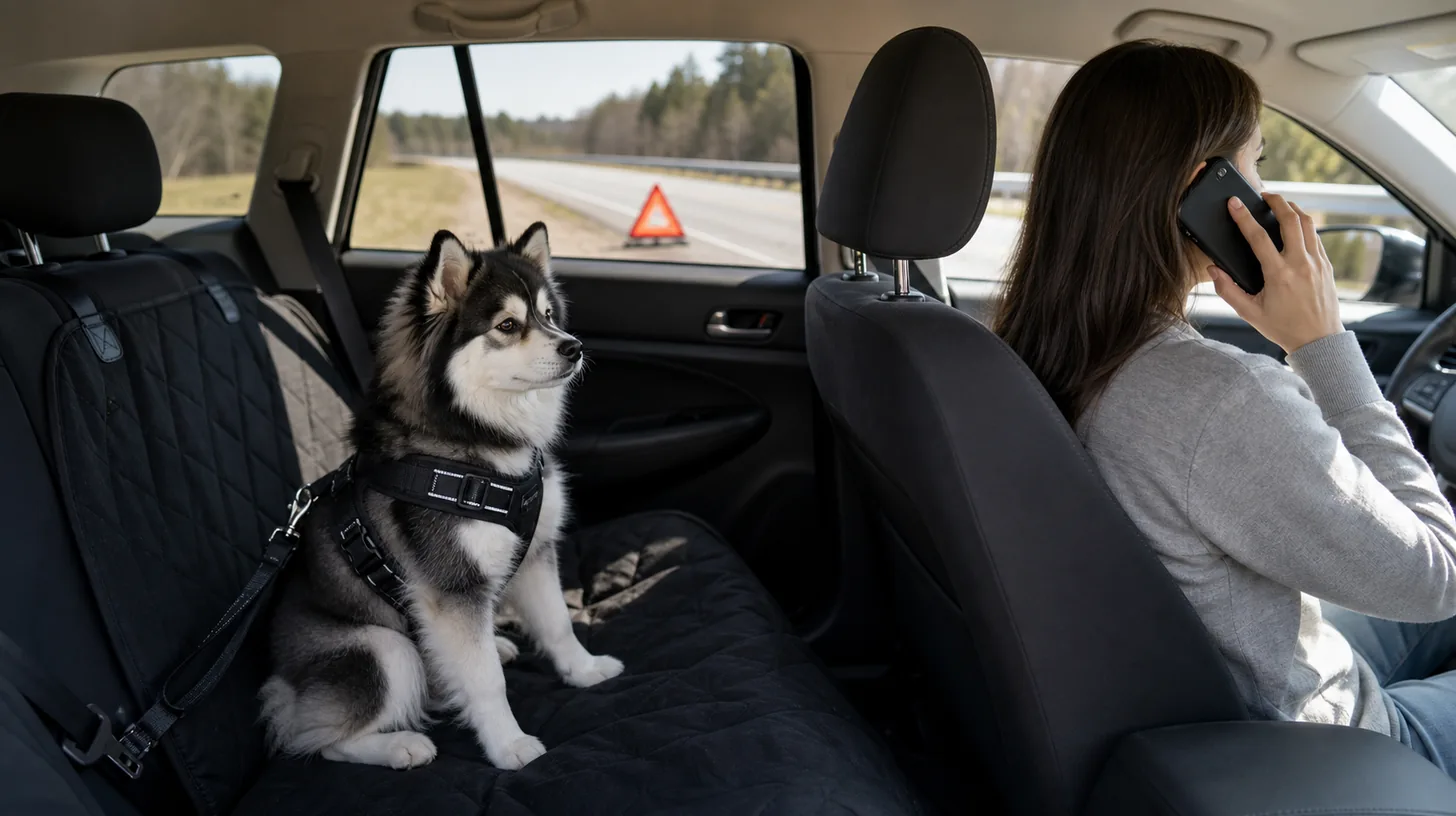
Direct answer: Keep the Pomsky secured inside with every door closed while you assess the vehicle position and call roadside or emergency help. Do not walk the dog beside traffic. Monitor cabin conditions, make the dog visible to responders through communication rather than an open door, and prepare a carrier or secondary restraint only if a protected transfer is required. Follow responder instructions when the location is unsafe.
A breakdown beside traffic is not a normal rest stop. Opening a door can expose a Pomsky to moving vehicles, noise, responders, unfamiliar handling, and an environment with no secure perimeter. The default is to keep the dog restrained inside while the caregiver assesses the immediate danger, calls for help, controls cabin conditions, and prepares for a transfer only when staying becomes less safe.
Stabilize the Vehicle Situation
Move only as directed and feasible, stop in the lowest-risk available position, activate hazard signals, set the brake, and keep every dog door closed.
Perform this check before adding the next variable. The target remains continuous restraint and door control until help arrives or a protected transfer is directed. Work in the safest reachable stopped position with hazard signals, closed doors, working communication, and the dog secured away from the driver. If the setup cannot preserve that condition, simplify it or stop rather than relying on speed or physical control. For this page, step 1 is specifically the stabilize the vehicle situation check.
The absence of an incident is not proof that the arrangement is sound. Recheck for walking beside traffic, opening multiple doors, releasing the restraint too early, poor cabin conditions, smoke, fire, collision exposure, or an improvised transfer. Document location, direction of travel, vehicle position, time, hazards, cabin conditions, responder instructions, dog status, and transfer sequence so a later caregiver can distinguish a passed step from one that was skipped. Record the outcome of stabilize the vehicle situation separately before moving on.
Confirm the Pomsky Is Secured
Check the rear restraint or closed carrier without disconnecting it and remove no equipment merely to make the dog more comfortable.
Use an observable pass condition: the relevant item is checked, the boundary is closed, and the Pomsky can remain safe without being used as a test. This protects the main objective, continuous restraint and door control until help arrives or a protected transfer is directed, while leaving a clear point at which the caregiver can step back. For this page, step 2 is specifically the confirm the pomsky is secured check.
Stop when the expected condition is absent or the situation begins to depend on force, luck, or an open boundary. Specifically avoid walking beside traffic, opening multiple doors, releasing the restraint too early, poor cabin conditions, smoke, fire, collision exposure, or an improvised transfer. The follow-up record should cover location, direction of travel, vehicle position, time, hazards, cabin conditions, responder instructions, dog status, and transfer sequence. Record the outcome of confirm the pomsky is secured separately before moving on.
Call With a Precise Location
Give the road, direction, nearest marker, vehicle description, hazard, passenger status, and fact that a secured dog is inside.
Keep the sequence repeatable across caregivers. Say what is being checked, complete it, and return equipment and people to neutral before continuing. In this page's context, success means continuous restraint and door control until help arrives or a protected transfer is directed; it does not mean proving that a known risk can be tolerated. For this page, step 3 is specifically the call with a precise location check.
Do not convert this step into a stress test. The principal avoidable risks are walking beside traffic, opening multiple doors, releasing the restraint too early, poor cabin conditions, smoke, fire, collision exposure, or an improvised transfer. Write down location, direction of travel, vehicle position, time, hazards, cabin conditions, responder instructions, dog status, and transfer sequence; a short factual note is more useful than a reassuring guess. Record the outcome of call with a precise location separately before moving on.
Keep the Driver Focused
Do not allow the Pomsky into the front seats, lap, pedal area, or doorway while the caregiver speaks to responders or observes traffic.
Treat this as one part of the complete routine, not an isolated trick. The surrounding setup is the safest reachable stopped position with hazard signals, closed doors, working communication, and the dog secured away from the driver. A clean transition reduces ambiguity and makes it easier to notice when the dog, equipment, environment, or records differ from the previous attempt. For this page, step 4 is specifically the keep the driver focused check.
If the Pomsky cannot remain comfortable or the equipment and environment cannot remain controlled, end the attempt. Do not proceed through walking beside traffic, opening multiple doors, releasing the restraint too early, poor cabin conditions, smoke, fire, collision exposure, or an improvised transfer. Capture location, direction of travel, vehicle position, time, hazards, cabin conditions, responder instructions, dog status, and transfer sequence before deciding what changes next. Record the outcome of keep the driver focused separately before moving on.
Do Not Attempt a Roadside Walk
A routine toileting need does not justify exposure beside active lanes, unstable shoulders, barriers, unknown animals, or recovery vehicles.
Pause long enough to inspect the result rather than assuming the action worked. Look at the dog, the physical boundary, and the next movement available to the caregiver. Continue only when the arrangement still supports continuous restraint and door control until help arrives or a protected transfer is directed. For this page, step 5 is specifically the do not attempt a roadside walk check.
The absence of an incident is not proof that the arrangement is sound. Recheck for walking beside traffic, opening multiple doors, releasing the restraint too early, poor cabin conditions, smoke, fire, collision exposure, or an improvised transfer. Document location, direction of travel, vehicle position, time, hazards, cabin conditions, responder instructions, dog status, and transfer sequence so a later caregiver can distinguish a passed step from one that was skipped. Record the outcome of do not attempt a roadside walk separately before moving on.
Monitor Cabin Conditions
Observe temperature, airflow, sunlight, exhaust, smoke, dog breathing, posture, and recovery while following emergency instructions.
A second capable adult can verify the boundary during early practice or higher-risk situations. That person should follow the same sequence and avoid adding prompts, handling, or access that changes the task. The shared standard remains continuous restraint and door control until help arrives or a protected transfer is directed. For this page, step 6 is specifically the monitor cabin conditions check.
Stop when the expected condition is absent or the situation begins to depend on force, luck, or an open boundary. Specifically avoid walking beside traffic, opening multiple doors, releasing the restraint too early, poor cabin conditions, smoke, fire, collision exposure, or an improvised transfer. The follow-up record should cover location, direction of travel, vehicle position, time, hazards, cabin conditions, responder instructions, dog status, and transfer sequence. Record the outcome of monitor cabin conditions separately before moving on.
Make the Dog Known Without Opening
Tell dispatch and arriving responders where the dog is secured, what equipment is present, and which door is intended for any controlled access.
Perform this check before adding the next variable. The target remains continuous restraint and door control until help arrives or a protected transfer is directed. Work in the safest reachable stopped position with hazard signals, closed doors, working communication, and the dog secured away from the driver. If the setup cannot preserve that condition, simplify it or stop rather than relying on speed or physical control. For this page, step 7 is specifically the make the dog known without opening check.
Do not convert this step into a stress test. The principal avoidable risks are walking beside traffic, opening multiple doors, releasing the restraint too early, poor cabin conditions, smoke, fire, collision exposure, or an improvised transfer. Write down location, direction of travel, vehicle position, time, hazards, cabin conditions, responder instructions, dog status, and transfer sequence; a short factual note is more useful than a reassuring guess. Record the outcome of make the dog known without opening separately before moving on.
Prepare a Secondary Containment Layer
Place a closed carrier, spare leash, identification, and emergency card within reach only if doing so does not require opening an unsafe door.
Use an observable pass condition: the relevant item is checked, the boundary is closed, and the Pomsky can remain safe without being used as a test. This protects the main objective, continuous restraint and door control until help arrives or a protected transfer is directed, while leaving a clear point at which the caregiver can step back. For this page, step 8 is specifically the prepare a secondary containment layer check.
If the Pomsky cannot remain comfortable or the equipment and environment cannot remain controlled, end the attempt. Do not proceed through walking beside traffic, opening multiple doors, releasing the restraint too early, poor cabin conditions, smoke, fire, collision exposure, or an improvised transfer. Capture location, direction of travel, vehicle position, time, hazards, cabin conditions, responder instructions, dog status, and transfer sequence before deciding what changes next. Record the outcome of prepare a secondary containment layer separately before moving on.
Control Every Required Door
Before a protected transfer, connect or enclose the Pomsky first, assign one adult to the door, and open only the responder-approved side.
Keep the sequence repeatable across caregivers. Say what is being checked, complete it, and return equipment and people to neutral before continuing. In this page's context, success means continuous restraint and door control until help arrives or a protected transfer is directed; it does not mean proving that a known risk can be tolerated. For this page, step 9 is specifically the control every required door check.
The absence of an incident is not proof that the arrangement is sound. Recheck for walking beside traffic, opening multiple doors, releasing the restraint too early, poor cabin conditions, smoke, fire, collision exposure, or an improvised transfer. Document location, direction of travel, vehicle position, time, hazards, cabin conditions, responder instructions, dog status, and transfer sequence so a later caregiver can distinguish a passed step from one that was skipped. Record the outcome of control every required door separately before moving on.
Follow Scene Authority
Police, fire, road, or recovery personnel may identify hazards the caregiver cannot see; their immediate scene instructions override the ordinary household sequence.
Treat this as one part of the complete routine, not an isolated trick. The surrounding setup is the safest reachable stopped position with hazard signals, closed doors, working communication, and the dog secured away from the driver. A clean transition reduces ambiguity and makes it easier to notice when the dog, equipment, environment, or records differ from the previous attempt. For this page, step 10 is specifically the follow scene authority check.
Stop when the expected condition is absent or the situation begins to depend on force, luck, or an open boundary. Specifically avoid walking beside traffic, opening multiple doors, releasing the restraint too early, poor cabin conditions, smoke, fire, collision exposure, or an improvised transfer. The follow-up record should cover location, direction of travel, vehicle position, time, hazards, cabin conditions, responder instructions, dog status, and transfer sequence. Record the outcome of follow scene authority separately before moving on.
Treat Fire or Collision Risk as Urgent
Smoke, flame, fuel, unstable vehicle position, impact danger, or rapidly unsafe temperature requires emergency action rather than waiting for routine roadside service.
Pause long enough to inspect the result rather than assuming the action worked. Look at the dog, the physical boundary, and the next movement available to the caregiver. Continue only when the arrangement still supports continuous restraint and door control until help arrives or a protected transfer is directed. For this page, step 11 is specifically the treat fire or collision risk as urgent check.
Do not convert this step into a stress test. The principal avoidable risks are walking beside traffic, opening multiple doors, releasing the restraint too early, poor cabin conditions, smoke, fire, collision exposure, or an improvised transfer. Write down location, direction of travel, vehicle position, time, hazards, cabin conditions, responder instructions, dog status, and transfer sequence; a short factual note is more useful than a reassuring guess. Record the outcome of treat fire or collision risk as urgent separately before moving on.
Review Equipment After the Incident
After reaching safety, inspect the restraint, harness, carrier, vehicle anchor, identification, supplies, and the dog's movement before the next trip.
A second capable adult can verify the boundary during early practice or higher-risk situations. That person should follow the same sequence and avoid adding prompts, handling, or access that changes the task. The shared standard remains continuous restraint and door control until help arrives or a protected transfer is directed. For this page, step 12 is specifically the review equipment after the incident check.
If the Pomsky cannot remain comfortable or the equipment and environment cannot remain controlled, end the attempt. Do not proceed through walking beside traffic, opening multiple doors, releasing the restraint too early, poor cabin conditions, smoke, fire, collision exposure, or an improvised transfer. Capture location, direction of travel, vehicle position, time, hazards, cabin conditions, responder instructions, dog status, and transfer sequence before deciding what changes next. Record the outcome of review equipment after the incident separately before moving on.
When to Escalate
This routine has a defined boundary. Stop when the Pomsky, caregiver, equipment, records, or environment no longer supports continuous restraint and door control until help arrives or a protected transfer is directed. Do not improvise through walking beside traffic, opening multiple doors, releasing the restraint too early, poor cabin conditions, smoke, fire, collision exposure, or an improvised transfer. Seek roadside or emergency responders for scene control and veterinary services for injury, distress, temperature illness, or medical change. Bring the concise observations already recorded rather than recreating the event.
Before the next attempt, review location, direction of travel, vehicle position, time, hazards, cabin conditions, responder instructions, dog status, and transfer sequence. Reopen the task only after the physical setup, instructions, and responsible person are clear. A conservative stop is useful information: it prevents a manageable problem from becoming an emergency and gives the appropriate professional a factual starting point.
Sources reviewed
Each source is used only for the claim scopes listed below. None establishes a guaranteed Pomsky outcome or replaces individual professional assessment.
- U.S. Centers for Disease Control and Prevention: Pet Emergency Preparedness - Supports: evacuation planning; pet records; emergency supplies; disaster readiness. Limit: Local emergency authority instructions take priority.
- American Animal Hospital Association: How Can I Discourage My Dog From Running Away? - Supports: secure fencing; leash use; recall foundations; escape-route checks; appropriate activity. Limit: No recall cue or fence design guarantees that an individual dog cannot escape.
- American Animal Hospital Association: Lifestyle and Safety Assessment - Supports: appropriate confinement; leash, collar and harness planning; lifestyle-specific safety review. Limit: Equipment selection must account for the individual dog's anatomy, behavior, health, and environment.