Written and reviewed by A Pomsky Editorial Team. Originally published 2026-07-26; substantively reviewed July 26, 2026.
Training boundary: Use humane, reward-based methods and protect safety with management. Pain, panic, aggression, a bite history, or serious handling risk requires a veterinarian or qualified behavior professional. Read the editorial policy.
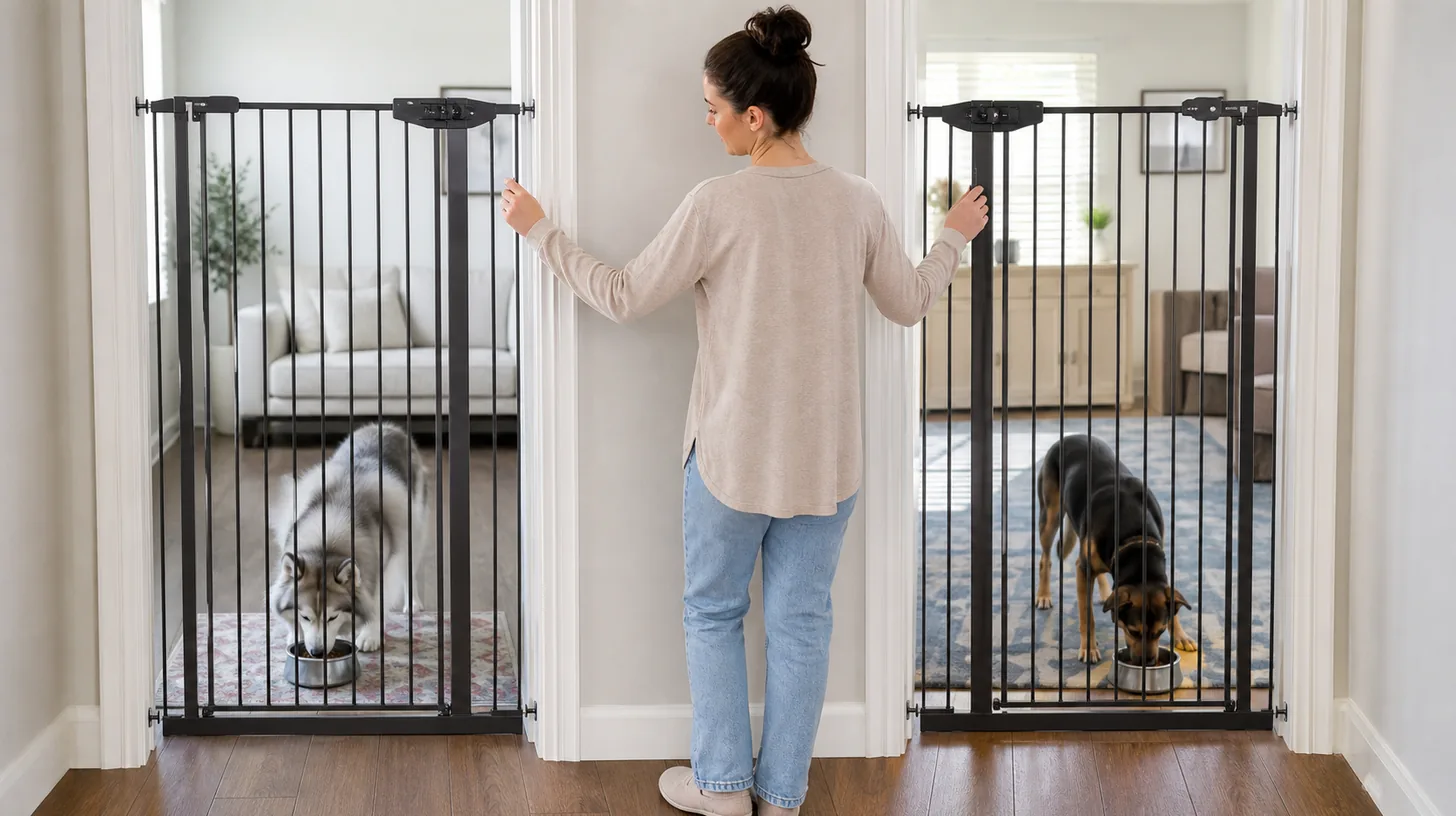
Direct answer: Prepare and identify each meal while the dogs are already separated. Move every dog into its assigned room before bowls appear, close and check the barriers, then place each bowl without crossing feeding zones. Supervise from outside the rooms, remove bowls and dropped food before opening barriers, and release dogs one at a time. Treat guarding or conflict as a safety issue, not disobedience.
Separate feeding removes avoidable competition from a predictable daily event. It does not require dogs to prove they can share, tolerate a person taking food, or finish at the same speed. The routine works when meals are identified before dogs move, each dog enters a closed assigned room, bowls remain inside those boundaries, and all food is removed before the household reunites.
Assign Permanent Feeding Rooms
Choose one room for each dog and verify that doors, gates, floors, ventilation, and caregiver access work before meals are prepared.
Use an observable pass condition: the relevant item is checked, the boundary is closed, and the Pomsky can remain safe without being used as a test. This protects the main objective, each dog completes the assigned meal without access to another dog's food or feeding space, while leaving a clear point at which the caregiver can step back. For this page, step 1 is specifically the assign permanent feeding rooms check.
If the Pomsky cannot remain comfortable or the equipment and environment cannot remain controlled, end the attempt. Do not proceed through open barriers, mislabeled meals, crossing bowls, reaching into a guarded area, dropped food, children entering, or releasing dogs before cleanup. Capture meal identity, amount offered, amount eaten, medication confirmation, finish time, appetite change, barrier issue, and conflict signal before deciding what changes next. Record the outcome of assign permanent feeding rooms separately before moving on.
Identify Every Meal
Use a clear household system for dog, food, measured amount, medication, and preparation time so similar bowls cannot be confused.
Keep the sequence repeatable across caregivers. Say what is being checked, complete it, and return equipment and people to neutral before continuing. In this page's context, success means each dog completes the assigned meal without access to another dog's food or feeding space; it does not mean proving that a known risk can be tolerated. For this page, step 2 is specifically the identify every meal check.
The absence of an incident is not proof that the arrangement is sound. Recheck for open barriers, mislabeled meals, crossing bowls, reaching into a guarded area, dropped food, children entering, or releasing dogs before cleanup. Document meal identity, amount offered, amount eaten, medication confirmation, finish time, appetite change, barrier issue, and conflict signal so a later caregiver can distinguish a passed step from one that was skipped. Record the outcome of identify every meal separately before moving on.
Separate Dogs Before Bowls Appear
Move dogs calmly to their rooms with no food in hand, close every barrier, and confirm placement before bringing out meals.
Treat this as one part of the complete routine, not an isolated trick. The surrounding setup is separate rooms with working closed doors or secure latched gates and no shared traffic path. A clean transition reduces ambiguity and makes it easier to notice when the dog, equipment, environment, or records differ from the previous attempt. For this page, step 3 is specifically the separate dogs before bowls appear check.
Stop when the expected condition is absent or the situation begins to depend on force, luck, or an open boundary. Specifically avoid open barriers, mislabeled meals, crossing bowls, reaching into a guarded area, dropped food, children entering, or releasing dogs before cleanup. The follow-up record should cover meal identity, amount offered, amount eaten, medication confirmation, finish time, appetite change, barrier issue, and conflict signal. Record the outcome of separate dogs before bowls appear separately before moving on.
Check Both Latches
Apply the same verbal and physical latch check every meal and keep children, visitors, and other pets outside the feeding corridor.
Pause long enough to inspect the result rather than assuming the action worked. Look at the dog, the physical boundary, and the next movement available to the caregiver. Continue only when the arrangement still supports each dog completes the assigned meal without access to another dog's food or feeding space. For this page, step 4 is specifically the check both latches check.
Do not convert this step into a stress test. The principal avoidable risks are open barriers, mislabeled meals, crossing bowls, reaching into a guarded area, dropped food, children entering, or releasing dogs before cleanup. Write down meal identity, amount offered, amount eaten, medication confirmation, finish time, appetite change, barrier issue, and conflict signal; a short factual note is more useful than a reassuring guess. Record the outcome of check both latches separately before moving on.
Deliver Without Crossing Zones
Carry one identified bowl directly to the assigned dog, place it, leave the room, and resecure the barrier before handling another meal.
A second capable adult can verify the boundary during early practice or higher-risk situations. That person should follow the same sequence and avoid adding prompts, handling, or access that changes the task. The shared standard remains each dog completes the assigned meal without access to another dog's food or feeding space. For this page, step 5 is specifically the deliver without crossing zones check.
If the Pomsky cannot remain comfortable or the equipment and environment cannot remain controlled, end the attempt. Do not proceed through open barriers, mislabeled meals, crossing bowls, reaching into a guarded area, dropped food, children entering, or releasing dogs before cleanup. Capture meal identity, amount offered, amount eaten, medication confirmation, finish time, appetite change, barrier issue, and conflict signal before deciding what changes next. Record the outcome of deliver without crossing zones separately before moving on.
Supervise From a Neutral Position
Remain where both barriers can be monitored without staring at, crowding, touching, or testing a dog while it eats.
Perform this check before adding the next variable. The target remains each dog completes the assigned meal without access to another dog's food or feeding space. Work in separate rooms with working closed doors or secure latched gates and no shared traffic path. If the setup cannot preserve that condition, simplify it or stop rather than relying on speed or physical control. For this page, step 6 is specifically the supervise from a neutral position check.
The absence of an incident is not proof that the arrangement is sound. Recheck for open barriers, mislabeled meals, crossing bowls, reaching into a guarded area, dropped food, children entering, or releasing dogs before cleanup. Document meal identity, amount offered, amount eaten, medication confirmation, finish time, appetite change, barrier issue, and conflict signal so a later caregiver can distinguish a passed step from one that was skipped. Record the outcome of supervise from a neutral position separately before moving on.
Allow Different Eating Speeds
A dog that finishes early remains separated with no access to the other room and receives no opportunity to watch closely at the barrier.
Use an observable pass condition: the relevant item is checked, the boundary is closed, and the Pomsky can remain safe without being used as a test. This protects the main objective, each dog completes the assigned meal without access to another dog's food or feeding space, while leaving a clear point at which the caregiver can step back. For this page, step 7 is specifically the allow different eating speeds check.
Stop when the expected condition is absent or the situation begins to depend on force, luck, or an open boundary. Specifically avoid open barriers, mislabeled meals, crossing bowls, reaching into a guarded area, dropped food, children entering, or releasing dogs before cleanup. The follow-up record should cover meal identity, amount offered, amount eaten, medication confirmation, finish time, appetite change, barrier issue, and conflict signal. Record the outcome of allow different eating speeds separately before moving on.
Remove Bowls Before Release
Wait until each dog has moved away, retrieve bowls according to the established low-conflict plan, and keep barriers closed throughout.
Keep the sequence repeatable across caregivers. Say what is being checked, complete it, and return equipment and people to neutral before continuing. In this page's context, success means each dog completes the assigned meal without access to another dog's food or feeding space; it does not mean proving that a known risk can be tolerated. For this page, step 8 is specifically the remove bowls before release check.
Do not convert this step into a stress test. The principal avoidable risks are open barriers, mislabeled meals, crossing bowls, reaching into a guarded area, dropped food, children entering, or releasing dogs before cleanup. Write down meal identity, amount offered, amount eaten, medication confirmation, finish time, appetite change, barrier issue, and conflict signal; a short factual note is more useful than a reassuring guess. Record the outcome of remove bowls before release separately before moving on.
Inspect Floors and Surfaces
Pick up dropped kibble, crumbs, food toys, packaging, and preparation residue from every room and the shared hallway.
Treat this as one part of the complete routine, not an isolated trick. The surrounding setup is separate rooms with working closed doors or secure latched gates and no shared traffic path. A clean transition reduces ambiguity and makes it easier to notice when the dog, equipment, environment, or records differ from the previous attempt. For this page, step 9 is specifically the inspect floors and surfaces check.
If the Pomsky cannot remain comfortable or the equipment and environment cannot remain controlled, end the attempt. Do not proceed through open barriers, mislabeled meals, crossing bowls, reaching into a guarded area, dropped food, children entering, or releasing dogs before cleanup. Capture meal identity, amount offered, amount eaten, medication confirmation, finish time, appetite change, barrier issue, and conflict signal before deciding what changes next. Record the outcome of inspect floors and surfaces separately before moving on.
Release One Dog at a Time
Choose a consistent order, confirm the other dogs remain secured, and move the released dog away from feeding rooms before opening another barrier.
Pause long enough to inspect the result rather than assuming the action worked. Look at the dog, the physical boundary, and the next movement available to the caregiver. Continue only when the arrangement still supports each dog completes the assigned meal without access to another dog's food or feeding space. For this page, step 10 is specifically the release one dog at a time check.
The absence of an incident is not proof that the arrangement is sound. Recheck for open barriers, mislabeled meals, crossing bowls, reaching into a guarded area, dropped food, children entering, or releasing dogs before cleanup. Document meal identity, amount offered, amount eaten, medication confirmation, finish time, appetite change, barrier issue, and conflict signal so a later caregiver can distinguish a passed step from one that was skipped. Record the outcome of release one dog at a time separately before moving on.
Do Not Stage Sharing Tests
Never move bowls closer, hand-feed dogs together, remove food to prove control, or punish warnings; those actions can increase risk.
A second capable adult can verify the boundary during early practice or higher-risk situations. That person should follow the same sequence and avoid adding prompts, handling, or access that changes the task. The shared standard remains each dog completes the assigned meal without access to another dog's food or feeding space. For this page, step 11 is specifically the do not stage sharing tests check.
Stop when the expected condition is absent or the situation begins to depend on force, luck, or an open boundary. Specifically avoid open barriers, mislabeled meals, crossing bowls, reaching into a guarded area, dropped food, children entering, or releasing dogs before cleanup. The follow-up record should cover meal identity, amount offered, amount eaten, medication confirmation, finish time, appetite change, barrier issue, and conflict signal. Record the outcome of do not stage sharing tests separately before moving on.
Respond to Appetite and Conflict Changes
Document refusal, rapid change, hovering, blocking, freezing, growling, snapping, or barrier charging and change management before the next meal.
Perform this check before adding the next variable. The target remains each dog completes the assigned meal without access to another dog's food or feeding space. Work in separate rooms with working closed doors or secure latched gates and no shared traffic path. If the setup cannot preserve that condition, simplify it or stop rather than relying on speed or physical control. For this page, step 12 is specifically the respond to appetite and conflict changes check.
Do not convert this step into a stress test. The principal avoidable risks are open barriers, mislabeled meals, crossing bowls, reaching into a guarded area, dropped food, children entering, or releasing dogs before cleanup. Write down meal identity, amount offered, amount eaten, medication confirmation, finish time, appetite change, barrier issue, and conflict signal; a short factual note is more useful than a reassuring guess. Record the outcome of respond to appetite and conflict changes separately before moving on.
When to Escalate
This routine has a defined boundary. Stop when the Pomsky, caregiver, equipment, records, or environment no longer supports each dog completes the assigned meal without access to another dog's food or feeding space. Do not improvise through open barriers, mislabeled meals, crossing bowls, reaching into a guarded area, dropped food, children entering, or releasing dogs before cleanup. Seek a veterinarian for diet or appetite concerns and a qualified behavior professional for guarding, intimidation, fighting, or unsafe household handling. Bring the concise observations already recorded rather than recreating the event.
Before the next attempt, review meal identity, amount offered, amount eaten, medication confirmation, finish time, appetite change, barrier issue, and conflict signal. Reopen the task only after the physical setup, instructions, and responsible person are clear. A conservative stop is useful information: it prevents a manageable problem from becoming an emergency and gives the appropriate professional a factual starting point.
Sources reviewed
Each source is used only for the claim scopes listed below. None establishes a guaranteed Pomsky outcome or replaces individual professional assessment.
- American Veterinary Society of Animal Behavior: Humane Dog Training Position Statement - Supports: reward-based training; aversive-method risk; behavior change principles. Limit: Does not guarantee outcomes for an individual dog.
- World Small Animal Veterinary Association: Global Nutrition Guidelines - Supports: nutrition assessment; body condition; individual feeding review. Limit: Not a brand endorsement and not a fixed ration calculator.
- American Veterinary Medical Association: Dog Bite Prevention - Supports: bite-risk awareness; leash and secure-gate prevention; avoiding escalation; professional behavior help. Limit: Breed alone does not predict bite risk, and general prevention guidance cannot control an active loose-dog encounter.