Written and reviewed by A Pomsky Editorial Team. Originally published 2026-07-26; substantively reviewed July 26, 2026.
Training boundary: Use humane, reward-based methods and protect safety with management. Pain, panic, aggression, a bite history, or serious handling risk requires a veterinarian or qualified behavior professional. Read the editorial policy.
Direct answer: Meet first in a quiet neutral area with one capable handler per dog. Start with parallel movement at workable distance, allow only brief curved greetings when both dogs remain loose and can disengage, and then stage entry into the home. Separate food, chews, beds, and unsupervised time while observing recovery and resource patterns.
Introduce a Pomsky to a resident dog first in neutral space with one capable handler per dog. Use distance and parallel movement before any brief greeting, then manage the transition into the home with separate food, rest, and high-value resources. A successful first meeting does not justify immediate unsupervised access.
Prepare the Home Before the Meeting
Create separate resting areas, water access, feeding locations, and confinement options. Remove bones, favorite toys, food puzzles, and other high-value items from shared paths. Inspect doors, gates, and fencing so either dog can be separated without people reaching between them.
Plan the route from the meeting area into the home. Narrow entrances and excited greetings can create conflict even after a calm walk. Decide which handler moves first, where each dog will settle, and how household members will avoid crowding.
Review Health and Behavior History
Consider pain, mobility, illness, bite history, guarding, play style, size difference, and prior dog experience. Do not rely on breed labels or a brief shelter description to guarantee compatibility. Dogs that are unwell or recovering from a stressful event may need more time before an introduction.
If either dog has caused injury, shows intense reactivity, or cannot be safely handled, consult a qualified professional before meeting. A muzzle may be part of a professional plan only when the dog has already been positively conditioned to a suitable basket muzzle.
Choose Neutral, Low-Traffic Space
Use an open area that neither dog strongly controls and that allows easy retreat. Avoid dog parks, tight sidewalks, busy pet-store entrances, and locations where loose dogs may approach. Each handler should have suitable equipment, rewards, and a shared plan.
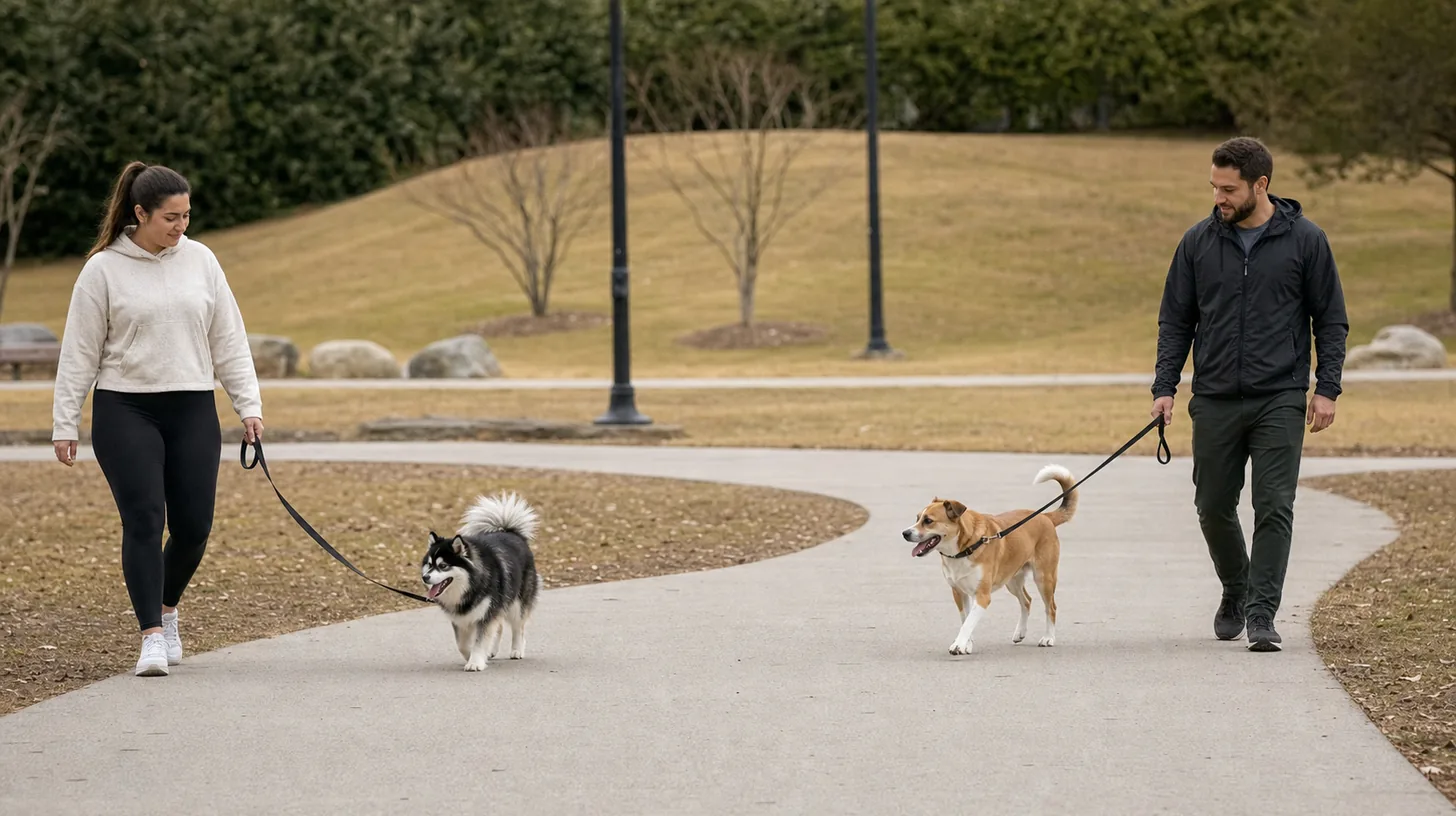
Begin far enough apart that both dogs can walk, sniff, and respond to their handlers. Head-on approaches increase social pressure. Parallel movement in the same direction usually provides better information while preserving distance.
Start With Parallel Movement
Walk on separate paths with slack leads and no requirement to look at the other dog. Reinforce checking in, sniffing the ground, and relaxed movement. Adjust distance when either dog stiffens, stares, pulls continuously, vocalizes, hides behind the handler, or stops recovering.
Do not correct growling or other warning signals. Increase distance and reassess. Suppressing a warning does not change the underlying discomfort. Several calm passes may be enough for one session; there is no requirement to complete a greeting.
Use Brief Curved Greetings Only When Ready
If both dogs repeatedly show loose movement, soft orientation, and easy disengagement, allow a curved approach rather than a direct rush. Keep leads loose and avoid tangling. Let the dogs gather brief information, then call them apart and resume movement.
Short greetings reduce pressure and let handlers evaluate recovery. Prolonged face-to-face restraint can create tension. If one dog tries to leave, honor that choice. Do not force play, hold collars together, or lift one dog into the other’s face.
Evaluate Play Carefully
Compatible play includes pauses, role changes, curved movement, and the ability to stop. Size and speed differences matter. Interrupt before arousal becomes difficult to manage, then see whether both dogs voluntarily choose to resume.
Mounting, body slamming, pinning, repeated chasing of one unwilling dog, guarding people, or ignoring escape attempts require separation and a lower-intensity plan. “They will work it out” is not a safety strategy. Use gates or leashes to create space without grabbing between dogs.
Transition Into the Home in Stages
After neutral movement, enter through a planned route rather than releasing both dogs at the doorway. One dog may settle behind a barrier while the other explores, then they can rotate. Keep the first indoor period brief and quiet.
Use separated stations with enough space that neither dog blocks the other. Continue to remove high-value items. A resident dog may respond differently once back in familiar territory, so outside success is not proof that indoor access is ready.
Separate Food, Chews, and Rest
Feed behind closed doors and pick up bowls before opening them. Give chews, stuffed toys, and medication separately. Provide more resting places than dogs and maintain clear routes to water, exits, and people. Prevent one dog from repeatedly taking the other’s bed.
Watch human attention as a possible resource. Greetings, sofa access, and training rewards can create crowding. Work with each dog individually and avoid dropping food between them. Resource management supports safety; it does not label either dog as dominant.
Supervise and Expand Freedom Gradually
Active supervision means watching posture, routes, and interactions rather than merely being in the room. Use brief shared periods followed by genuine rest apart. Increase duration only when both dogs continue normal eating, sleeping, play, and recovery.
When the household cannot supervise, use secure separation. Do not rush unsupervised access because the first days appear calm. New conflict can emerge around visitors, fatigue, illness, maturity, or a newly introduced resource.
Record Patterns and Seek Help Early
Log locations, resources, distance, body-language changes, interruptions, and recovery. Look for specific patterns instead of describing a dog as jealous or stubborn. Video may help a professional only when captured during ordinary safe management; never provoke an interaction for footage.
Pause and seek qualified reward-based help after fights, bites, repeated guarding, escalating staring, inability to interrupt safely, or persistent stress. Injuries need veterinary care. Some dogs can share a home only with structured separation, and some pairings are not safe. The goal is a workable household, not forced friendship.
Reassess After Household Changes
Repeat easier management after travel, boarding, surgery, illness, a visitor staying overnight, adolescence, or a major schedule change. Familiar dogs can interact differently when pain, fatigue, or resources change. Restore separate feeding and shorter supervised periods before assuming the previous routine still applies.
Keep gates functional and teach caregivers how to rotate dogs without doorway crowding. Add each animal's veterinary and handling information to the household emergency plan. If one dog must be transported or confined unexpectedly, preserve a safe area for the other rather than improvising shared access.
Recheck the plan whenever a new resource, person, or animal enters the household.
Sources reviewed
Each source is used only for the claim scopes listed below. None establishes a guaranteed Pomsky outcome or replaces individual professional assessment.
- American Veterinary Society of Animal Behavior: Puppy Socialization Position Statement - Supports: puppy socialization window; safe exposure; puppy classes. Limit: Vaccination and exposure decisions still require the puppy's veterinarian.
- American Veterinary Medical Association: Dog Bite Prevention - Supports: bite-risk awareness; leash and secure-gate prevention; avoiding escalation; professional behavior help. Limit: Breed alone does not predict bite risk, and general prevention guidance cannot control an active loose-dog encounter.