Written and reviewed by A Pomsky Editorial Team. Originally published 2026-07-26; substantively reviewed July 26, 2026.
Training boundary: Use humane, reward-based methods and protect safety with management. Pain, panic, aggression, a bite history, or serious handling risk requires a veterinarian or qualified behavior professional. Read the editorial policy.
Direct answer: If a Pomsky guards food, toys, resting places, or stolen items, do not test the dog or reach in to prove ownership. Prevent access to predictable triggers, separate children and other animals, use barriers and planned exchanges only when safe, and document the context and body language. Seek qualified behavior help promptly for escalation, bite history, unpredictable guarding, or household safety concerns.
Resource guarding can involve food, toys, resting places, stolen objects, space, or people. Do not provoke a reaction to test severity. Prevent conflict, stop forced removal and punishment, document the contexts from a safe distance, and involve a veterinarian and qualified behavior professional when risk is present.
Recognize the Context Without Testing
Possible signs include freezing, hovering, hard staring, eating faster, moving away with an item, blocking access, growling, snapping, or biting when someone approaches. These signals can have different causes and do not establish a diagnosis from an article.
Do not repeatedly approach, touch the bowl, take food, or reach for an item to see what happens. A test can escalate risk and teach the dog that human approach predicts loss. Observe normal situations from a safe distance and stop creating rehearsals.
Protect People and Other Animals
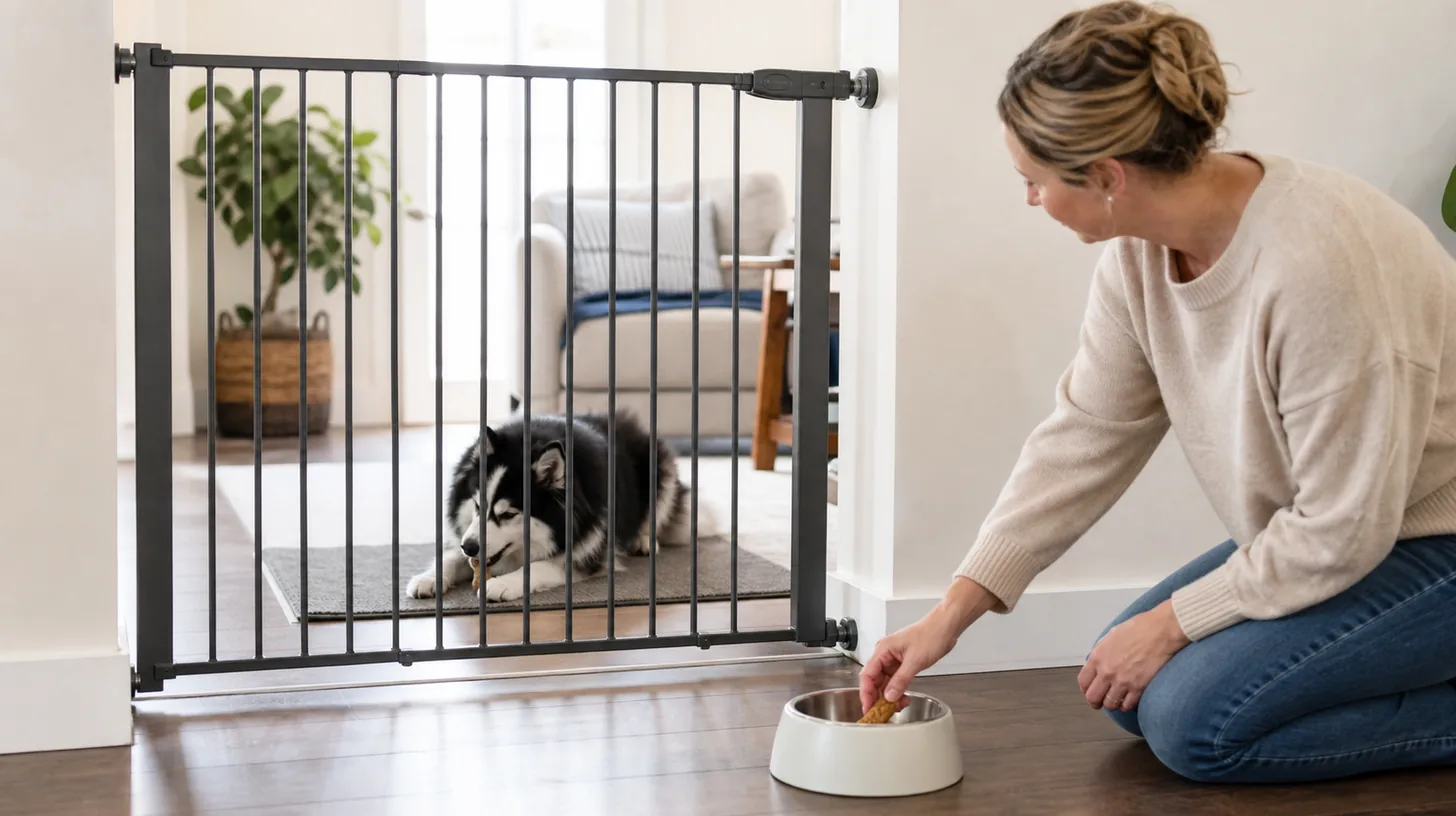
Use doors, gates, separate feeding areas, and household routines to prevent access during high-value activities. Children should never participate in training or retrieve items from the dog. Active adult supervision or complete separation is required; “the dog has always been fine” is not a safety system.
Feed pets separately and pick up empty bowls only after animals are secured elsewhere. Avoid crowding at doorways, beds, chews, and dropped food. Tell visitors which areas and items are off limits.
Stop Coercive Removal
Do not alpha roll, pin, yell, hit, use shock or spray, pry the mouth open, or repeatedly take valued items to prove control. Punishment may suppress warning signals without changing the underlying risk and can intensify conflict.
A trained drop-it cue is useful for voluntary trades in safe, non-guarding practice. It is not a treatment protocol for a dog already guarding an item. Do not approach closely to conduct a trade when body language or history makes approach unsafe.
Reduce Access to Guarded Items
Prevention begins before the item appears. Store food, chews, laundry, rubbish, children's toys, and hazardous objects behind secure barriers. Keep counters clear and bins closed. Use planned enrichment that can be delivered and removed without conflict.
If the dog obtains a non-dangerous item and approach is unsafe, create distance and contact a qualified professional for a plan. If the item is hazardous, contact a veterinarian or emergency service and explain both the exposure and bite risk. Human safety remains essential.
Record Patterns for Professional Review
Write down the resource, location, people or animals present, distance at the first sign, sequence of events, and what ended the incident. Video may be useful only when it can be captured passively without moving closer, provoking the dog, or delaying safety.
Record medical changes, pain signs, appetite changes, medications, and recent stressors. Sudden behavior change may have a medical component. The veterinarian can assess health factors and coordinate referral.
Choose Qualified Help
Look for a professional who uses reward-based methods, takes a detailed history, coordinates with the veterinarian, explains safety management, and does not guarantee a cure. The American Veterinary Society of Animal Behavior provides guidance on humane training and selecting behavior consultants.
Ask how the professional handles bite risk, children, multi-pet homes, and emergency situations. Avoid anyone who recommends confrontation, dominance tests, flooding, or removing warnings through punishment.
Build Skills Below the Risk Threshold
Professional plans may use controlled approach-and-retreat work, trade foundations, stationing, or other exercises at distances where the dog remains comfortable. These details must be individualized. Household members should not improvise closer exposure to accelerate progress.
Management is not failure. A dog can have a good quality of life while meals, chews, and resting spaces are carefully separated. Reliable management protects learning and prevents additional incidents.
Know When the Situation Is Urgent
Seek prompt professional help after a bite, attempted bite, escalation in intensity, guarding of unpredictable spaces, conflict involving a child, or inability to manage the environment safely. Medical signs, pain, or sudden onset also require veterinary assessment.
For immediate danger, separate people and animals without grabbing the dog or entering a confined confrontation. Follow local emergency and medical guidance for injuries. Do not rely on an online article during an active crisis.
Review the Safety Plan
Audit gates, storage, feeding locations, household compliance, and pet-sitter instructions regularly. Update the plan when the home, dog population, children, health, or guarded resources change. Keep professional contacts accessible.
The goal is not to prove that anyone can take anything from the Pomsky. It is to reduce preventable conflict, preserve communication, and create a professionally guided path toward safer behavior. No training plan can promise zero risk.
Prepare a Pet-Sitter and Visitor Protocol
A caregiver should know which resources, rooms, and situations have been associated with guarding; where gates and secure storage are located; how pets are separated for meals; and whom to contact. Do not ask an unfamiliar sitter to practice trades, approach the dog while eating, or test whether the behavior has improved.
Use written instructions that prioritize prevention: deliver food after the dog is separated, leave the area, allow undisturbed eating, and secure the dog elsewhere before collecting the bowl. Explain which chews and toys are not offered when the primary handler is absent.
Visitors should not reach for the dog's possessions, enter protected resting areas, or feed items without permission. Children require complete separation from guarded-resource situations. A sign on a private storage cabinet can help household members follow the plan without publicly labeling the dog.
Review the protocol with the veterinary or behavior professional. Update it after incidents, treatment changes, new pets, moving home, or changes in the dog's health. A clear handoff prevents a well-meaning person from creating a confrontation that the regular household has learned to avoid.
Keep emergency human medical contacts separate from the behavior plan. After a bite, follow appropriate wound-care and medical guidance and report as local rules require. Do not ask the behavior professional to replace healthcare or public-health decisions. Coordinated roles make the response clearer without minimizing either human injury or the dog's welfare.
Review access during travel and boarding as well. A new room, unfamiliar caregiver, shared feeding area, or valuable item can change the context. Provide written separation instructions and ask whether the facility can meet them before arrival. If it cannot, choose another arrangement rather than relaxing the safety plan.
Sources reviewed
Each source is used only for the claim scopes listed below. None establishes a guaranteed Pomsky outcome or replaces individual professional assessment.
- American Veterinary Society of Animal Behavior: Humane Dog Training Position Statement - Supports: reward-based training; aversive-method risk; behavior change principles. Limit: Does not guarantee outcomes for an individual dog.
- American Veterinary Society of Animal Behavior: How to Select a Behavior Consultant - Supports: trainer credentials; behavior consultant selection; red flags. Limit: Avoid implying that a title alone proves competence.