Written and reviewed by A Pomsky Editorial Team. Originally published 2026-07-26; substantively reviewed July 26, 2026.
Training boundary: Use humane, reward-based methods and protect safety with management. Pain, panic, aggression, a bite history, or serious handling risk requires a veterinarian or qualified behavior professional. Read the editorial policy.
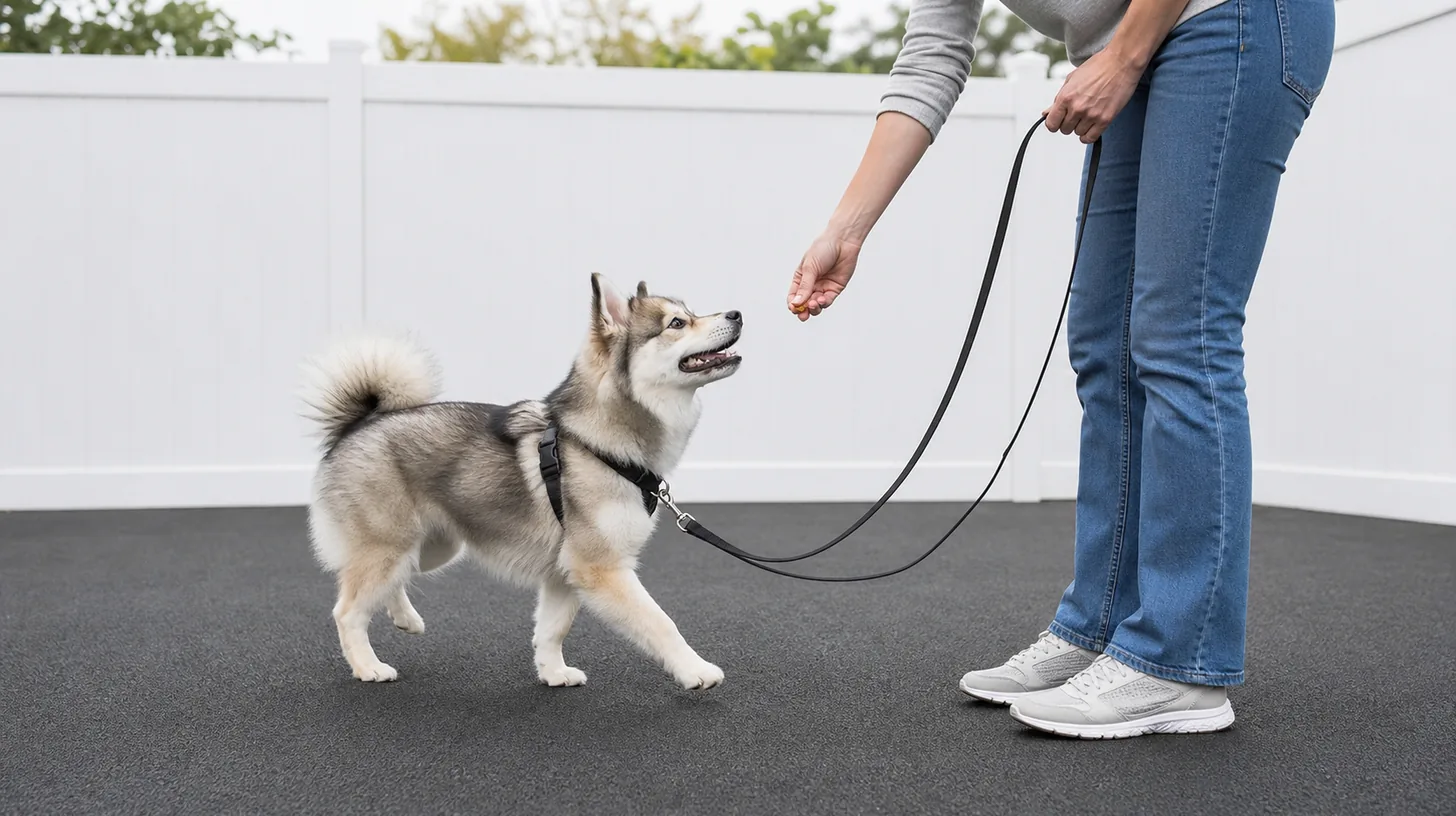
Direct answer: In a quiet secure area, connect a well-fitted harness and apply the smallest steady sideways leash pressure the Pomsky can notice. The instant the dog turns or takes one step toward the pressure, release the leash fully, mark, and reward near your leg. Repeat only while the dog remains comfortable; never pull, jerk, drag, or increase pressure to force a response.
Leash pressure should become quiet information, not a contest of strength. This exercise teaches a Pomsky that the faint sensation of a leash moving sideways predicts an easy choice: orient toward the handler, make one small movement, feel the pressure disappear, and receive a reward. It is a foundation skill for ordinary handling, not a correction and not a substitute for loose-leash walking.
Define the Finished Response
Choose one observable result before training: the Pomsky turns the head, shifts weight, or takes one step toward the handler and the leash immediately becomes slack.
Perform this check before adding the next variable. The target remains a voluntary orientation or single step toward the lightest detectable sideways pressure. Work in a fenced, distraction-free area with level nonslip footing and a well-fitted harness. If the setup cannot preserve that condition, simplify it or stop rather than relying on speed or physical control. For this page, step 1 is specifically the define the finished response check.
Do not convert this step into a stress test. The principal avoidable risks are tightening the line, pulling continuously, jerking, trapping the dog, or practicing through fear. Write down direction, starting slack, response offered, recovery, and whether the next repetition should be easier; a short factual note is more useful than a reassuring guess. Record the outcome of define the finished response separately before moving on.
Check Harness Fit and Hardware
Inspect straps, attachment point, stitching, clip, ring, and leash before the dog enters the practice area; the connection must not concentrate force on the neck.
Use an observable pass condition: the relevant item is checked, the boundary is closed, and the Pomsky can remain safe without being used as a test. This protects the main objective, a voluntary orientation or single step toward the lightest detectable sideways pressure, while leaving a clear point at which the caregiver can step back. For this page, step 2 is specifically the check harness fit and hardware check.
If the Pomsky cannot remain comfortable or the equipment and environment cannot remain controlled, end the attempt. Do not proceed through tightening the line, pulling continuously, jerking, trapping the dog, or practicing through fear. Capture direction, starting slack, response offered, recovery, and whether the next repetition should be easier before deciding what changes next. Record the outcome of check harness fit and hardware separately before moving on.
Build Value Beside the Handler
Deliver several easy rewards near the handler's leg with the leash already loose so the destination is familiar before pressure is introduced.
Keep the sequence repeatable across caregivers. Say what is being checked, complete it, and return equipment and people to neutral before continuing. In this page's context, success means a voluntary orientation or single step toward the lightest detectable sideways pressure; it does not mean proving that a known risk can be tolerated. For this page, step 3 is specifically the build value beside the handler check.
The absence of an incident is not proof that the arrangement is sound. Recheck for tightening the line, pulling continuously, jerking, trapping the dog, or practicing through fear. Document direction, starting slack, response offered, recovery, and whether the next repetition should be easier so a later caregiver can distinguish a passed step from one that was skipped. Record the outcome of build value beside the handler separately before moving on.
Start With Sideways Information
Move the hand only far enough to remove slack and create a faint steady sideways sensation; do not pull backward or lift the dog.
Treat this as one part of the complete routine, not an isolated trick. The surrounding setup is a fenced, distraction-free area with level nonslip footing and a well-fitted harness. A clean transition reduces ambiguity and makes it easier to notice when the dog, equipment, environment, or records differ from the previous attempt. For this page, step 4 is specifically the start with sideways information check.
Stop when the expected condition is absent or the situation begins to depend on force, luck, or an open boundary. Specifically avoid tightening the line, pulling continuously, jerking, trapping the dog, or practicing through fear. The follow-up record should cover direction, starting slack, response offered, recovery, and whether the next repetition should be easier. Record the outcome of start with sideways information separately before moving on.
Release Before Delivering the Reward
The instant the Pomsky orients or moves toward the sensation, move the leash hand toward the dog so pressure fully disappears, then mark and reward.
Pause long enough to inspect the result rather than assuming the action worked. Look at the dog, the physical boundary, and the next movement available to the caregiver. Continue only when the arrangement still supports a voluntary orientation or single step toward the lightest detectable sideways pressure. For this page, step 5 is specifically the release before delivering the reward check.
Do not convert this step into a stress test. The principal avoidable risks are tightening the line, pulling continuously, jerking, trapping the dog, or practicing through fear. Write down direction, starting slack, response offered, recovery, and whether the next repetition should be easier; a short factual note is more useful than a reassuring guess. Record the outcome of release before delivering the reward separately before moving on.
Teach Both Directions Separately
Practice left and right as separate pictures, returning to neutral slack between repetitions and keeping the handler's body quiet.
A second capable adult can verify the boundary during early practice or higher-risk situations. That person should follow the same sequence and avoid adding prompts, handling, or access that changes the task. The shared standard remains a voluntary orientation or single step toward the lightest detectable sideways pressure. For this page, step 6 is specifically the teach both directions separately check.
If the Pomsky cannot remain comfortable or the equipment and environment cannot remain controlled, end the attempt. Do not proceed through tightening the line, pulling continuously, jerking, trapping the dog, or practicing through fear. Capture direction, starting slack, response offered, recovery, and whether the next repetition should be easier before deciding what changes next. Record the outcome of teach both directions separately separately before moving on.
Accept a Weight Shift First
For a hesitant learner, release for an ear turn, head turn, or weight shift rather than waiting for a complete step and increasing force.
Perform this check before adding the next variable. The target remains a voluntary orientation or single step toward the lightest detectable sideways pressure. Work in a fenced, distraction-free area with level nonslip footing and a well-fitted harness. If the setup cannot preserve that condition, simplify it or stop rather than relying on speed or physical control. For this page, step 7 is specifically the accept a weight shift first check.
The absence of an incident is not proof that the arrangement is sound. Recheck for tightening the line, pulling continuously, jerking, trapping the dog, or practicing through fear. Document direction, starting slack, response offered, recovery, and whether the next repetition should be easier so a later caregiver can distinguish a passed step from one that was skipped. Record the outcome of accept a weight shift first separately before moving on.
Add One Step of Handler Movement
After stationary responses are easy, take one slow step away, pause, and reinforce the Pomsky for following into slack rather than reaching the end of the line.
Use an observable pass condition: the relevant item is checked, the boundary is closed, and the Pomsky can remain safe without being used as a test. This protects the main objective, a voluntary orientation or single step toward the lightest detectable sideways pressure, while leaving a clear point at which the caregiver can step back. For this page, step 8 is specifically the add one step of handler movement check.
Stop when the expected condition is absent or the situation begins to depend on force, luck, or an open boundary. Specifically avoid tightening the line, pulling continuously, jerking, trapping the dog, or practicing through fear. The follow-up record should cover direction, starting slack, response offered, recovery, and whether the next repetition should be easier. Record the outcome of add one step of handler movement separately before moving on.
Change Only One Variable
Introduce a new room, mild distraction, different direction, or extra step one at a time while preserving the same release rule.
Keep the sequence repeatable across caregivers. Say what is being checked, complete it, and return equipment and people to neutral before continuing. In this page's context, success means a voluntary orientation or single step toward the lightest detectable sideways pressure; it does not mean proving that a known risk can be tolerated. For this page, step 9 is specifically the change only one variable check.
Do not convert this step into a stress test. The principal avoidable risks are tightening the line, pulling continuously, jerking, trapping the dog, or practicing through fear. Write down direction, starting slack, response offered, recovery, and whether the next repetition should be easier; a short factual note is more useful than a reassuring guess. Record the outcome of change only one variable separately before moving on.
Keep Repetitions Brief
End after a few clean responses while the dog still approaches the setup willingly; repetition count is less important than relaxed recovery.
Treat this as one part of the complete routine, not an isolated trick. The surrounding setup is a fenced, distraction-free area with level nonslip footing and a well-fitted harness. A clean transition reduces ambiguity and makes it easier to notice when the dog, equipment, environment, or records differ from the previous attempt. For this page, step 10 is specifically the keep repetitions brief check.
If the Pomsky cannot remain comfortable or the equipment and environment cannot remain controlled, end the attempt. Do not proceed through tightening the line, pulling continuously, jerking, trapping the dog, or practicing through fear. Capture direction, starting slack, response offered, recovery, and whether the next repetition should be easier before deciding what changes next. Record the outcome of keep repetitions brief separately before moving on.
Recognize Stop Signals
Stop for bracing, crouching, frantic scanning, refusal of usual food, repeated scratching at equipment, vocal distress, or inability to return to slack.
Pause long enough to inspect the result rather than assuming the action worked. Look at the dog, the physical boundary, and the next movement available to the caregiver. Continue only when the arrangement still supports a voluntary orientation or single step toward the lightest detectable sideways pressure. For this page, step 11 is specifically the recognize stop signals check.
The absence of an incident is not proof that the arrangement is sound. Recheck for tightening the line, pulling continuously, jerking, trapping the dog, or practicing through fear. Document direction, starting slack, response offered, recovery, and whether the next repetition should be easier so a later caregiver can distinguish a passed step from one that was skipped. Record the outcome of recognize stop signals separately before moving on.
Connect the Skill to Daily Handling
Use the response only for small predictable adjustments, then return to ordinary loose-leash communication instead of keeping pressure on during walks.
A second capable adult can verify the boundary during early practice or higher-risk situations. That person should follow the same sequence and avoid adding prompts, handling, or access that changes the task. The shared standard remains a voluntary orientation or single step toward the lightest detectable sideways pressure. For this page, step 12 is specifically the connect the skill to daily handling check.
Stop when the expected condition is absent or the situation begins to depend on force, luck, or an open boundary. Specifically avoid tightening the line, pulling continuously, jerking, trapping the dog, or practicing through fear. The follow-up record should cover direction, starting slack, response offered, recovery, and whether the next repetition should be easier. Record the outcome of connect the skill to daily handling separately before moving on.
When to Escalate
This routine has a defined boundary. Stop when the Pomsky, caregiver, equipment, records, or environment no longer supports a voluntary orientation or single step toward the lightest detectable sideways pressure. Do not improvise through tightening the line, pulling continuously, jerking, trapping the dog, or practicing through fear. Seek a veterinarian for pain or movement concerns and a qualified reward-based professional for persistent fear, freezing, or aggression risk. Bring the concise observations already recorded rather than recreating the event.
Before the next attempt, review direction, starting slack, response offered, recovery, and whether the next repetition should be easier. Reopen the task only after the physical setup, instructions, and responsible person are clear. A conservative stop is useful information: it prevents a manageable problem from becoming an emergency and gives the appropriate professional a factual starting point.
Sources reviewed
Each source is used only for the claim scopes listed below. None establishes a guaranteed Pomsky outcome or replaces individual professional assessment.
- American Veterinary Society of Animal Behavior: Humane Dog Training Position Statement - Supports: reward-based training; aversive-method risk; behavior change principles. Limit: Does not guarantee outcomes for an individual dog.
- American Kennel Club: The Importance of a Well-Fitting Harness - Supports: harness measurement; strap clearance; shoulder movement; escape and chafing checks. Limit: No harness corrects pulling by itself or fits every body shape; pain, rubbing, or gait change needs reassessment.