Written and reviewed by A Pomsky Editorial Team. Originally published 2026-07-26; substantively reviewed July 26, 2026.
Training boundary: Use humane, reward-based methods and protect safety with management. Pain, panic, aggression, a bite history, or serious handling risk requires a veterinarian or qualified behavior professional. Read the editorial policy.
Direct answer: Teach the turn first in a quiet secure area: give one distinct cue, rotate smoothly, move several steps away, and reward the Pomsky for following on a loose leash. Add distance and distractions one variable at a time. Use the cue early to create safety, never to test the dog close to traffic, animals, or known triggers.
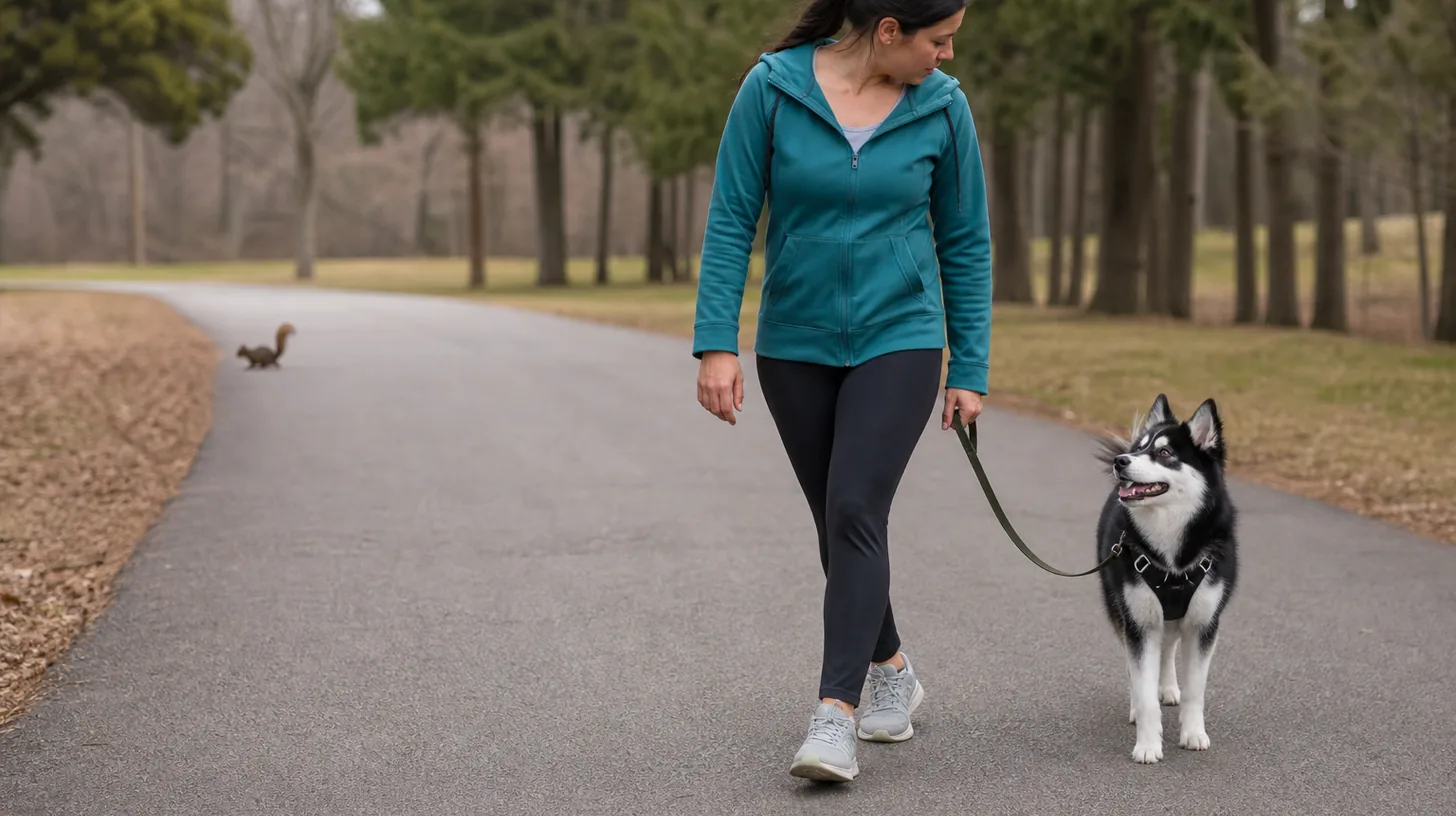
An emergency U-turn gives a caregiver a practiced way to leave a developing problem before the Pomsky reaches it. The cue is not a test of obedience near traffic, loose dogs, wildlife, or a known trigger. It is a simple team movement: the handler notices a reason to leave, gives one familiar cue, turns smoothly, and reinforces the dog for moving away together.
Define the Emergency U-Turn
Choose a short cue that is not used for ordinary changes of direction. Say it once in a neutral tone, turn away from the original route, and move several steps to a safer location. The Pomsky should not need to sit, make prolonged eye contact, or approach the handler before turning. Speed matters less than a clear, predictable pattern.
The skill supports early exit from a situation. It does not make unsafe distance safe, replace a secure harness and leash, or guarantee a response under every level of distraction. When a hazard is already too close, use distance, a physical barrier, or another safe route rather than repeating the cue.
Prepare a Low-Distraction Practice Area
Begin indoors or in a securely enclosed, quiet area with good footing. Fit the Pomsky's ordinary walking equipment and use a leash long enough to remain loose during the turn. Remove food, toys, people, and other animals that could make the first repetitions difficult. Keep high-value rewards ready but out of the dog's face.
Walk only a few steps before each practice turn. Avoid drilling in tight circles or making many rapid repetitions. A short session with several calm successes is easier to understand and less physically demanding than repeated abrupt direction changes.
Build the Movement Before Adding the Cue
Start by turning your shoulders and stepping away while encouraging the Pomsky to follow. Mark or calmly praise the first movement in the new direction, then deliver the reward after both of you have traveled a few steps. Feed where you want the dog to continue moving, not back toward the original path.
Keep the leash slack. Do not jerk the collar, drag the dog around, or use the turn to surprise the Pomsky. If the dog stops, shorten the distance, improve the reward, and make your movement easier to follow. The behavior should be learned through successful repetition rather than physical pressure.
Add One Distinct Verbal Cue
When the Pomsky readily follows the turn, say the chosen cue immediately before your body begins to move. Use the same words, tone, and direction pattern for several sessions. Reward every prompt response while the cue is new. Do not combine it with recall, leave-it, heel, and repeated name calls.
The cue predicts movement with the caregiver. It should not predict scolding, the end of every enjoyable walk, or forced contact. After some practice turns, continue to a pleasant activity so the Pomsky does not learn that turning always removes all access to exploration.
Practice Both Directions Safely
Train left and right turns in separate, easy repetitions. The handler should know which direction creates more space before giving the cue. Check that the leash does not wrap around legs and that the Pomsky is not turned into a wall, curb, bicycle, or another person.
Household members may move differently, so each capable adult should practice at the easiest level. Children should not be responsible for emergency handling. If a caregiver cannot turn safely because of mobility, balance, or equipment limitations, a qualified reward-based trainer can help design an alternative exit pattern.
Add Distraction One Variable at a Time
Move from indoors to a fenced yard, quiet driveway, empty parking area, or calm section of a familiar route only after easy practice is reliable. Add one modest distraction at a distance, such as a stationary object or a familiar person. Keep enough space that the Pomsky can notice and still turn without leash tension.
Do not recruit an unfamiliar dog, cyclist, child, or wildlife encounter as a training prop. Real triggers are not needed to prove the cue. If the response slows, increase distance and return to an easier setup. Progress is measured by clear movement under planned conditions, not by how close the dog can get to danger.
Use the Cue Early on Real Walks
Scan ahead and decide before the Pomsky becomes fixed on the situation. Give the cue, turn toward the safest available route, and keep moving until a solid barrier or useful distance exists. Reward after the team is safely traveling away. Then decide whether to continue, wait, cross, or end the outing.
An emergency turn is especially useful at blind corners, narrow paths, parking-lot exits, or when an off-leash dog appears at a distance. It is not suitable when turning would move the team into traffic or another hazard. The caregiver still has to evaluate the environment before choosing the direction.
Protect Equipment and Leash Mechanics
Inspect the harness or collar, leash, clip, and attachment points before practice. Hold the leash so it cannot slide free, but preserve enough slack for the Pomsky to turn without a sharp correction. Avoid retractable-line surprises, damaged hardware, and wrapping the leash around a wrist or hand.
If the Pomsky can back out of current equipment, solve fit and containment before adding outdoor difficulty. No training cue makes an unsuitable setup escape-proof. Practice any new equipment in a secure area and follow the manufacturer's directions.
Record Useful Training Evidence
Track the setting, distraction, starting distance, direction, leash tension, and whether the Pomsky moved on the first cue. Note recovery after the turn and any physical discomfort. A simple record helps caregivers increase one variable at a time and reveals situations that remain too difficult.
Do not record success as a percentage without context. Five indoor turns and one crowded-street turn are not equivalent trials. Useful evidence describes the conditions and the dog's observable response.
Avoid Common Training Errors
Do not wait until the Pomsky is lunging, freeze beside the trigger, repeat the cue, or pull in the opposite direction. Avoid punishment after a slow response. These choices can make the cue less clear and can associate turning with conflict.
Do not practice until the dog loses interest or becomes physically tired. Avoid sharp pivots on slippery surfaces, after strenuous activity, or when gait and comfort are uncertain. Veterinary guidance is appropriate when movement, breathing, pain, or exercise tolerance changes.
Know When a Broader Plan Is Needed
A U-turn is one skill, not a complete behavior program. Frequent barking, lunging, panic, escape attempts, or inability to recover may require a larger route, distance, and professional support plan. A veterinarian can assess possible medical contributors, and a qualified reward-based behavior professional can help select safe training conditions.
The finished behavior should look ordinary: one cue, a smooth shared turn, a loose or quickly softening leash, movement to safety, and recovery at a useful distance. Its value comes from rehearsal before an emergency and from a caregiver who chooses early, safe exits rather than testing limits.
Sources reviewed
Each source is used only for the claim scopes listed below. None establishes a guaranteed Pomsky outcome or replaces individual professional assessment.
- American Veterinary Society of Animal Behavior: Humane Dog Training Position Statement - Supports: reward-based training; aversive-method risk; behavior change principles. Limit: Does not guarantee outcomes for an individual dog.
- American Animal Hospital Association: How Can I Safely Walk My Reactive Dog? - Supports: distance and route management; well-fitted walking equipment; reward-based handling; professional behavior referral. Limit: Equipment and general management cannot guarantee safety during an uncontrolled loose-dog encounter.