Written and reviewed by A Pomsky Editorial Team. Originally published 2026-07-26; substantively reviewed July 26, 2026.
Training boundary: Use humane, reward-based methods and protect safety with management. Pain, panic, aggression, a bite history, or serious handling risk requires a veterinarian or qualified behavior professional. Read the editorial policy.
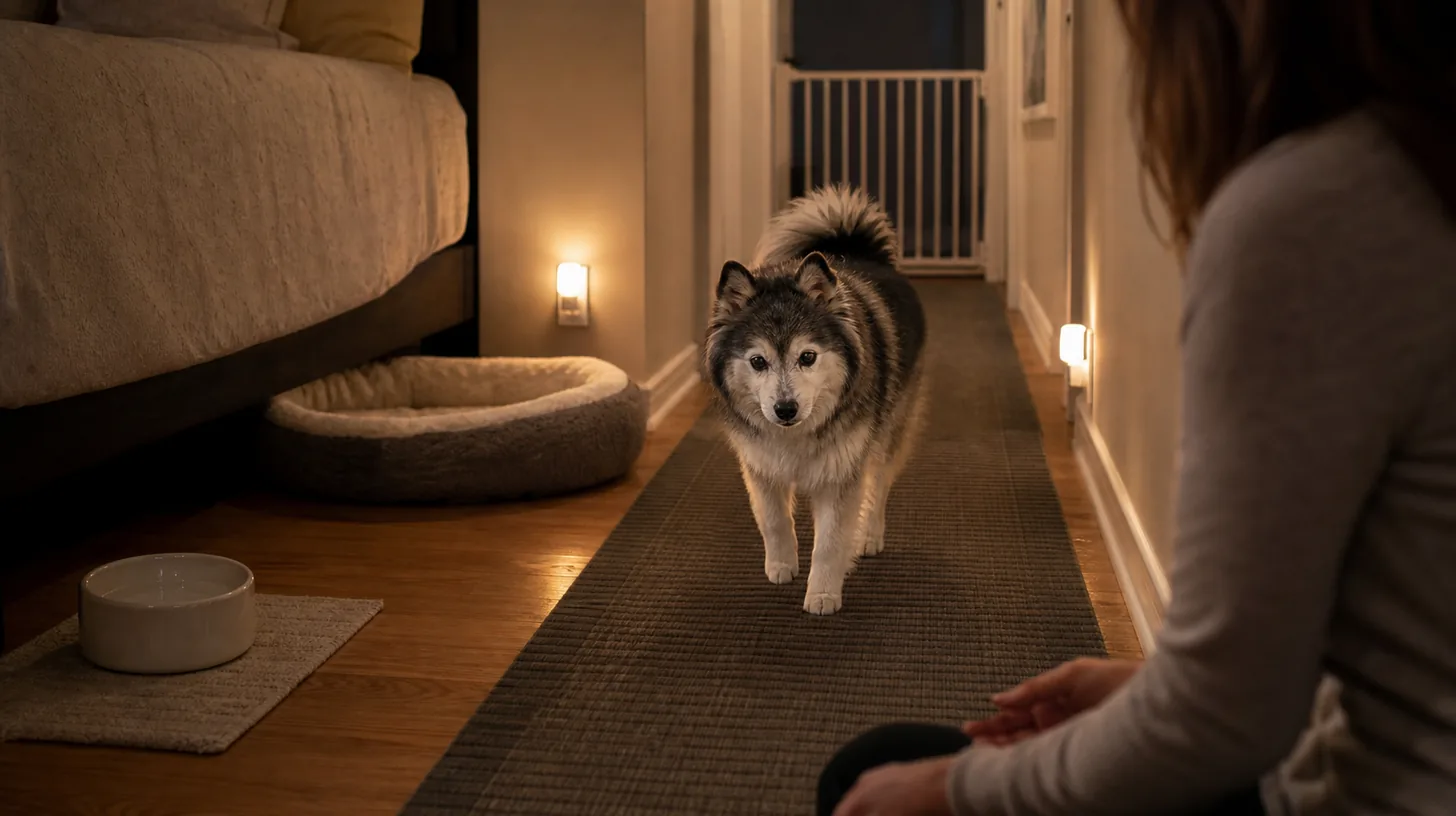
Direct answer: Build one short predictable route between the senior Pomsky's bed, water, caregiver, and toileting area. Add gentle low lighting, continuous nonslip footing, closed stair barriers, and stable furniture placement. Rehearse the route while awake, keep essentials accessible, and record new hesitation, circling, collisions, accidents, pain signs, or sleep disruption for prompt veterinary assessment.
A senior Pomsky may move differently after dark even when the daytime home seems familiar. Lower light, sleep inertia, reflective floors, rearranged furniture, stairs, urgency to toilet, and sensory or mobility changes can combine into a difficult route. A nighttime setup should make essential destinations predictable while treating new difficulty as information for a veterinarian, not simply as aging.
Identify the Essential Night Route
Map the shortest practical path between the Pomsky's bed, water, caregiver, and toileting access. Include every turn, threshold, surface change, door, and stair. Remove optional detours rather than asking the dog to navigate the whole home.
Walk the route at night with ordinary lights off. Human daytime memory often misses shadows, glare, narrow gaps, and objects left in the travel line.
Establish a Daytime Baseline
Observe the Pomsky using the same route while fully awake. Note gait, paw placement, turning, hesitation, head position, response to voice, and recovery after rising. Record any support already needed.
If the route is difficult during the day, nighttime lighting alone is unlikely to solve it. Ask the veterinary team about new pain, weakness, balance, vision, hearing, urinary, or cognitive concerns.
Create Continuous Traction
Cover slippery sections with stable nonslip runners or mats that do not curl, slide, or create raised edges. Connect traction across thresholds rather than leaving polished gaps between rugs. Test each mat with human pressure from several directions.
Avoid loose blankets and small scatter rugs. Recheck after cleaning because backing can deteriorate or floors may remain damp.
Add Gentle Orientation Lighting
Use low, steady lights that reveal the floor edge, turns, water, and barriers without producing glare into the dog's eyes. Place lights so the route remains visible from bed before the Pomsky stands.
Avoid flashing, color-changing, motion-triggered surprises, and cords across the path. Secure electrical components and inspect heat and manufacturer placement requirements.
Keep Furniture Stable
Do not rearrange furniture, baskets, fans, or floor lamps along the route without reintroducing the change in daylight. Push chairs in, close drawers, and keep doors consistently open or closed according to the plan.
Remove low transparent or reflective objects that are hard to detect. Mark unavoidable edges with safe visual contrast that does not create a chew or trip hazard.
Block Stairs and Unsafe Rooms
Use a reliable barrier before the stair approach, not at the final step where momentum has already developed. Check gate stability, spacing, latch, and floor contact. Close access to utility rooms, balconies, garages, and cluttered storage areas at night.
A gate is useful only when every caregiver closes it. Include the latch check in the household bedtime routine.
Make the Bed Easy to Enter
Place the bed directly beside the route on nonslip footing. Choose a height and edge the Pomsky can use without jumping or catching a paw. Keep bedding dry, flat, and free from loose covers that can wrap around legs.
If the dog repeatedly changes sleeping location, record where and when. Temperature, pain, noise, toileting need, or social contact may be relevant.
Keep Water Accessible
Place a stable clean bowl on a nonslip waterproof mat beside the route but outside the walking line. The Pomsky should not need to cross a slick floor or stairs to drink. Clean spills promptly and restore the mat to its exact position.
Do not restrict water to reduce nighttime trips unless the veterinarian directs a specific plan. Drinking changes may be medically important.
Plan Toileting Access
Decide who responds, how the Pomsky becomes connected, which door opens, and where the safe nighttime path continues. Turn on required lights before moving the dog. Check weather, footing, wildlife, and gates before opening the exterior door.
Use the same calm route back to bed. Avoid rushing a stiff or disoriented dog because of household inconvenience.
Use Predictable Caregiver Cues
Approach where the Pomsky can detect you, speak softly before touching, and allow time to rise. Avoid startling the dog from sleep or pulling by the collar. Keep a flashlight accessible for the caregiver without shining it directly at the dog.
If hearing or vision appears reduced, use the communication methods already discussed with the veterinary team.
Rehearse Before Bedtime
Walk the completed route in daylight and then at dusk. Let the Pomsky investigate new mats, lights, and gates without pressure. Confirm the dog can turn around, reach each destination, and return.
Do not wait for an urgent nighttime trip to discover that a mat slides or a gate blocks the caregiver.
Observe Specific Changes
Record time, route, hesitation, collisions, circling, vocalization, staring, accidents, difficulty lying down or rising, sleep disruption, drinking, and recovery. Video may help the veterinary team when captured safely without delaying assistance.
Avoid labeling every change as confusion. Pain, sensory loss, medication effects, urinary urgency, environmental noise, and other conditions can look similar at home.
Respond to a Difficult Night
Turn on broader lighting, reduce distance, and support the Pomsky using only an established safe method. Do not drag, force stairs, or improvise a lift that risks a fall. Keep the dog in one secure comfortable area while arranging professional guidance.
Sudden collapse, inability to stand, marked breathing change, severe pain, seizure-like activity, or acute disorientation requires urgent veterinary routing.
Review Medications and Routines With Professionals
Keep an accurate list of current veterinary prescriptions and administration times. Report nighttime changes rather than changing doses or timing independently. Review any new supplement or calming product with the veterinary team.
Home setup supports movement; it does not replace diagnosis or treatment.
Audit the Route Regularly
Recheck lights, mat grip, gate latches, bowl position, bed condition, cords, and furniture after cleaning, visitors, maintenance, or health changes. Ask another adult to walk the route because familiarity can hide defects.
The best nighttime route is short, stable, well lit, and boring. Its value is measured by safe ordinary movement and useful observation, not by asking a senior Pomsky to adapt to a changing house.
Share the Route With Caregivers
Show every overnight caregiver the light controls, gate sequence, connection point, toileting exit, emergency contacts, and observation log. A written handoff prevents one person from moving a mat, opening a stair gate, or restricting water because they did not understand the established setup.
Sources reviewed
Each source is used only for the claim scopes listed below. None establishes a guaranteed Pomsky outcome or replaces individual professional assessment.
- American Animal Hospital Association: Pain Management: 2023 AAHA Senior Care Guidelines - Supports: traction surfaces; ramps and mobility aids; resting-area and home-hazard adaptation. Limit: Environmental changes support access but do not diagnose or treat pain, arthritis, neurologic disease, or mobility loss.
- American Animal Hospital Association: AAHA-AVMA Canine Preventive Healthcare Guidelines - Supports: preventive exams; individual risk assessment; parasite and vaccination planning. Limit: The veterinarian sets the schedule for the individual dog and location.
- American Animal Hospital Association: Lifestyle and Safety Assessment - Supports: appropriate confinement; leash, collar and harness planning; lifestyle-specific safety review. Limit: Equipment selection must account for the individual dog's anatomy, behavior, health, and environment.