Written and reviewed by A Pomsky Editorial Team. Originally published 2026-07-26; substantively reviewed July 26, 2026.
Safety boundary: This guide is educational and cannot diagnose, treat, or replace veterinary, medical, public-health, emergency-dispatch, animal-control, or jurisdiction-specific legal guidance. Use the health disclaimer and contact the appropriate professional for the actual situation.
Direct answer: Start with a veterinary assessment of new pain or mobility signs, then build continuous traction along essential routes, reduce stairs and jumps, and make beds, water, food, toilet access, and lighting easier to reach. Recheck the setup regularly and escalate falls, weakness, pain, or sudden functional change.
Begin with a veterinary mobility baseline
Home changes should follow, not replace, an assessment of new mobility or pain signs. Ask the veterinarian about stiffness, slipping, altered gait, reluctance to climb, difficulty rising, nighttime movement, toileting changes, or reduced activity. Sudden weakness, collapse, dragging limbs, severe pain, or inability to stand may require urgent care.
Record the Pomsky’s normal route from bed to water, food, exit, toilet area, and family spaces. Note where the dog hesitates, slips, jumps, or avoids movement. Short videos can help the veterinary team when recording is safe. Do not diagnose arthritis or prescribe exercise, supplements, or medication based on age alone.
Add traction to essential routes
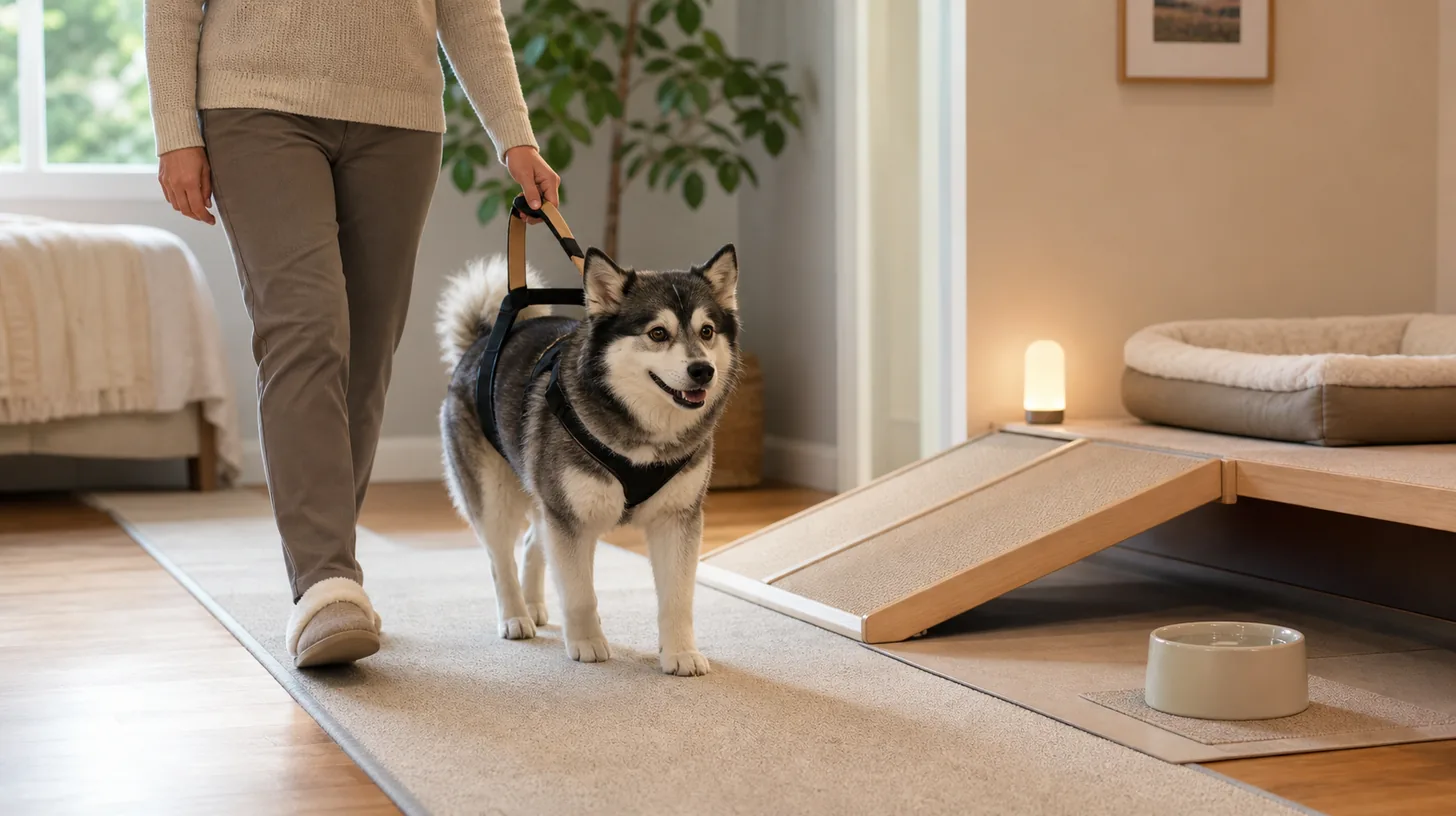
Place secured non-slip rugs, runners, or mats across smooth floors, especially at turns, doorways, beside beds, and where the dog stands to eat. Edges must lie flat and backing must not slide. Create continuous traction rather than isolated “islands” that require the dog to step onto slick flooring between mats.
Test the route while walking beside the dog without pulling. Watch toe spreading, stride length, slipping, and confidence. Clean and dry surfaces promptly because wet rugs create another hazard. Avoid loose towels, curling mats, and adhesive products that damage floors or expose the dog to chemicals.
Reduce difficult stairs and jumps
Block unsupervised stair access with a secure gate and provide the dog’s essential resources on one level when possible. A ramp may help only when its slope, width, surface, side protection, and load rating fit the dog and location. Introduce it on a low angle with rewards and never drag the Pomsky across it.
For furniture or vehicles, remove unnecessary jumping. Use a stable ramp, steps assessed for the individual, or trained adult assistance according to veterinary advice. Do not lift a painful dog without learning safe support. Equipment marketed as orthopedic or senior-friendly is not automatically suitable; stability and observed movement matter.
Set up accessible rest areas
Provide a bed large enough for the dog’s natural sleeping posture, with support and entry height that allow easy access. Place it on non-slip flooring away from drafts, hot vents, busy doorways, and places where people may trip over the dog. More than one bed can reduce unnecessary travel between family areas.
Observe how the Pomsky lies down, changes position, and rises. A bed that is too soft may be difficult to exit, while a high bolster may obstruct access. Wash covers and keep bedding dry. Persistent restlessness, inability to settle, vocalization, or repeated position changes should be discussed with the veterinarian rather than solved only by buying another bed.
Make food water and toilet access easier
Place water on a stable non-slip surface along the main route and provide access without stairs. Keep bowls from sliding. Feeding height and posture should be individualized with veterinary input; do not assume elevation is beneficial for every dog. Maintain the prescribed food and medication routine and monitor appetite and water changes.
Increase toilet opportunities if movement is slower, but investigate new accidents, straining, diarrhea, excessive thirst, or urine changes. Improve lighting and traction on the route to the exit. At night, use gentle illumination that helps navigation without creating glare. Outdoor paths should be even, secure, and cleared of ice, heat, or debris.
Improve visibility and reduce collisions
Keep furniture placement consistent and remove low obstacles, cords, clutter, and unstable decorative items from travel paths. Mark step edges with visual contrast when appropriate and use night-lights in hallways. Close access to balconies, pools, construction areas, and narrow gaps where a dog could become trapped.
Vision and hearing changes can alter how a senior responds to touch or approach. Announce yourself calmly, avoid startling the sleeping dog, and let the Pomsky orient before handling. Children should not climb over or disturb a resting senior dog. New confusion, circling, staring, sleep reversal, or disorientation requires veterinary discussion.
Support movement without forcing exercise
Follow the veterinarian’s activity recommendations and use short, predictable movement on secure surfaces. Warm up with easy walking and allow sniffing and rest. A well-fitted harness with a support handle may help some dogs, but fit, anatomy, and purpose must be assessed. Do not pull upward by a collar or use a device that changes gait without professional guidance.
Track duration, surface, weather, recovery, and next-day stiffness rather than chasing a universal exercise target. Stop for limping, weakness, heavy breathing, repeated sitting, or reluctance. More activity is not always better, and complete inactivity can also have consequences; the correct plan is individual.
Audit the setup every month
Walk the route at the dog’s eye level and check mat movement, worn surfaces, ramp stability, gate latches, lighting, bowl access, bed condition, and new clutter. Re-measure equipment after weight or coat changes. Update emergency and lifting plans with all caregivers.
Compare the dog’s current function with the baseline record. If the setup no longer supports independent access, ask the veterinary team about rehabilitation, pain management, assistive devices, and quality-of-life assessment. Home adaptation is an ongoing process, not a one-time senior makeover.
Escalate pain and safety changes promptly
Contact the veterinarian for persistent limping, reluctance to move, repeated falls, difficulty rising, appetite or sleep changes, vocalization, or altered behavior. Seek urgent advice for collapse, severe pain, inability to stand, sudden weakness, breathing difficulty, or major injury. Do not give human pain medicine.
The aim is to reduce preventable slips, unnecessary stairs, difficult access, and environmental confusion while preserving choice and participation. Rugs, ramps, beds, and lighting can support a senior Pomsky, but they cannot diagnose or treat the cause of mobility loss. The safest home plan remains connected to ongoing veterinary assessment.
Prepare for emergencies before mobility declines further. Decide how two adults can move the dog without pulling limbs or compressing the chest, where a stretcher or supportive blanket is stored, and which exit avoids stairs. Ask the veterinary team to demonstrate appropriate assistance for the individual dog. Keep transport equipment accessible and ensure caregivers know that a painful or frightened dog may react differently during handling.
Sources reviewed
Each source is used only for the claim scopes listed below. None establishes a guaranteed Pomsky outcome or replaces individual professional assessment.
- American Animal Hospital Association: Pain Management: 2023 AAHA Senior Care Guidelines - Supports: traction surfaces; ramps and mobility aids; resting-area and home-hazard adaptation. Limit: Environmental changes support access but do not diagnose or treat pain, arthritis, neurologic disease, or mobility loss.
- American Animal Hospital Association: AAHA-AVMA Canine Preventive Healthcare Guidelines - Supports: preventive exams; individual risk assessment; parasite and vaccination planning. Limit: The veterinarian sets the schedule for the individual dog and location.