Written and reviewed by A Pomsky Editorial Team. Originally published 2026-07-26; substantively reviewed July 26, 2026.
Training boundary: Use humane, reward-based methods and protect safety with management. Pain, panic, aggression, a bite history, or serious handling risk requires a veterinarian or qualified behavior professional. Read the editorial policy.
Direct answer: Assign who secures the Pomsky, stage identified leash or carrier equipment, practice primary and alternate exits, load into the established transport setup, meet at a defined location, and test the contact chain. Record equipment, route, communication, and training problems afterward. Never use smoke, unsafe alarms, blocked exits, or another simulated hazard.
An evacuation checklist is useful only if the household can perform it. A Pomsky home evacuation drill should practice locating and securing the dog, attaching identified transport equipment, using primary and alternate exits, loading safely, confirming a meeting point, and testing communication. The drill must remain low stress and must never use smoke, alarms at harmful volume, blocked exits, or other simulated danger.
Define a Safe Drill Scenario
Choose one realistic reason to leave, such as a building evacuation order or approaching severe weather, without creating the hazard. Set a simple objective: everyone and the Pomsky reach the meeting point with required equipment within a measured but unhurried period.
Tell all participants that it is a drill and assign a stop word. Keep children supervised and do not involve emergency services unless the activity has been coordinated with them. Neighbors, building staff, and alarm companies may need notice to prevent confusion.
Assign Roles Before Movement Starts
Designate one adult to secure the Pomsky, one to collect the go bag when staffing allows, and one to check communication and the human household. Identify a backup for each role. No one should assume someone else has the dog.
Write the role order near the emergency supplies. In a small household, one person may perform several tasks, so the plan should prioritize life safety, leash or carrier control, keys, phone, and exit. Do not re-enter an unsafe building for supplies or an animal; follow emergency authority instructions.
Stage Identified Transport Equipment
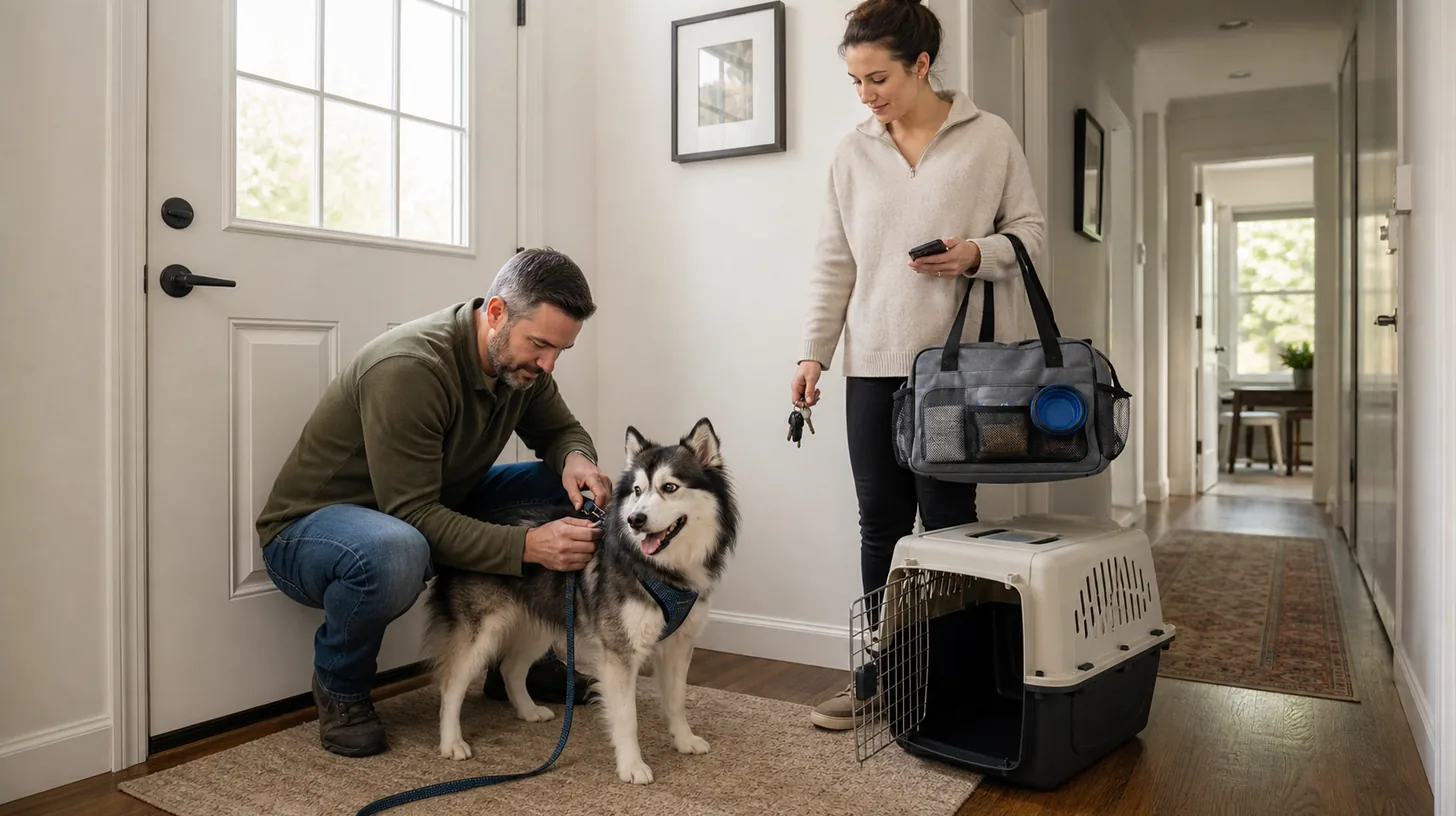
Keep the Pomsky's well-fitted leash, harness or collar, carrier when appropriate, current tag, and go bag in known accessible locations. Check that equipment is not buried behind seasonal storage. A second leash and recent photograph can be useful backups.
Practice attaching equipment while the environment is calm. If the Pomsky hides or avoids handling, build that skill separately with reward-based training. An emergency drill should not become a chase around the home or a forced carrier session.
Practice the Locate-and-Secure Step
Begin with the Pomsky in an ordinary safe location. The assigned handler calmly calls or approaches, secures the leash or closes the carrier, rewards cooperation, and announces that the dog is controlled. Time this step only after the routine is familiar.
Test likely complications on separate days, such as the dog resting upstairs or behind a baby gate. Do not intentionally frighten the dog into hiding. If recall is unreliable, use closed doors, gates, and a room-by-room search plan rather than relying on repeated shouting.
Use Primary and Alternate Exits
Walk the primary route to the outside meeting point, checking doors, stairs, elevators, gates, and surfaces. Follow building rules about elevator use during emergencies. On another drill, practice the alternate route if it is legally accessible and physically safe.
Keep the Pomsky on leash or in the carrier throughout. Do not release the dog at the meeting point. Note narrow doors, slippery stairs, automatic gates, crowding, or places where another animal may be encountered. These are plan defects to solve after the drill.
Rehearse Vehicle or Transport Loading
If the plan uses a vehicle, practice moving from the meeting point to the car and securing the Pomsky in the established travel setup. Confirm that keys, fuel or charging, carrier space, and the route out are available. Never run a vehicle in an enclosed area.
For households without a car, identify the actual transport arrangement and its pet rules. Ask a willing contact in advance rather than assuming a rideshare, shelter, or public service will accept animals during an event.
Confirm the Meeting Point and Contact Chain
Select a nearby meeting point and a more distant backup outside the immediate hazard area. Every household member should know both. At the point, account for people and animals and send the agreed message to an out-of-area contact.
Keep contact information offline as well as on phones. Network congestion and power loss can interrupt communication. Do not publish the household's evacuation status or empty-home location broadly on social media.
Test the Go Bag Without Expanding the Drill
Carry the existing go bag and confirm that it is manageable with the Pomsky. Check water, bowls, food, medication, records, sanitation supplies, first-aid information, identification, and any climate needs according to the household's emergency plan.
Do not unpack every item during the timed movement. Review dates, batteries, food, medication, and documents afterward. A bag that is too heavy or stored too far from the exit needs redesign, not faster handling under pressure.
Record Friction and Recovery
After returning home, note time to secure the Pomsky, exit used, equipment problems, missed contacts, transport issues, and the dog's behavior and recovery. Reward calm participation and allow the dog to settle. Do not repeat the full drill immediately to correct every mistake.
Separate problems into equipment, environment, communication, and training. Assign one change at a time with an owner and review date. A slower calm drill that exposes real weaknesses is more valuable than a fast performance that depends on luck.
Adapt for Multi-Pet and Accessibility Needs
Each animal needs an identified handler or a realistic sequence. Cats, birds, and other pets may require different carriers and room access. Prevent leashes from tangling and animals from competing at doors. Practice separately before combining movements.
Include mobility, hearing, vision, medication, language, and child-care needs for people in the household. Ask local emergency management or building staff about accessible evacuation procedures. The Pomsky plan cannot be separated from the human life-safety plan.
Schedule Bounded Repeat Drills
Repeat a short component after equipment, household, address, season, or health changes. A full drill a few times a year may be enough for many households, while leash attachment, carrier comfort, and door routines can be practiced briefly during normal life.
Update microchip contacts, tags, veterinary records, photographs, medication lists, destinations, and shelter information. Current local emergency instructions always take priority. The purpose of practice is to make safe actions familiar and reveal gaps before a real evacuation, not to imitate danger.
Keep the completed drill record with the emergency plan and date the next review. When a problem cannot be corrected immediately, document a temporary workaround and who is responsible for resolving it so the same weakness is not silently carried into the next exercise.
Sources reviewed
Each source is used only for the claim scopes listed below. None establishes a guaranteed Pomsky outcome or replaces individual professional assessment.
- U.S. Centers for Disease Control and Prevention: Pet Emergency Preparedness - Supports: evacuation planning; pet records; emergency supplies; disaster readiness. Limit: Local emergency authority instructions take priority.
- U.S. Centers for Disease Control and Prevention: Pet Emergency Checklist - Supports: emergency kit contents; records; identification; transport supplies. Limit: Adapt the checklist to local hazards and the dog's medical needs.