Written and reviewed by A Pomsky Editorial Team. Originally published 2026-07-26; substantively reviewed July 26, 2026.
Safety boundary: This guide is educational and cannot diagnose, treat, or replace veterinary, medical, public-health, emergency-dispatch, animal-control, or jurisdiction-specific legal guidance. Use the health disclaimer and contact the appropriate professional for the actual situation.
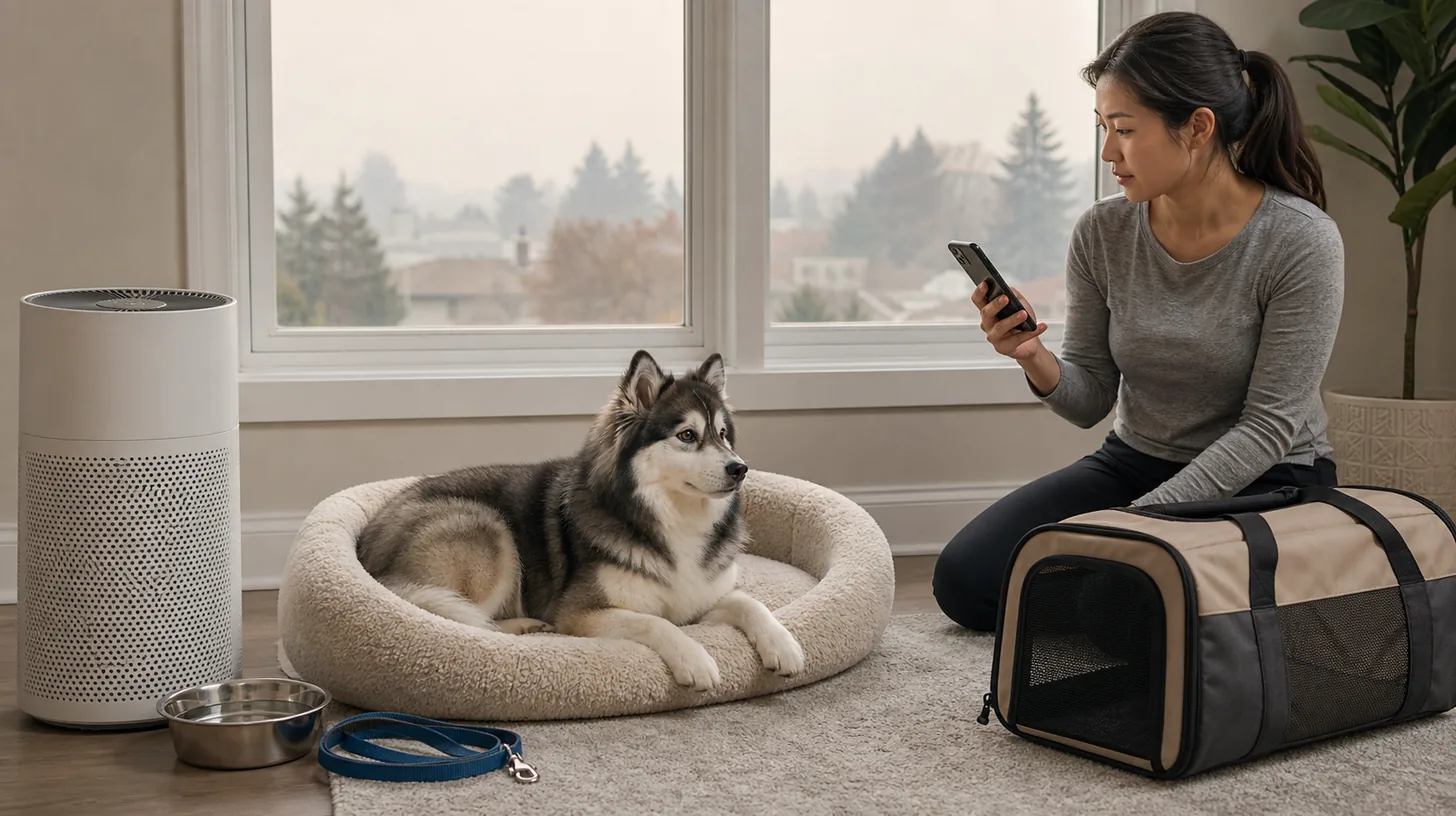
Direct answer: Check current official air quality and emergency alerts, reduce outdoor time and exertion, create a cleaner indoor resting area, and keep an evacuation kit and carrier ready. Watch the individual dog for respiratory or behavior changes and seek veterinary help promptly for breathing difficulty, collapse, or rapidly worsening signs.
Check current air quality and the fire situation
Use current official air-quality and emergency information for the exact location. Smoke levels can change by hour and vary across a city. Check the Air Quality Index, local emergency alerts, evacuation zones, wind, and visible conditions before every outdoor trip. Do not rely only on smell or a distant-looking sky; harmful particles may be present even when smoke is less obvious.
Make decisions for the individual Pomsky. Puppies, seniors, pregnant dogs, and dogs with heart, lung, or other medical concerns may need stricter limits set by a veterinarian. Ask the veterinarian in advance what signs and thresholds should change the dog’s plan. General online advice cannot determine whether a specific dog is safe in current conditions.
Reduce outdoor exposure without skipping toilet safety
When smoke is affecting air quality, keep toilet trips short and calm. Use the nearest secure area, avoid running and vigorous play, and return indoors promptly. Keep the dog on a fitted harness and leash because reduced visibility, emergency vehicles, displaced wildlife, and sudden evacuation activity can add escape risk.
Replace long walks with lower-exertion indoor activities such as food searches, brief reward-based training, gentle play, and rest. Adjust food rewards within the normal feeding plan. Do not try to compensate with intense indoor exercise in a hot or poorly ventilated room. The objective is lower smoke exposure and manageable activity, not exhaustion.
Create a cleaner indoor area
Close windows and doors when advised, and use heating, cooling, and filtration equipment according to manufacturer and public-health guidance. Choose one room with limited exterior leakage as the dog’s main resting area. Keep water available and move beds away from doors that open frequently. Avoid adding indoor pollutants such as smoking, candles, aerosol sprays, frying smoke, or unnecessary vacuuming that resuspends particles.
Never improvise a sealed room that becomes hot, oxygen-poor, or inaccessible during evacuation. Carbon monoxide and fire conditions are separate emergency hazards. If the building is not safe or authorities order evacuation, leave according to official instructions. Cleaner-air planning must remain compatible with fire safety and human evacuation needs.
Watch breathing and behavior for change
Observe respiratory rate and effort while the Pomsky is resting, not immediately after activity. Look for repeated coughing, gagging, nasal discharge, eye irritation, unusual fatigue, reduced appetite, noisy or difficult breathing, weakness, or inability to settle. Compare with the dog’s normal baseline and note the time, air conditions, and activity.
Breathing difficulty, collapse, blue or pale gums, severe weakness, or rapidly worsening signs require urgent veterinary care. Call ahead and explain the smoke situation so the clinic can advise safe arrival. Do not give human medication, inhalers, supplements, or home remedies unless the veterinarian specifically directs them for that dog.
Protect eyes coat and paws after trips
After an outdoor break, wipe the face and paws gently with a clean damp cloth if smoke residue or ash is present. Brush loose surface debris only in a way that does not disperse ash into the room. Keep the dog from licking visible ash, soot, fire retardant, or contaminated water. Wash hands after handling contaminated materials.
Do not use harsh cleaners, fragranced sprays, or unapproved eye drops. Ash may contain irritants and fire sites may contain chemicals, sharp debris, and unstable surfaces. Prevent access to burned areas even after the visible fire is out. Contact a veterinarian or poison service after suspected ingestion or significant chemical exposure.
Prepare for evacuation before the alert
Keep a carrier or vehicle restraint ready, and maintain positive familiarity with it before fire season. Pack food, water, medication, records, identification, waste supplies, a leash and backup, a familiar mat, and current photos. Store the kit where it can be reached without entering a hazardous area. Identify several destinations that accept pets.
Plan how every animal will be loaded, who is responsible, and which route alternatives exist. Practice a calm loading sequence. Do not wait for a Pomsky to hide during alarms before testing the carrier. If authorities issue an evacuation order, follow it promptly; content on this page does not override official emergency instructions.
Avoid masks and improvised smoke treatments
Human masks are not designed or validated to seal safely on a dog’s face, and they may increase stress, heat, or breathing resistance. Do not tape material around the muzzle or place a mask on a struggling dog. Do not run ozone generators around people or pets. Use evidence-based building ventilation and filtration guidance instead of products that make unverified detoxification claims.
Bathing is not a treatment for inhaled smoke. If the coat is heavily contaminated, ask the veterinarian or emergency officials about safe decontamination, especially when chemical retardants or fire debris may be involved. Protect handlers from exposure as well.
Reassess before normal exercise resumes
Continue checking current air quality after the sky appears clearer. Resume walks and higher exertion gradually, watching recovery and respiratory signs. A dog that seems normal at rest may still tire faster. If coughing, fatigue, eye irritation, or appetite change persists, contact the veterinarian before returning to the usual routine.
Record the event and update the emergency kit afterward. Replace used water, food, medication, filters, and damaged equipment. Wildfire smoke safety is an active monitoring process: current conditions, individual health, indoor air, evacuation readiness, and professional escalation all matter. No coat type or mixed-breed label makes a Pomsky immune to smoke exposure.
Plan for power and internet loss. Keep battery-powered alerts, printed evacuation information, a charged power bank, and a way to contact the veterinarian without relying on one app. Know how doors, garage access, elevators, filtration, and temperature control work during an outage. If indoor conditions cannot remain safe, move early to a verified destination rather than waiting for the dog to show respiratory signs.
Households with several animals should assign carriers, leashes, medication, and loading responsibility by name. Practice loading every animal without leaving one loose while another exits. Smoke events can combine poor visibility, sirens, unfamiliar responders, and displaced pets; redundant identification and physical containment are essential even for a Pomsky with good recall.
Sources reviewed
Each source is used only for the claim scopes listed below. None establishes a guaranteed Pomsky outcome or replaces individual professional assessment.
- U.S. Environmental Protection Agency AirNow: Wildfire Smoke: Protect Your Pets - Supports: wildfire smoke exposure reduction; activity limits during smoke events; warning signs requiring veterinary help. Limit: Air quality and individual health risks change quickly; emergency or breathing signs require direct veterinary care.
- U.S. Centers for Disease Control and Prevention: Pet Emergency Preparedness - Supports: evacuation planning; pet records; emergency supplies; disaster readiness. Limit: Local emergency authority instructions take priority.