Written and reviewed by A Pomsky Editorial Team. Originally published 2026-07-26; substantively reviewed July 26, 2026.
Training boundary: Use humane, reward-based methods and protect safety with management. Pain, panic, aggression, a bite history, or serious handling risk requires a veterinarian or qualified behavior professional. Read the editorial policy.
Direct answer: Count the food as part of the Pomsky's planned meal, inspect the feeder for damage and detachable pieces, and stabilize it on a nonslip surface. Begin with the easiest configuration so food is readily available, supervise the entire session, and change only one difficulty feature at a time. Remove the feeder for chewing, breakage, guarding, repeated frustration, or any health concern.
A puzzle feeder can turn part of a meal into supervised exploration, but novelty does not automatically make an object safe or useful. The caregiver still controls food accounting, equipment condition, difficulty, location, and the end of the session. The best first trial looks easy: the Pomsky finds food quickly, can walk away, and never needs to chew or dismantle the feeder.
Count Food Before Setup
Measure the portion from the Pomsky's planned food rather than adding an untracked enrichment allowance, and keep the remaining meal separate.
Keep the sequence repeatable across caregivers. Say what is being checked, complete it, and return equipment and people to neutral before continuing. In this page's context, success means calm food finding from an intact feeder while the caregiver observes every interaction; it does not mean proving that a known risk can be tolerated. For this page, step 1 is specifically the count food before setup check.
The absence of an incident is not proof that the arrangement is sound. Recheck for unmeasured extra food, detachable parts, damaged material, frantic pawing, hard chewing, swallowing risk, or another animal entering. Document food used, configuration, duration, methods attempted, frustration signs, damage, cleanup, and appetite afterward so a later caregiver can distinguish a passed step from one that was skipped. Record the outcome of count food before setup separately before moving on.
Inspect the Empty Feeder
Flex and view every component, checking edges, seams, hinges, cups, sliders, suction parts, and previous tooth marks before food is added.
Treat this as one part of the complete routine, not an isolated trick. The surrounding setup is a quiet single-dog feeding area with a washable nonslip mat and enough room to step away. A clean transition reduces ambiguity and makes it easier to notice when the dog, equipment, environment, or records differ from the previous attempt. For this page, step 2 is specifically the inspect the empty feeder check.
Stop when the expected condition is absent or the situation begins to depend on force, luck, or an open boundary. Specifically avoid unmeasured extra food, detachable parts, damaged material, frantic pawing, hard chewing, swallowing risk, or another animal entering. The follow-up record should cover food used, configuration, duration, methods attempted, frustration signs, damage, cleanup, and appetite afterward. Record the outcome of inspect the empty feeder separately before moving on.
Match Size and Mechanics
Choose openings and moving parts that the Pomsky can operate without trapping the jaw, paw, nail, tag, or harness hardware.
Pause long enough to inspect the result rather than assuming the action worked. Look at the dog, the physical boundary, and the next movement available to the caregiver. Continue only when the arrangement still supports calm food finding from an intact feeder while the caregiver observes every interaction. For this page, step 3 is specifically the match size and mechanics check.
Do not convert this step into a stress test. The principal avoidable risks are unmeasured extra food, detachable parts, damaged material, frantic pawing, hard chewing, swallowing risk, or another animal entering. Write down food used, configuration, duration, methods attempted, frustration signs, damage, cleanup, and appetite afterward; a short factual note is more useful than a reassuring guess. Record the outcome of match size and mechanics separately before moving on.
Stabilize the Feeding Surface
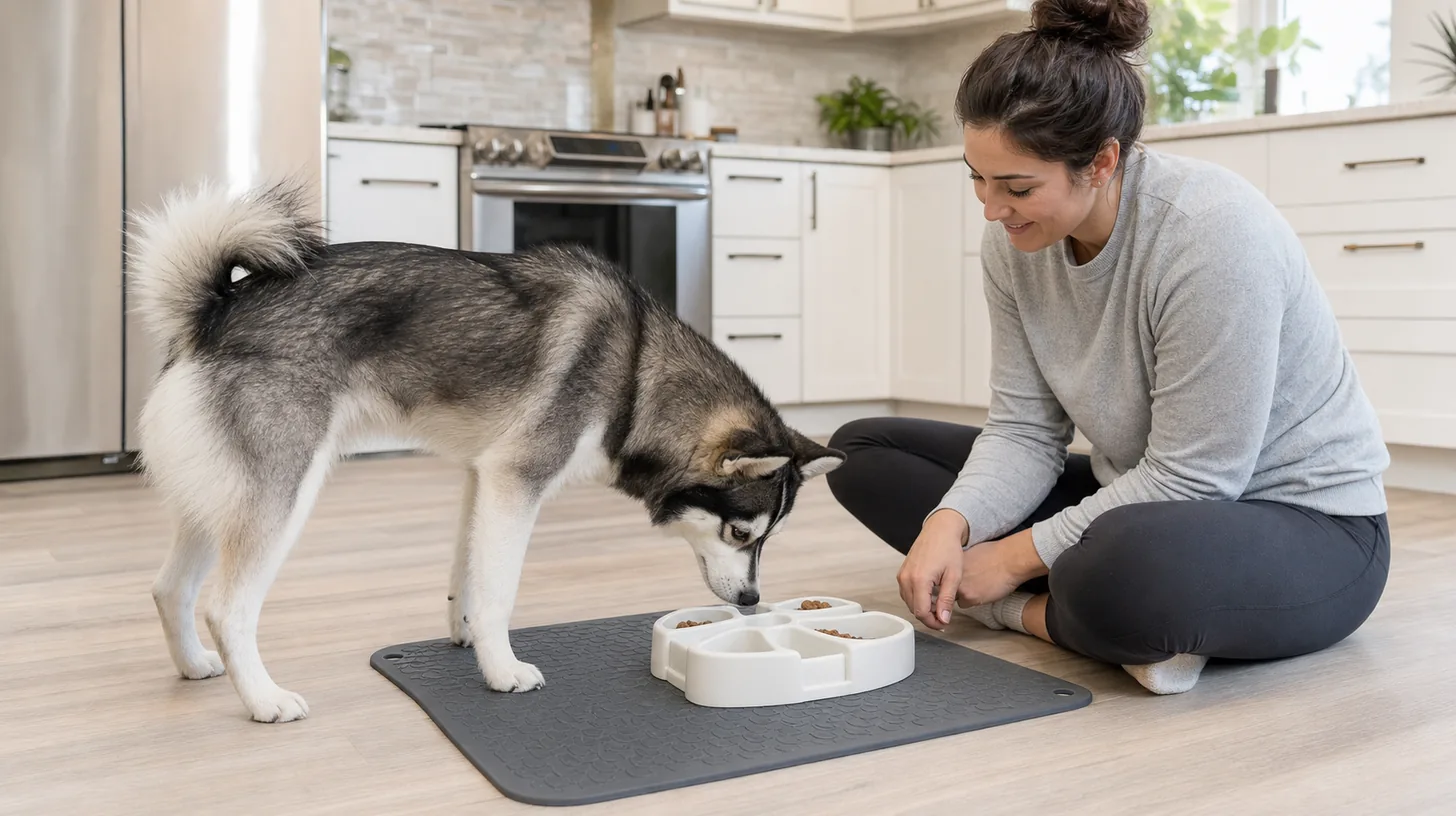
Place the feeder on a level nonslip mat away from stairs, doors, heat sources, furniture gaps, and household traffic.
A second capable adult can verify the boundary during early practice or higher-risk situations. That person should follow the same sequence and avoid adding prompts, handling, or access that changes the task. The shared standard remains calm food finding from an intact feeder while the caregiver observes every interaction. For this page, step 4 is specifically the stabilize the feeding surface check.
If the Pomsky cannot remain comfortable or the equipment and environment cannot remain controlled, end the attempt. Do not proceed through unmeasured extra food, detachable parts, damaged material, frantic pawing, hard chewing, swallowing risk, or another animal entering. Capture food used, configuration, duration, methods attempted, frustration signs, damage, cleanup, and appetite afterward before deciding what changes next. Record the outcome of stabilize the feeding surface separately before moving on.
Make the First Trial Obvious
Leave compartments open or food partly exposed so one gentle nose or paw movement produces success without sustained force.
Perform this check before adding the next variable. The target remains calm food finding from an intact feeder while the caregiver observes every interaction. Work in a quiet single-dog feeding area with a washable nonslip mat and enough room to step away. If the setup cannot preserve that condition, simplify it or stop rather than relying on speed or physical control. For this page, step 5 is specifically the make the first trial obvious check.
The absence of an incident is not proof that the arrangement is sound. Recheck for unmeasured extra food, detachable parts, damaged material, frantic pawing, hard chewing, swallowing risk, or another animal entering. Document food used, configuration, duration, methods attempted, frustration signs, damage, cleanup, and appetite afterward so a later caregiver can distinguish a passed step from one that was skipped. Record the outcome of make the first trial obvious separately before moving on.
Supervise From Within Reach
Watch the mouth, paws, posture, and equipment continuously while allowing the dog enough space to solve the simple task.
Use an observable pass condition: the relevant item is checked, the boundary is closed, and the Pomsky can remain safe without being used as a test. This protects the main objective, calm food finding from an intact feeder while the caregiver observes every interaction, while leaving a clear point at which the caregiver can step back. For this page, step 6 is specifically the supervise from within reach check.
Stop when the expected condition is absent or the situation begins to depend on force, luck, or an open boundary. Specifically avoid unmeasured extra food, detachable parts, damaged material, frantic pawing, hard chewing, swallowing risk, or another animal entering. The follow-up record should cover food used, configuration, duration, methods attempted, frustration signs, damage, cleanup, and appetite afterward. Record the outcome of supervise from within reach separately before moving on.
Change One Difficulty Feature
Close one lid, cover one compartment, or add one easy movement only after the current configuration remains calm and successful.
Keep the sequence repeatable across caregivers. Say what is being checked, complete it, and return equipment and people to neutral before continuing. In this page's context, success means calm food finding from an intact feeder while the caregiver observes every interaction; it does not mean proving that a known risk can be tolerated. For this page, step 7 is specifically the change one difficulty feature check.
Do not convert this step into a stress test. The principal avoidable risks are unmeasured extra food, detachable parts, damaged material, frantic pawing, hard chewing, swallowing risk, or another animal entering. Write down food used, configuration, duration, methods attempted, frustration signs, damage, cleanup, and appetite afterward; a short factual note is more useful than a reassuring guess. Record the outcome of change one difficulty feature separately before moving on.
Separate Other Animals
Feed every pet behind a closed barrier and complete bowl and floor cleanup before opening access between animals.
Treat this as one part of the complete routine, not an isolated trick. The surrounding setup is a quiet single-dog feeding area with a washable nonslip mat and enough room to step away. A clean transition reduces ambiguity and makes it easier to notice when the dog, equipment, environment, or records differ from the previous attempt. For this page, step 8 is specifically the separate other animals check.
If the Pomsky cannot remain comfortable or the equipment and environment cannot remain controlled, end the attempt. Do not proceed through unmeasured extra food, detachable parts, damaged material, frantic pawing, hard chewing, swallowing risk, or another animal entering. Capture food used, configuration, duration, methods attempted, frustration signs, damage, cleanup, and appetite afterward before deciding what changes next. Record the outcome of separate other animals separately before moving on.
Interrupt Unsafe Use Calmly
Trade for food and remove the feeder if the Pomsky bites, flips, guards, breaks, or tries to swallow part of it; do not wrestle over the object.
Pause long enough to inspect the result rather than assuming the action worked. Look at the dog, the physical boundary, and the next movement available to the caregiver. Continue only when the arrangement still supports calm food finding from an intact feeder while the caregiver observes every interaction. For this page, step 9 is specifically the interrupt unsafe use calmly check.
The absence of an incident is not proof that the arrangement is sound. Recheck for unmeasured extra food, detachable parts, damaged material, frantic pawing, hard chewing, swallowing risk, or another animal entering. Document food used, configuration, duration, methods attempted, frustration signs, damage, cleanup, and appetite afterward so a later caregiver can distinguish a passed step from one that was skipped. Record the outcome of interrupt unsafe use calmly separately before moving on.
Clean and Dry Every Component
Follow the current care instructions, remove residue from seams, allow complete drying, and reassemble only after another hardware check.
A second capable adult can verify the boundary during early practice or higher-risk situations. That person should follow the same sequence and avoid adding prompts, handling, or access that changes the task. The shared standard remains calm food finding from an intact feeder while the caregiver observes every interaction. For this page, step 10 is specifically the clean and dry every component check.
Stop when the expected condition is absent or the situation begins to depend on force, luck, or an open boundary. Specifically avoid unmeasured extra food, detachable parts, damaged material, frantic pawing, hard chewing, swallowing risk, or another animal entering. The follow-up record should cover food used, configuration, duration, methods attempted, frustration signs, damage, cleanup, and appetite afterward. Record the outcome of clean and dry every component separately before moving on.
Retire Damage Rather Than Repairing Blindly
Do not rely on tape, glue, improvised fasteners, or a missing piece when the repair could create a chemical, sharp-edge, or ingestion hazard.
Perform this check before adding the next variable. The target remains calm food finding from an intact feeder while the caregiver observes every interaction. Work in a quiet single-dog feeding area with a washable nonslip mat and enough room to step away. If the setup cannot preserve that condition, simplify it or stop rather than relying on speed or physical control. For this page, step 11 is specifically the retire damage rather than repairing blindly check.
Do not convert this step into a stress test. The principal avoidable risks are unmeasured extra food, detachable parts, damaged material, frantic pawing, hard chewing, swallowing risk, or another animal entering. Write down food used, configuration, duration, methods attempted, frustration signs, damage, cleanup, and appetite afterward; a short factual note is more useful than a reassuring guess. Record the outcome of retire damage rather than repairing blindly separately before moving on.
Keep Enrichment in Perspective
Use ordinary bowls, scatter alternatives approved for the environment, training rewards, and non-food activity as appropriate instead of increasing puzzle difficulty indefinitely.
Use an observable pass condition: the relevant item is checked, the boundary is closed, and the Pomsky can remain safe without being used as a test. This protects the main objective, calm food finding from an intact feeder while the caregiver observes every interaction, while leaving a clear point at which the caregiver can step back. For this page, step 12 is specifically the keep enrichment in perspective check.
If the Pomsky cannot remain comfortable or the equipment and environment cannot remain controlled, end the attempt. Do not proceed through unmeasured extra food, detachable parts, damaged material, frantic pawing, hard chewing, swallowing risk, or another animal entering. Capture food used, configuration, duration, methods attempted, frustration signs, damage, cleanup, and appetite afterward before deciding what changes next. Record the outcome of keep enrichment in perspective separately before moving on.
When to Escalate
This routine has a defined boundary. Stop when the Pomsky, caregiver, equipment, records, or environment no longer supports calm food finding from an intact feeder while the caregiver observes every interaction. Do not improvise through unmeasured extra food, detachable parts, damaged material, frantic pawing, hard chewing, swallowing risk, or another animal entering. Seek a veterinarian for dietary, swallowing, dental, gastrointestinal, or appetite concerns and a qualified professional for guarding or severe frustration. Bring the concise observations already recorded rather than recreating the event.
Before the next attempt, review food used, configuration, duration, methods attempted, frustration signs, damage, cleanup, and appetite afterward. Reopen the task only after the physical setup, instructions, and responsible person are clear. A conservative stop is useful information: it prevents a manageable problem from becoming an emergency and gives the appropriate professional a factual starting point.
Sources reviewed
Each source is used only for the claim scopes listed below. None establishes a guaranteed Pomsky outcome or replaces individual professional assessment.
- World Small Animal Veterinary Association: Global Nutrition Guidelines - Supports: nutrition assessment; body condition; individual feeding review. Limit: Not a brand endorsement and not a fixed ration calculator.
- American Veterinary Society of Animal Behavior: Humane Dog Training Position Statement - Supports: reward-based training; aversive-method risk; behavior change principles. Limit: Does not guarantee outcomes for an individual dog.
- American Animal Hospital Association: Lifestyle and Safety Assessment - Supports: appropriate confinement; leash, collar and harness planning; lifestyle-specific safety review. Limit: Equipment selection must account for the individual dog's anatomy, behavior, health, and environment.