Written and reviewed by A Pomsky Editorial Team. Originally published 2026-07-26; substantively reviewed July 26, 2026.
Training boundary: Use humane, reward-based methods and protect safety with management. Pain, panic, aggression, a bite history, or serious handling risk requires a veterinarian or qualified behavior professional. Read the editorial policy.
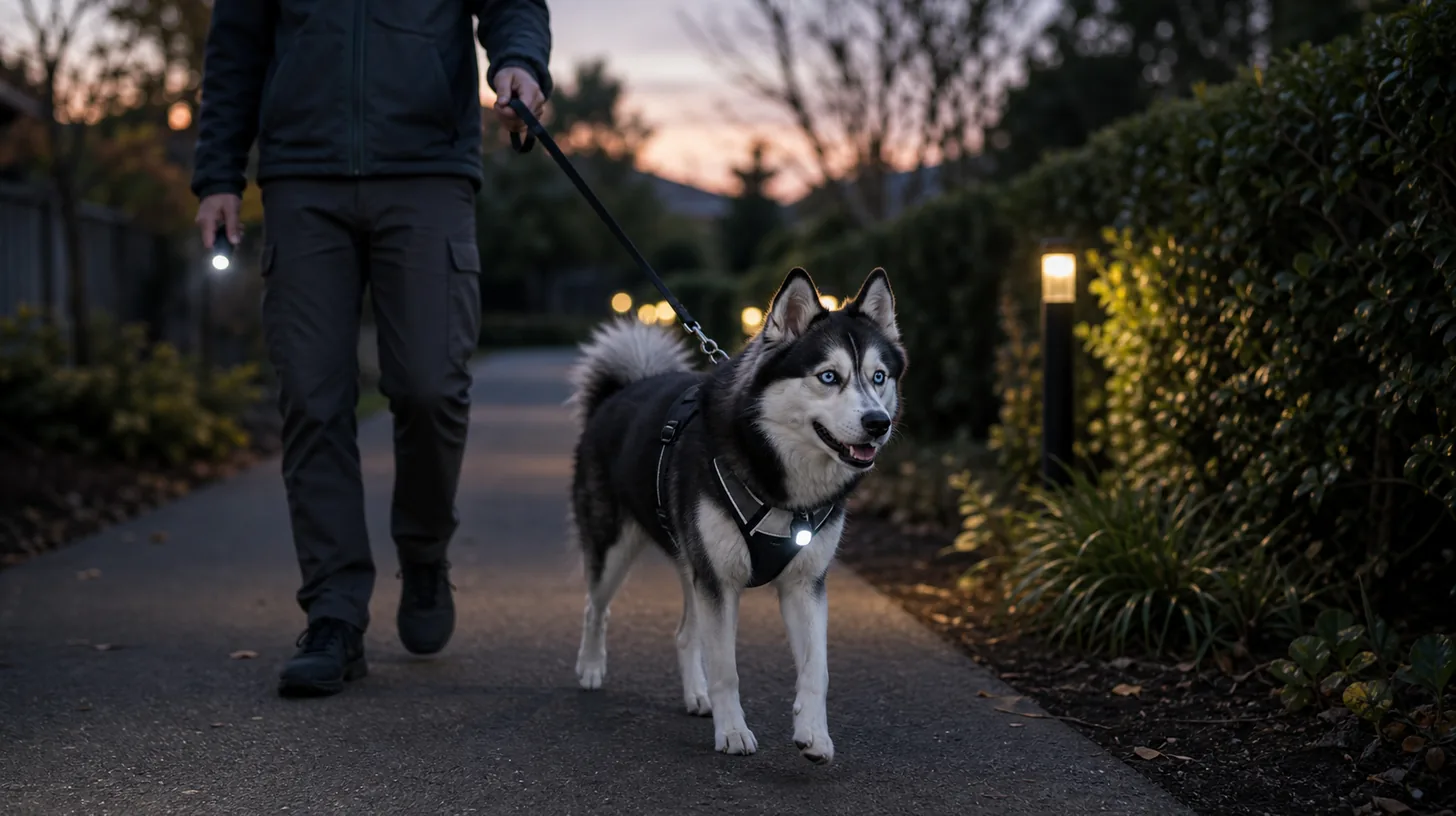
Direct answer: Treat reflective panels and small lights as secondary visibility accessories, not leash attachments or permission to use an unsafe route. Recheck collar or harness fit, inspect every clip, housing, battery door, charging point, and loose part, then view reflection and light from front, rear, and side in a protected dark area. Preserve identification, carry an independent human light, and retire unreliable gear.
Reflective strips and small lights can improve visibility, but they do not make a Pomsky conspicuous from every direction or make a dark route safe. Visibility gear must remain secondary to a fitted collar or harness, secure identification, leash control, human lighting, route choice, and traffic avoidance. The useful inspection occurs in darkness before departure and includes attachment, batteries, loose parts, glare, and failure backup.
Separate Load-Bearing and Visibility Functions
Identify which equipment controls the Pomsky and which accessory only adds visibility so a decorative item never becomes an improvised leash connection.
Use an observable pass condition: the relevant item is checked, the boundary is closed, and the Pomsky can remain safe without being used as a test. This protects the main objective, reliable multi-angle visibility on correctly fitted gear with secure parts and a separate human backup light, while leaving a clear point at which the caregiver can step back. In this routine, step 1 is the separate load-bearing and visibility functions decision.
The absence of an incident is not proof that the arrangement is sound. Recheck for loose batteries, dangling parts, blocked identification, poor fit, false confidence, glare, low visibility angle, charging damage, or relying on one failed light. Document gear identity, fit, reflective zones, light mode, attachment, battery, charging condition, viewing angle, route finding, backup, and retirement decision so a later caregiver can distinguish a passed step from one that was skipped. Record the result of separate load-bearing and visibility functions before continuing.
Recheck Collar or Harness Fit
Inspect current measurements, coat, skin, movement, closures, and escape resistance before adding any reflective cover, clip, band, or light.
Keep the sequence repeatable across caregivers. Say what is being checked, complete it, and return equipment and people to neutral before continuing. In this page's context, success means reliable multi-angle visibility on correctly fitted gear with secure parts and a separate human backup light; it does not mean proving that a known risk can be tolerated. In this routine, step 2 is the recheck collar or harness fit decision.
The absence of an incident is not proof that the arrangement is sound. Recheck for loose batteries, dangling parts, blocked identification, poor fit, false confidence, glare, low visibility angle, charging damage, or relying on one failed light. Document gear identity, fit, reflective zones, light mode, attachment, battery, charging condition, viewing angle, route finding, backup, and retirement decision so a later caregiver can distinguish a passed step from one that was skipped. Record the result of recheck collar or harness fit before continuing.
Inspect Reflective Surfaces in Darkness
Use a controlled beam from several heights and angles to find dirt, folds, wear, blocked panels, and directions from which reflection disappears.
Treat this as one part of the complete routine, not an isolated trick. The surrounding setup is a controlled darkened area away from traffic with the complete walking setup, fresh or verified batteries, backup light, and a second observer when available. A clean transition reduces ambiguity and makes it easier to notice when the dog, equipment, environment, or records differ from the previous attempt. In this routine, step 3 is the inspect reflective surfaces in darkness decision.
The absence of an incident is not proof that the arrangement is sound. Recheck for loose batteries, dangling parts, blocked identification, poor fit, false confidence, glare, low visibility angle, charging damage, or relying on one failed light. Document gear identity, fit, reflective zones, light mode, attachment, battery, charging condition, viewing angle, route finding, backup, and retirement decision so a later caregiver can distinguish a passed step from one that was skipped. Record the result of inspect reflective surfaces in darkness before continuing.
Inspect Every Light Attachment
Check housing, clip, ring, cover, seal, switch, cable, charging port, battery door, small parts, and position for looseness or dog access.
Pause long enough to inspect the result rather than assuming the action worked. Look at the dog, the physical boundary, and the next movement available to the caregiver. Continue only when the arrangement still supports reliable multi-angle visibility on correctly fitted gear with secure parts and a separate human backup light. In this routine, step 4 is the inspect every light attachment decision.
The absence of an incident is not proof that the arrangement is sound. Recheck for loose batteries, dangling parts, blocked identification, poor fit, false confidence, glare, low visibility angle, charging damage, or relying on one failed light. Document gear identity, fit, reflective zones, light mode, attachment, battery, charging condition, viewing angle, route finding, backup, and retirement decision so a later caregiver can distinguish a passed step from one that was skipped. Record the result of inspect every light attachment before continuing.
Verify Battery and Charging Condition
Follow current instructions, inspect for heat, swelling, leakage, corrosion, damaged cables, or incomplete closure, and store spare batteries securely.
A second capable adult can verify the boundary during early practice or higher-risk situations. That person should follow the same sequence and avoid adding prompts, handling, or access that changes the task. The shared standard remains reliable multi-angle visibility on correctly fitted gear with secure parts and a separate human backup light. In this routine, step 5 is the verify battery and charging condition decision.
The absence of an incident is not proof that the arrangement is sound. Recheck for loose batteries, dangling parts, blocked identification, poor fit, false confidence, glare, low visibility angle, charging damage, or relying on one failed light. Document gear identity, fit, reflective zones, light mode, attachment, battery, charging condition, viewing angle, route finding, backup, and retirement decision so a later caregiver can distinguish a passed step from one that was skipped. Record the result of verify battery and charging condition before continuing.
Check Identification Remains Readable
Confirm that tags, contact information, microchip references, and ordinary closures are not covered, tangled, silenced unsafely, or displaced.
Perform this check before adding the next variable. The target remains reliable multi-angle visibility on correctly fitted gear with secure parts and a separate human backup light. Work in a controlled darkened area away from traffic with the complete walking setup, fresh or verified batteries, backup light, and a second observer when available. If the setup cannot preserve that condition, simplify it or stop rather than relying on speed or physical control. In this routine, step 6 is the check identification remains readable decision.
The absence of an incident is not proof that the arrangement is sound. Recheck for loose batteries, dangling parts, blocked identification, poor fit, false confidence, glare, low visibility angle, charging damage, or relying on one failed light. Document gear identity, fit, reflective zones, light mode, attachment, battery, charging condition, viewing angle, route finding, backup, and retirement decision so a later caregiver can distinguish a passed step from one that was skipped. Record the result of check identification remains readable before continuing.
Observe the Pomsky Moving
Watch walking, turning, sitting, sniffing, and looking down for bouncing, rubbing, glare near the eyes, restricted movement, noise, or attempts to chew.
Use an observable pass condition: the relevant item is checked, the boundary is closed, and the Pomsky can remain safe without being used as a test. This protects the main objective, reliable multi-angle visibility on correctly fitted gear with secure parts and a separate human backup light, while leaving a clear point at which the caregiver can step back. In this routine, step 7 is the observe the pomsky moving decision.
The absence of an incident is not proof that the arrangement is sound. Recheck for loose batteries, dangling parts, blocked identification, poor fit, false confidence, glare, low visibility angle, charging damage, or relying on one failed light. Document gear identity, fit, reflective zones, light mode, attachment, battery, charging condition, viewing angle, route finding, backup, and retirement decision so a later caregiver can distinguish a passed step from one that was skipped. Record the result of observe the pomsky moving before continuing.
View the Setup From Road Angles
From a protected area, have another adult observe front, rear, and side visibility at low and higher angles without entering traffic or testing driver reaction.
Keep the sequence repeatable across caregivers. Say what is being checked, complete it, and return equipment and people to neutral before continuing. In this page's context, success means reliable multi-angle visibility on correctly fitted gear with secure parts and a separate human backup light; it does not mean proving that a known risk can be tolerated. In this routine, step 8 is the view the setup from road angles decision.
The absence of an incident is not proof that the arrangement is sound. Recheck for loose batteries, dangling parts, blocked identification, poor fit, false confidence, glare, low visibility angle, charging damage, or relying on one failed light. Document gear identity, fit, reflective zones, light mode, attachment, battery, charging condition, viewing angle, route finding, backup, and retirement decision so a later caregiver can distinguish a passed step from one that was skipped. Record the result of view the setup from road angles before continuing.
Carry an Independent Human Light
Bring a working flashlight or other suitable light and keep the route short enough to return safely after accessory failure.
Treat this as one part of the complete routine, not an isolated trick. The surrounding setup is a controlled darkened area away from traffic with the complete walking setup, fresh or verified batteries, backup light, and a second observer when available. A clean transition reduces ambiguity and makes it easier to notice when the dog, equipment, environment, or records differ from the previous attempt. In this routine, step 9 is the carry an independent human light decision.
The absence of an incident is not proof that the arrangement is sound. Recheck for loose batteries, dangling parts, blocked identification, poor fit, false confidence, glare, low visibility angle, charging damage, or relying on one failed light. Document gear identity, fit, reflective zones, light mode, attachment, battery, charging condition, viewing angle, route finding, backup, and retirement decision so a later caregiver can distinguish a passed step from one that was skipped. Record the result of carry an independent human light before continuing.
Clean Test and Retire After Use
Inspect moisture, impact, dirt, attachment movement, battery state, and damage after every dark outing and retire unreliable equipment.
Pause long enough to inspect the result rather than assuming the action worked. Look at the dog, the physical boundary, and the next movement available to the caregiver. Continue only when the arrangement still supports reliable multi-angle visibility on correctly fitted gear with secure parts and a separate human backup light. In this routine, step 10 is the clean test and retire after use decision.
The absence of an incident is not proof that the arrangement is sound. Recheck for loose batteries, dangling parts, blocked identification, poor fit, false confidence, glare, low visibility angle, charging damage, or relying on one failed light. Document gear identity, fit, reflective zones, light mode, attachment, battery, charging condition, viewing angle, route finding, backup, and retirement decision so a later caregiver can distinguish a passed step from one that was skipped. Record the result of clean test and retire after use before continuing.
When to Stop and Escalate
Stop when the Pomsky, caregiver, equipment, records, or environment no longer supports reliable multi-angle visibility on correctly fitted gear with secure parts and a separate human backup light. Do not improvise through loose batteries, dangling parts, blocked identification, poor fit, false confidence, glare, low visibility angle, charging damage, or relying on one failed light. Seek the veterinary team for skin, eye, gait, or injury concerns and the product manufacturer for current fit, charging, battery, cleaning, and disposal instructions. Bring the factual observations already collected rather than recreating the event.
Before another attempt, review gear identity, fit, reflective zones, light mode, attachment, battery, charging condition, viewing angle, route finding, backup, and retirement decision. Resume only after the responsible person, physical setup, and controlling instructions are clear. A stop is part of the protocol: it preserves useful evidence and prevents uncertainty from becoming exposure.
Keep the Routine Current
Recheck the complete setup whenever the dog, household, product, instructions, environment, or purpose changes. The intended outcome remains reliable multi-angle visibility on correctly fitted gear with secure parts and a separate human backup light, not a perfect-looking performance. Use the newest primary instruction, retain dated records, and retire superseded assumptions so every caregiver begins from the same current plan.
Sources reviewed
Each source is used only for the claim scopes listed below. None establishes a guaranteed Pomsky outcome or replaces individual professional assessment.
- American Animal Hospital Association: Lifestyle and Safety Assessment - Supports: appropriate confinement; leash, collar and harness planning; lifestyle-specific safety review. Limit: Equipment selection must account for the individual dog's anatomy, behavior, health, and environment.
- American Animal Hospital Association: How Can I Discourage My Dog From Running Away? - Supports: secure fencing; leash use; recall foundations; escape-route checks; appropriate activity. Limit: No recall cue or fence design guarantees that an individual dog cannot escape.
- American Kennel Club: Finding and Choosing the Right Dog Collar for Your Dog - Supports: neck measurement; flat-collar fit; routine cleaning and rechecking. Limit: A two-finger check is a starting fit check, not a guarantee against escape, injury, or coat compression.
- American Kennel Club: The Importance of a Well-Fitting Harness - Supports: harness measurement; strap clearance; shoulder movement; escape and chafing checks. Limit: No harness corrects pulling by itself or fits every body shape; pain, rubbing, or gait change needs reassessment.