Written and reviewed by A Pomsky Editorial Team. Originally published 2026-07-26; substantively reviewed July 26, 2026.
Training boundary: Use humane, reward-based methods and protect safety with management. Pain, panic, aggression, a bite history, or serious handling risk requires a veterinarian or qualified behavior professional. Read the editorial policy.
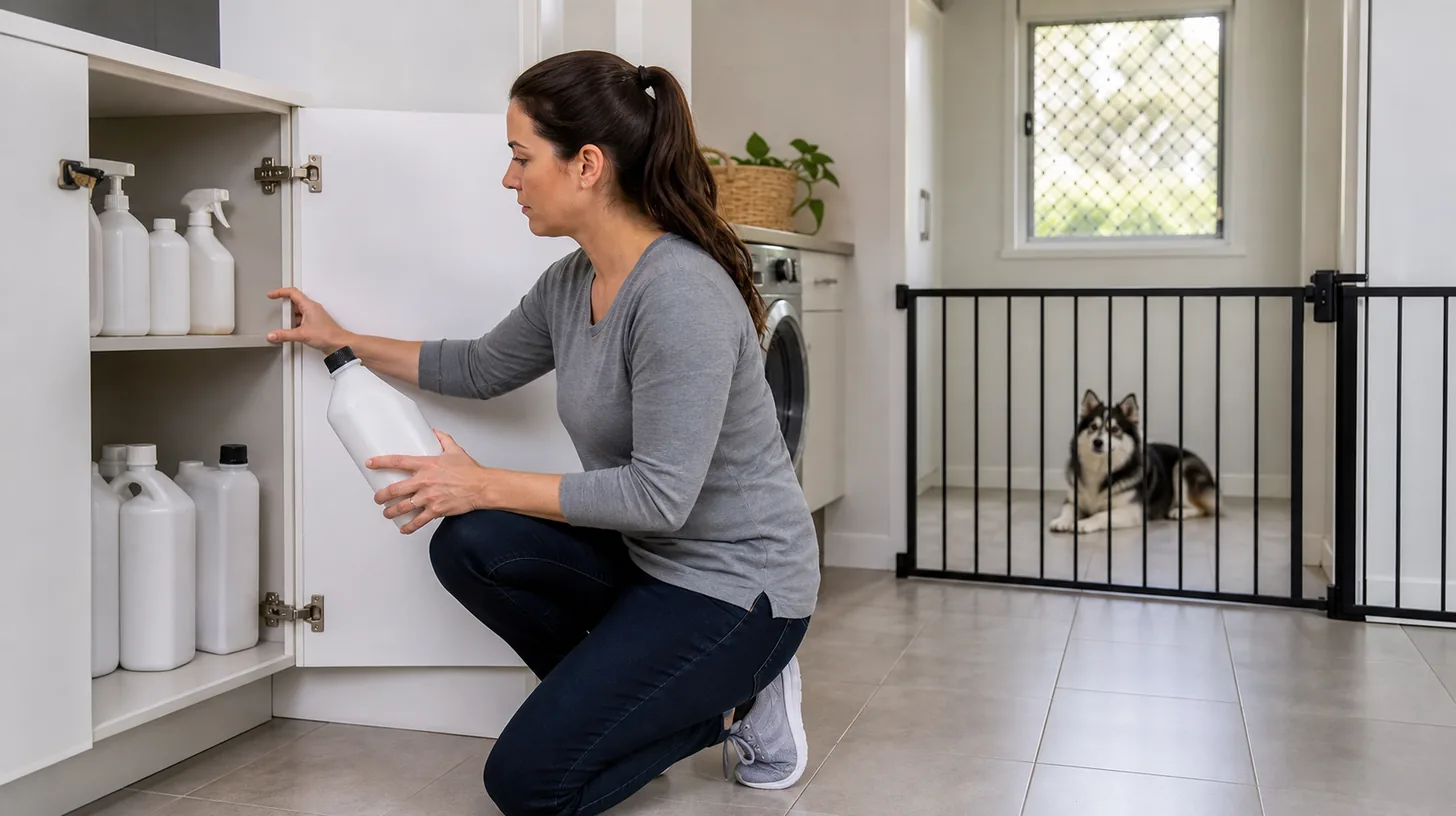
Direct answer: Inventory every cleaning product, preserve original labels, store containers behind a reliable barrier, and move the Pomsky to a separate room before use. Follow the product's ventilation, dilution, rinsing, and reentry directions, secure buckets and waste, and contact veterinary or poison professionals after suspected exposure.
A household cleaning-product audit reduces a Pomsky's access to concentrates, diluted solutions, wet surfaces, buckets, wipes, pods, and waste. It does not label a product safe for pets or replace the manufacturer's directions. Preserve every label, use secure storage, separate the dog during cleaning, and contact veterinary or poison professionals after a suspected exposure.
Inventory Every Cleaning Location
Check the kitchen, bathrooms, laundry area, garage, utility closet, outdoor storage, vehicle, travel kit, and cleaning caddy. Include detergents, disinfectants, toilet products, drain and oven cleaners, floor solutions, solvents, fragrance products, wipes, pods, powders, and unlabeled transferred liquids.
Record the product name, original container, storage location, and whether the closure works. Dispose of unknown or damaged products through current local guidance. Never identify a liquid by color or smell.
Preserve Original Labels and Containers
Keep each product in its original container with readable directions, ingredients or emergency information, and identifying codes. Do not pour cleaners into beverage bottles, food jars, or unmarked spray bottles. A handwritten nickname is not enough during an exposure investigation.
If a working solution must be prepared under the label directions, label the temporary container clearly, keep it under adult control, and empty or store it as directed immediately after use. Do not leave it on the floor or sink edge.
Build Secure Storage
Use a closed cabinet or storage room the Pomsky cannot open. Place concentrated products high enough to reduce spill exposure but not where a leaking container can fall onto food, animal supplies, or people. Secondary containment can help control leaks when compatible with the product.
Child-resistant packaging is not necessarily dog-resistant. Laundry and dishwasher pods, wipes, and small containers can be carried or punctured. Confirm the barrier after every use and keep keys or latches available to responsible adults.
Separate the Pomsky Before Cleaning
Move the Pomsky to a prepared room or gated area before opening products, filling a bucket, spraying, mopping, or cleaning a toilet. Provide water, resting space, and an appropriate activity. The separation should continue until products are closed, tools are stored, waste is removed, and treated surfaces meet label directions for reentry.
Do not ask the dog to stay on a mat beside active cleaning. Sudden movement, splashing, fumes, and dropped wipes are preventable exposures. A physical barrier is clearer than repeated verbal correction.
Follow Product Directions Exactly
Use only the concentration, surface, protective equipment, ventilation, contact time, rinsing, and reentry instructions on the current label. Do not combine products. Mixing can create dangerous reactions for people and animals.
Ventilation needs vary by product and space. Open or operate ventilation only when it does not create an escape route for the Pomsky. If safe use requirements cannot be met, choose another time or obtain appropriate professional guidance.
Control Buckets, Tools, and Wet Surfaces
Keep buckets and basins within reach of the responsible adult and empty them promptly as directed. A diluted solution or dirty rinse water is not drinking water. Store mops, sponges, brushes, gloves, and cloths where the dog cannot lick or chew residue.
Block access to wet floors, bathtubs, toilets, and treated outdoor areas. Slippery surfaces also create fall risk. A product that is dry to the eye may still have a specified rinse or reentry requirement.
Protect Food and Dog Supplies
Remove bowls, food, treats, medication, toys, bedding, grooming tools, and enrichment items before cleaning nearby. Prevent spray drift and wipe storage shelves before replacing supplies when the label requires it. Use separate tools for food-contact and waste areas.
Do not spray a product onto a dog bed, crate, toy, collar, harness, or bowl unless the product directions explicitly cover that use and the veterinarian agrees when medical concerns exist. “Pet friendly” marketing language is not a substitute for directions.
Manage Waste and Laundry
Place used wipes, paper towels, gloves, empty pods, dryer sheets, vacuum debris, and contaminated packaging in a closed waste system. Take trash out without leaving an open bag near the Pomsky. Rinse or dispose of containers only as directed.
Keep laundry sorted and inaccessible before and after washing. Detergent residue, stain products, and small dryer items can create exposure or obstruction risks. Check the washer and dryer before closing and starting them.
Prepare an Exposure Information Kit
Keep the veterinarian, emergency hospital, and recognized animal poison service contacts available. Know the Pomsky's current weight and medications. During cleaning, keep the product container and phone accessible to the adult without placing them near the dog.
If exposure is suspected, move the Pomsky away from further contact without endangering yourself. Record product, amount if known, route, timing, and signs. Follow professional instructions. Do not induce vomiting, give food or liquid, or apply a neutralizing home remedy unless directed for that case.
Recognize Urgent Signs
Breathing difficulty, collapse, seizures, severe weakness, marked eye pain, extensive burns, or other serious signs require urgent veterinary or emergency routing. Do not delay while searching the internet for a product rating.
Less dramatic signs can still matter. Coughing, drooling, vomiting, pawing at the mouth, skin irritation, altered behavior, or repeated licking after cleaning warrants prompt professional advice based on the specific exposure.
Audit Caregivers and Services
Share the storage map, dog-separation rule, approved products, ventilation limits, and emergency contacts with family, pet sitters, house cleaners, and maintenance staff. Ask outside services what they will use before arrival and keep the Pomsky separated from their work area.
Reaudit after moving, changing products, hiring a new service, or discovering a failed latch. The goal is an unbroken prevention system: identified products, preserved labels, secure barriers, controlled use, safe reentry, contained waste, and immediate access to case-specific professional advice.
Run a Five-Minute Pre-Cleaning Brief
Before each cleaning session, name the rooms, products, ventilation method, dog-separation location, reentry condition, waste destination, and responsible adult. Confirm the Pomsky has water and that every person knows not to open the barrier. This brief is especially useful when a cleaner, sitter, or family member joins the routine.
Afterward, one adult closes and stores products, empties controlled liquids as directed, removes waste, checks treated surfaces, restores dog supplies, and announces that reentry conditions are satisfied. Record spills, damaged packaging, failed latches, or unusual dog behavior. A consistent closeout prevents a nearly finished task from leaving the most accessible exposure behind.
Sources reviewed
Each source is used only for the claim scopes listed below. None establishes a guaranteed Pomsky outcome or replaces individual professional assessment.
- ASPCA: Animal Poison Control - Supports: poison emergency routing; information to collect after exposure. Limit: Never replace urgent veterinary or poison-control instructions with article advice.
- U.S. Centers for Disease Control and Prevention: Pet Emergency Checklist - Supports: emergency kit contents; records; identification; transport supplies. Limit: Adapt the checklist to local hazards and the dog's medical needs.
- American Animal Hospital Association: Lifestyle and Safety Assessment - Supports: appropriate confinement; leash, collar and harness planning; lifestyle-specific safety review. Limit: Equipment selection must account for the individual dog's anatomy, behavior, health, and environment.