Written and reviewed by A Pomsky Editorial Team. Originally published 2026-07-26; substantively reviewed July 26, 2026.
Training boundary: Use humane, reward-based methods and protect safety with management. Pain, panic, aggression, a bite history, or serious handling risk requires a veterinarian or qualified behavior professional. Read the editorial policy.
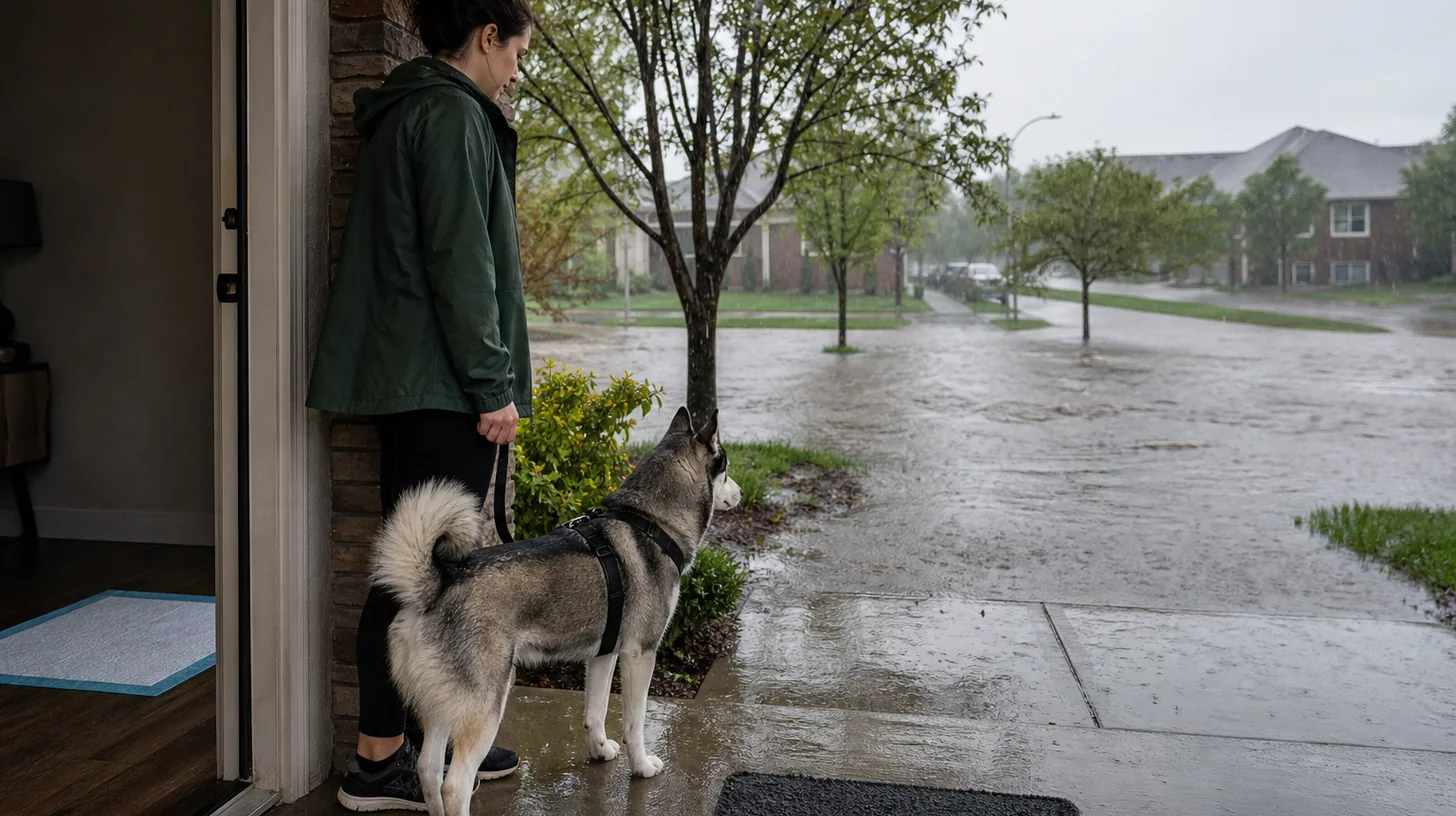
Direct answer: Check current official alerts, lightning, wind, visibility, drainage, traffic, standing or moving water, and a safe return route immediately before leaving. Keep a Pomsky out of all flood water and cancel the walk when weather, contamination, traction, control, or recovery is uncertain; use an indoor toilet or enrichment alternative instead. After ordinary rain exposure, remove wet equipment and clean and dry the dog in a controlled entry area.
Rain alone does not decide whether a Pomsky walk is workable. Visibility, lightning, wind, traffic spray, drainage, moving water, standing water, contamination, surface traction, and route exits can change within minutes. Flood water is not an enrichment opportunity or a test of the dog's coat. The decision begins with current official alerts and keeps an indoor toilet and activity alternative ready.
Check Current Official Alerts
Review local weather, flood, lightning, road, and emergency information immediately before departure because an earlier forecast cannot confirm present conditions.
Pause long enough to inspect the result rather than assuming the action worked. Look at the dog, the physical boundary, and the next movement available to the caregiver. Continue only when the arrangement still supports a timely outdoor cancellation or a brief controlled route that avoids flood water and preserves safe return. In this routine, step 1 is the check current official alerts decision.
Stop when the expected condition is absent or the situation begins to depend on force, luck, or an open boundary. Specifically avoid lightning, moving or standing flood water, hidden debris, contamination, traffic, poor visibility, slippery surfaces, cold stress, forced exposure, or delayed care. The follow-up record should cover alert source and time, rain, lightning, wind, visibility, drainage, route, surface, dog response, exposure, cleanup, and cancellation reason. Record the result of check current official alerts before continuing.
Inspect From a Dry Location
Look for moving water, pooled water, blocked drains, traffic spray, fallen material, unstable branches, poor lighting, and a clear return path without entering the hazard.
A second capable adult can verify the boundary during early practice or higher-risk situations. That person should follow the same sequence and avoid adding prompts, handling, or access that changes the task. The shared standard remains a timely outdoor cancellation or a brief controlled route that avoids flood water and preserves safe return. In this routine, step 2 is the inspect from a dry location decision.
Do not convert this step into a stress test. The principal avoidable risks are lightning, moving or standing flood water, hidden debris, contamination, traffic, poor visibility, slippery surfaces, cold stress, forced exposure, or delayed care. Write down alert source and time, rain, lightning, wind, visibility, drainage, route, surface, dog response, exposure, cleanup, and cancellation reason; a short factual note is more useful than a reassuring guess. Record the result of inspect from a dry location before continuing.
Treat Flood Water as Off Limits
Do not allow wading, drinking, sniffing at the edge, retrieving items, or crossing because depth, current, debris, contamination, and surface condition are uncertain.
Perform this check before adding the next variable. The target remains a timely outdoor cancellation or a brief controlled route that avoids flood water and preserves safe return. Work in a dry indoor departure point with current alerts, route observations, fitted equipment, towels, and an indoor alternative. If the setup cannot preserve that condition, simplify it or stop rather than relying on speed or physical control. In this routine, step 3 is the treat flood water as off limits decision.
If the Pomsky cannot remain comfortable or the equipment and environment cannot remain controlled, end the attempt. Do not proceed through lightning, moving or standing flood water, hidden debris, contamination, traffic, poor visibility, slippery surfaces, cold stress, forced exposure, or delayed care. Capture alert source and time, rain, lightning, wind, visibility, drainage, route, surface, dog response, exposure, cleanup, and cancellation reason before deciding what changes next. Record the result of treat flood water as off limits before continuing.
Assess Visibility and Traffic
Cancel when drivers, cyclists, pedestrians, or the caregiver cannot reliably see and avoid the Pomsky along the complete route.
Use an observable pass condition: the relevant item is checked, the boundary is closed, and the Pomsky can remain safe without being used as a test. This protects the main objective, a timely outdoor cancellation or a brief controlled route that avoids flood water and preserves safe return, while leaving a clear point at which the caregiver can step back. In this routine, step 4 is the assess visibility and traffic decision.
The absence of an incident is not proof that the arrangement is sound. Recheck for lightning, moving or standing flood water, hidden debris, contamination, traffic, poor visibility, slippery surfaces, cold stress, forced exposure, or delayed care. Document alert source and time, rain, lightning, wind, visibility, drainage, route, surface, dog response, exposure, cleanup, and cancellation reason so a later caregiver can distinguish a passed step from one that was skipped. Record the result of assess visibility and traffic before continuing.
Check Wind Lightning and Noise
Keep the Pomsky indoors when lightning, strong wind, falling objects, sudden noise, or distress makes control or recovery unreliable.
Keep the sequence repeatable across caregivers. Say what is being checked, complete it, and return equipment and people to neutral before continuing. In this page's context, success means a timely outdoor cancellation or a brief controlled route that avoids flood water and preserves safe return; it does not mean proving that a known risk can be tolerated. In this routine, step 5 is the check wind lightning and noise decision.
Stop when the expected condition is absent or the situation begins to depend on force, luck, or an open boundary. Specifically avoid lightning, moving or standing flood water, hidden debris, contamination, traffic, poor visibility, slippery surfaces, cold stress, forced exposure, or delayed care. The follow-up record should cover alert source and time, rain, lightning, wind, visibility, drainage, route, surface, dog response, exposure, cleanup, and cancellation reason. Record the result of check wind lightning and noise before continuing.
Choose the Shortest Safe Objective
When ordinary rain remains manageable, use a brief toilet route near home rather than preserving a distance or exercise target.
Treat this as one part of the complete routine, not an isolated trick. The surrounding setup is a dry indoor departure point with current alerts, route observations, fitted equipment, towels, and an indoor alternative. A clean transition reduces ambiguity and makes it easier to notice when the dog, equipment, environment, or records differ from the previous attempt. In this routine, step 6 is the choose the shortest safe objective decision.
Do not convert this step into a stress test. The principal avoidable risks are lightning, moving or standing flood water, hidden debris, contamination, traffic, poor visibility, slippery surfaces, cold stress, forced exposure, or delayed care. Write down alert source and time, rain, lightning, wind, visibility, drainage, route, surface, dog response, exposure, cleanup, and cancellation reason; a short factual note is more useful than a reassuring guess. Record the result of choose the shortest safe objective before continuing.
Use Current Fitted Equipment
Connect the Pomsky before any exterior door opens, keep the leash short enough for the environment, and avoid umbrellas or clothing that impair control or fit.
Pause long enough to inspect the result rather than assuming the action worked. Look at the dog, the physical boundary, and the next movement available to the caregiver. Continue only when the arrangement still supports a timely outdoor cancellation or a brief controlled route that avoids flood water and preserves safe return. In this routine, step 7 is the use current fitted equipment decision.
If the Pomsky cannot remain comfortable or the equipment and environment cannot remain controlled, end the attempt. Do not proceed through lightning, moving or standing flood water, hidden debris, contamination, traffic, poor visibility, slippery surfaces, cold stress, forced exposure, or delayed care. Capture alert source and time, rain, lightning, wind, visibility, drainage, route, surface, dog response, exposure, cleanup, and cancellation reason before deciding what changes next. Record the result of use current fitted equipment before continuing.
Reassess During Every Minute
Turn back after drainage changes, water rises, traction falls, visibility decreases, traffic increases, or the Pomsky shows discomfort or poor recovery.
A second capable adult can verify the boundary during early practice or higher-risk situations. That person should follow the same sequence and avoid adding prompts, handling, or access that changes the task. The shared standard remains a timely outdoor cancellation or a brief controlled route that avoids flood water and preserves safe return. In this routine, step 8 is the reassess during every minute decision.
The absence of an incident is not proof that the arrangement is sound. Recheck for lightning, moving or standing flood water, hidden debris, contamination, traffic, poor visibility, slippery surfaces, cold stress, forced exposure, or delayed care. Document alert source and time, rain, lightning, wind, visibility, drainage, route, surface, dog response, exposure, cleanup, and cancellation reason so a later caregiver can distinguish a passed step from one that was skipped. Record the result of reassess during every minute before continuing.
Clean and Dry After Ordinary Rain
At a dry controlled entry, remove wet equipment, towel the coat and paws gently, inspect for debris or irritation, and prevent access to contaminated runoff.
Perform this check before adding the next variable. The target remains a timely outdoor cancellation or a brief controlled route that avoids flood water and preserves safe return. Work in a dry indoor departure point with current alerts, route observations, fitted equipment, towels, and an indoor alternative. If the setup cannot preserve that condition, simplify it or stop rather than relying on speed or physical control. In this routine, step 9 is the clean and dry after ordinary rain decision.
Stop when the expected condition is absent or the situation begins to depend on force, luck, or an open boundary. Specifically avoid lightning, moving or standing flood water, hidden debris, contamination, traffic, poor visibility, slippery surfaces, cold stress, forced exposure, or delayed care. The follow-up record should cover alert source and time, rain, lightning, wind, visibility, drainage, route, surface, dog response, exposure, cleanup, and cancellation reason. Record the result of clean and dry after ordinary rain before continuing.
Switch to the Indoor Alternative
Use the prepared indoor toilet or low-pressure enrichment plan when outdoor conditions are unsuitable instead of delaying elimination indefinitely or forcing exposure.
Use an observable pass condition: the relevant item is checked, the boundary is closed, and the Pomsky can remain safe without being used as a test. This protects the main objective, a timely outdoor cancellation or a brief controlled route that avoids flood water and preserves safe return, while leaving a clear point at which the caregiver can step back. In this routine, step 10 is the switch to the indoor alternative decision.
Do not convert this step into a stress test. The principal avoidable risks are lightning, moving or standing flood water, hidden debris, contamination, traffic, poor visibility, slippery surfaces, cold stress, forced exposure, or delayed care. Write down alert source and time, rain, lightning, wind, visibility, drainage, route, surface, dog response, exposure, cleanup, and cancellation reason; a short factual note is more useful than a reassuring guess. Record the result of switch to the indoor alternative before continuing.
When to Stop and Escalate
Stop when the Pomsky, caregiver, equipment, records, or environment no longer supports a timely outdoor cancellation or a brief controlled route that avoids flood water and preserves safe return. Do not improvise through lightning, moving or standing flood water, hidden debris, contamination, traffic, poor visibility, slippery surfaces, cold stress, forced exposure, or delayed care. Seek local emergency authorities for flood or weather instructions and veterinary or emergency professionals for injury, breathing change, collapse, ingestion, or concerning exposure. Bring the factual observations already collected rather than recreating the event.
Before another attempt, review alert source and time, rain, lightning, wind, visibility, drainage, route, surface, dog response, exposure, cleanup, and cancellation reason. Resume only after the responsible person, physical setup, and controlling instructions are clear. A stop is part of the protocol: it preserves useful evidence and prevents uncertainty from becoming exposure.
Keep the Routine Current
Recheck the complete setup whenever the dog, household, product, instructions, environment, or purpose changes. The intended outcome remains a timely outdoor cancellation or a brief controlled route that avoids flood water and preserves safe return, not a perfect-looking performance. Use the newest primary instruction, retain dated records, and retire superseded assumptions so every caregiver begins from the same current plan.
Sources reviewed
Each source is used only for the claim scopes listed below. None establishes a guaranteed Pomsky outcome or replaces individual professional assessment.
- U.S. Centers for Disease Control and Prevention: Pet Emergency Preparedness - Supports: evacuation planning; pet records; emergency supplies; disaster readiness. Limit: Local emergency authority instructions take priority.
- American Animal Hospital Association: Lifestyle and Safety Assessment - Supports: appropriate confinement; leash, collar and harness planning; lifestyle-specific safety review. Limit: Equipment selection must account for the individual dog's anatomy, behavior, health, and environment.
- ASPCA: Emergency Care for Your Pet - Supports: heatstroke as a veterinary emergency; emergency clinic planning; professional escalation. Limit: A general article cannot assess stability or replace emergency veterinary examination and treatment.