Written and reviewed by A Pomsky Editorial Team. Originally published 2026-07-26; substantively reviewed July 26, 2026.
Training boundary: Use humane, reward-based methods and protect safety with management. Pain, panic, aggression, a bite history, or serious handling risk requires a veterinarian or qualified behavior professional. Read the editorial policy.
Direct answer: Reinforce voluntary approach to a nonslip portable mat, build only a few seconds of comfortable stationing, and use a clear release. Add neutral caregiver movement and one familiar touch at a time while preserving an opt-out. The mat supports predictability but does not replace veterinary restraint, pain assessment, or urgent care decisions.
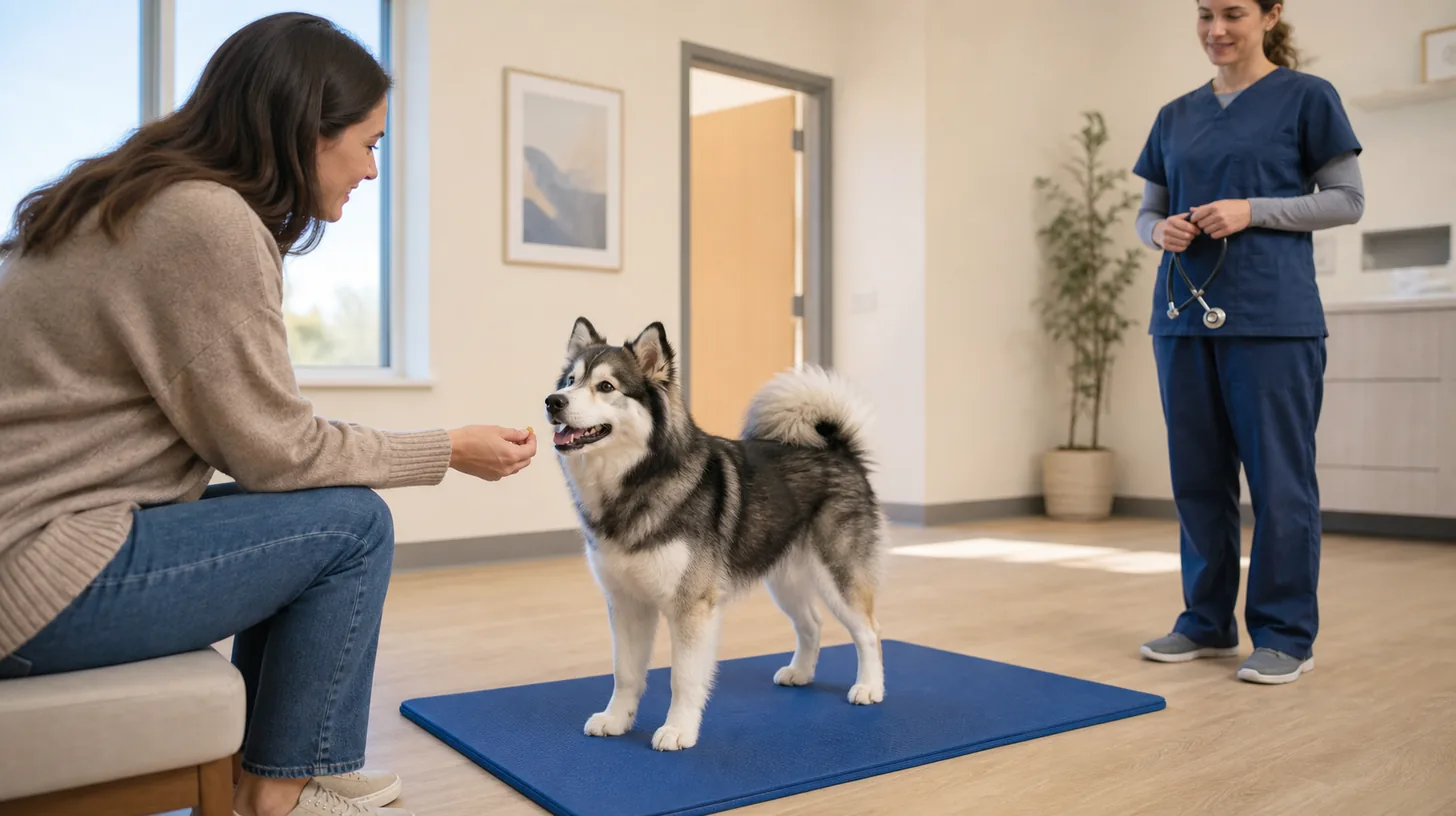
A portable exam mat can give a Pomsky a predictable place to stand, sit, or lie during low-pressure handling practice. The mat is not a restraint device and does not replace veterinary judgment. Its purpose is to make the context clear, reinforce voluntary participation, and help caregivers notice when the dog needs an easier step or a pause.
Select a Stable Portable Mat
Use a mat with a nonslip base, enough room for the Pomsky's normal posture, and a surface that can be cleaned. It should lie flat without curling edges. Avoid placing it on a table, scale, or elevated surface until veterinary staff have confirmed that the setup is safe and the dog has been trained for that location.
Choose one mat primarily for cooperative practice so its meaning stays consistent. Keep rewards ready but out of the dog's reach. Begin in a familiar quiet room where the Pomsky can leave freely. The first sessions should involve no examination or grooming procedure.
Build Voluntary Approach
Place the mat on the floor and mark any calm orientation toward it. Reward beside or on the near edge, then allow the Pomsky to move away. Gradually reinforce one paw, two paws, and eventually all four paws on the surface. Do not lift or push the dog onto the mat.
If the Pomsky avoids the mat, check for odor, texture, movement, or previous associations. A towel or different nonslip surface may be easier. Keep the mat far enough away that the dog can observe without pressure. Voluntary approach is the foundation; duration added to forced placement will not create cooperation.
Establish a Comfortable Station
Once the Pomsky steps onto the mat readily, deliver several small rewards while the dog remains there, then use a release cue and toss a reward away. The release makes leaving part of the exercise and prevents the mat from becoming a trap.
Build duration in seconds. Vary easy repetitions rather than extending every trial. Standing, sitting, or lying can be accepted unless a specific veterinary procedure requires another posture. Watch for shifting away, paw lifting, crouching, freezing, rapid panting, or refusal of food, which may indicate that the session has become difficult.
Add a Cue Without Removing Choice
When mat approach is predictable, say a cue such as “mat,” pause, and then place or indicate the mat. Mark the completed approach and reward. Over time, present the mat in slightly different positions while keeping the floor and surroundings easy.
The cue is an invitation to perform a trained behavior. It should not be repeated while the dog is trying to leave. If the Pomsky declines, reduce the challenge or end the session. A cooperative-care cue loses value when it consistently predicts restraint or an unavoidable procedure.
Introduce Neutral Caregiver Movement
Stand beside the mat, sit in a chair, move one step around the dog, and briefly handle an empty towel or stethoscope-shaped object without touching the Pomsky. Reward the dog for remaining comfortable. Change one movement at a time.
Many dogs are more concerned by leaning over, reaching from behind, or blocking an exit than by the object itself. Keep your body turned slightly sideways, maintain an open path away, and avoid looming. Another person can participate only after learning the same low-pressure mechanics.
Pair One Brief Touch With Reinforcement
Begin with a touch the Pomsky already accepts, such as one second on the shoulder. Mark, remove the hand, reward, and release. Add only one dimension at a time: location, duration, pressure, object, or posture. Do not combine ear lifting, paw holding, and body restraint in one early session.
The mat should predict short, understandable steps. A dog that turns the head toward the hand, steps off, or changes posture is communicating useful information. Stop the touch and reset. Preserving an opt-out can make later participation more reliable and helps prevent the caregiver from overlooking discomfort.
Coordinate With Existing Consent Skills
A trained chin rest can be used on the mat when head positioning is relevant. Paw-handling practice can also begin from the station, but each skill should remain independently clear. The Pomsky should not have to tolerate every type of handling simply because all four feet are on the mat.
Use separate cues and releases. For example, “mat” requests stationing, while a chin-rest cue requests head placement. If either behavior weakens, simplify it outside the combined sequence. Clear components are easier to troubleshoot than one long routine with hidden expectations.
Practice Equipment and Locations Carefully
Introduce a towel, brush, empty syringe without a needle, scale, or other safe object at a distance before bringing it near the dog. Actual medical instruments and procedures belong to trained veterinary staff. Never simulate painful treatment or administer medication merely as a training exercise.
Take the familiar mat to the parked car, clinic parking area, or another quiet location only when the Pomsky is comfortable there. A veterinary lobby or examination room may add substantial difficulty. Ask the clinic whether a low-traffic practice visit is appropriate and follow its infection-control and safety rules.
Prepare a Veterinary Handoff
Tell veterinary staff what the mat cue means, what posture the Pomsky offers, which handling steps have been practiced, and what signs indicate a pause. Bring high-value rewards if medically appropriate and the clinic approves them. Do not promise that training will eliminate the need for professional restraint, sedation, or another safety plan.
Veterinary teams must balance welfare, diagnostic need, time, and safety. A mat can improve predictability, but urgent care may require a different approach. Discuss severe fear, bite history, pain, or previous difficult visits before arrival so the team can plan appropriately.
Track Comfort Rather Than Endurance
Record the location, mat response, duration, touch or object introduced, body-language changes, and recovery. Progress means the Pomsky approaches willingly, can perform a small known step, and returns to ordinary behavior afterward. Remaining motionless is not by itself proof of comfort.
Stop and seek veterinary advice when handling sensitivity appears suddenly, is localized, or accompanies limping, appetite change, vocalization, or other illness signs. Qualified reward-based behavior support may be appropriate for persistent fear. Cooperative exam mat training should reduce avoidable pressure, not hide pain or force compliance.
Sources reviewed
Each source is used only for the claim scopes listed below. None establishes a guaranteed Pomsky outcome or replaces individual professional assessment.
- American Animal Hospital Association: Humane Restraint of Animals - Supports: least-stress handling; basket muzzle preparation; positive behavior modification. Limit: Does not authorize forceful restraint or replace veterinary handling decisions.
- American Veterinary Society of Animal Behavior: Humane Dog Training Position Statement - Supports: reward-based training; aversive-method risk; behavior change principles. Limit: Does not guarantee outcomes for an individual dog.