Written and reviewed by A Pomsky Editorial Team. Originally published 2026-07-26; substantively reviewed July 26, 2026.
Training boundary: Use humane, reward-based methods and protect safety with management. Pain, panic, aggression, a bite history, or serious handling risk requires a veterinarian or qualified behavior professional. Read the editorial policy.
Direct answer: Check equipment before leaving the unit, pause at blind thresholds, wait back from elevator doors, and let passengers exit first. Skip crowded cars or unfamiliar dogs, position the Pomsky clear of door seams, avoid confined greetings, and move away promptly after exiting. Use an approved retreat or alternate route whenever safe distance cannot be maintained.
Apartment elevators and lobbies compress doors, people, dogs, carts, noise, and blind corners into a small shared route. A Pomsky does not need to greet anyone to use that route successfully. The household needs a repeatable routine: inspect equipment, pause at thresholds, create distance, skip crowded cars, protect paws and leash from doors, and choose another exit when conditions are unsuitable.
Prepare Before Leaving the Unit
Fit the Pomsky's current harness or collar and leash, verify identification, and inspect clips and straps. Carry rewards and any cleanup supplies without overloading the leash hand. Check building notices, elevator outages, and severe weather before opening the door.
Listen through the door and use a peephole when available. A quiet pause can prevent a sudden collision with a neighbor, dog, cart, or worker.
Use a Controlled Unit Exit
Ask for the established door-wait behavior, open only enough to inspect, and move through when the hall is clear. Keep the leash short enough to prevent a blind rush but not tight. Close and lock the unit door before proceeding.
If another dog or person is immediately outside, close the door and wait. Do not force a narrow pass to stay on schedule.
Approach Blind Corners With Space
Walk on the side that gives the caregiver the earliest view, and slow before corridor intersections, stair doors, mail areas, and trash rooms. Avoid letting the Pomsky lead around a blind corner at full leash length.
Use a planned retreat point, such as a wider corridor section or the unit doorway. An emergency U-turn can help only when the exit direction is itself clear.
Wait for the Elevator Safely
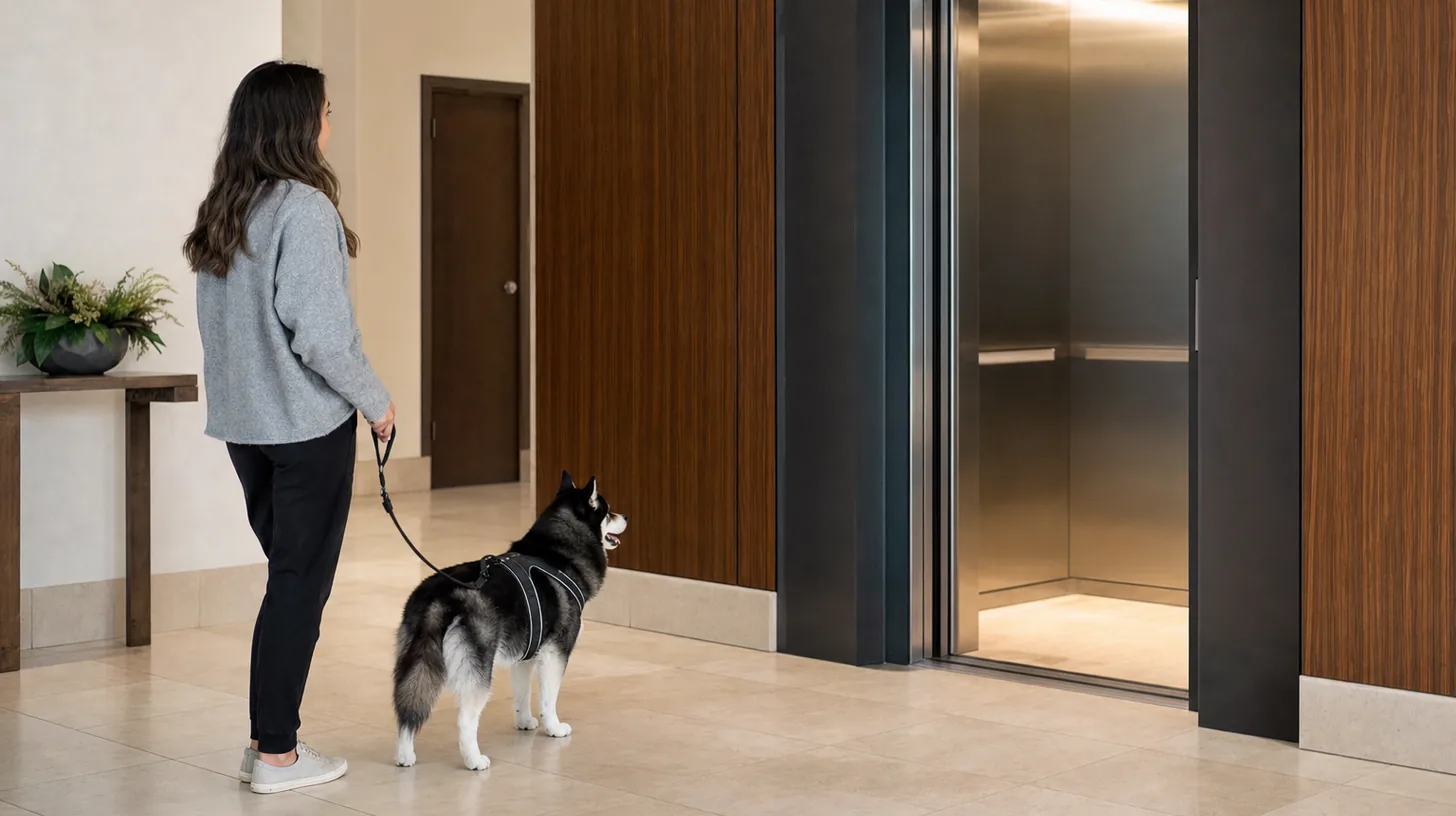
Stand back from the door rather than directly in front of it. Position the Pomsky away from the opening seam and give exiting passengers priority. Keep the leash and tail clear of door edges.
Do not allow nose-to-door waiting. The arriving car may contain a dog, mobility device, bicycle, luggage, or maintenance equipment. Distance gives the caregiver time to decline the ride.
Decide When to Skip a Car
Skip an elevator that is crowded, contains an unfamiliar dog, has loose objects, shows a spill, or does not leave enough space for safe positioning. Let the doors close and call another car. Convenience is not a reason to create a confined greeting.
If repeated cars are unsuitable, return to the unit or use an approved alternative. Do not hold doors while negotiating with another handler.
Enter and Position Deliberately
Enter together after the car is empty enough and the floor is safe. Move the Pomsky fully across the threshold before turning. Stand away from the control panel and door track, with the dog beside or behind the caregiver rather than spanning the doorway.
Keep the leash organized and visible. Avoid loops around legs, equipment, or another passenger. Do not attach the leash to elevator fixtures.
Share the Car Without Greetings
Offer a calm station close to the caregiver and reinforce disengagement from people and objects. Politely decline petting when space is limited. The Pomsky is not required to interact with neighbors.
If another passenger enters unexpectedly and safe distance disappears, exit at the next safe floor or use the emergency plan appropriate to the building. Do not correct the dog for communicating discomfort.
Exit Through a Clear Doorway
Check the opening before moving. Let blocking passengers leave, then cross the threshold together without rushing. Move several steps away so the Pomsky is not standing where the doors close or where the next group gathers.
Pause before entering the lobby. Glass doors, street exits, delivery carts, and waiting dogs can create a second blind transition immediately after the elevator.
Navigate the Lobby
Choose the widest route, avoid reception and package congestion, and create distance from doorways. Do not permit greetings beside exterior doors. Keep the Pomsky under adult control while automatic doors cycle.
If the lobby is crowded, return to the elevator or wait in a protected area allowed by the building. Follow property rules and accessibility needs without blocking shared travel.
Evaluate the Stairs Separately
Stairs may be an alternative only when permitted and physically suitable for both dog and caregiver. Consider traction, lighting, door security, number of flights, current mobility, and who may be entering from the other side.
Do not assume stairs are safer during pain, fatigue, recovery, or a building emergency. Veterinary guidance may be needed for individual movement limits, and building emergency instructions take priority.
Practice at Quiet Times
Rehearse individual parts when traffic is low: unit exit, hall pause, waiting distance, entering an empty car, position, and exit. Reward calm movement and finish before the Pomsky becomes overwhelmed.
Do not arrange close encounters as practice. Difficulty should grow through ordinary conditions at safe distances, one variable at a time.
Record Recurring Problems
Note time, location, crowding, dogs, noises, door behavior, recovery, and the route that worked. Patterns can support schedule changes, a different elevator bank, or a wider lobby path.
Persistent panic, lunging, escape attempts, or inability to recover warrants veterinary and qualified reward-based behavior support. The solution may include management changes rather than more exposure.
Maintain a Building-Specific Plan
Update the routine after moving, construction, elevator service changes, a new pet, mobility change, or revised building rules. Share the plan with capable dog walkers and sitters, including where to retreat and when to abandon the trip.
The successful routine is uneventful: equipment is checked, thresholds are scanned, crowded cars are skipped, the Pomsky remains clear of doors, and the caregiver chooses distance over forced interaction.
Run a Final Door-to-Street Check
Before treating the routine as established, walk through it at a quiet time with one adult observing rather than handling. Confirm the unit door closes, the retreat point remains usable, the dog can wait away from the elevator seam, the leash stays clear, and the lobby exit does not create an uncontrolled pull toward the street. Repeat after construction or layout changes. Stop the rehearsal if another dog, crowd, spill, alarm, or equipment fault changes the setting. The building route is successful only while each transition remains physically manageable.
Sources reviewed
Each source is used only for the claim scopes listed below. None establishes a guaranteed Pomsky outcome or replaces individual professional assessment.
- American Veterinary Society of Animal Behavior: Humane Dog Training Position Statement - Supports: reward-based training; aversive-method risk; behavior change principles. Limit: Does not guarantee outcomes for an individual dog.
- American Animal Hospital Association: How Can I Discourage My Dog From Running Away? - Supports: secure fencing; leash use; recall foundations; escape-route checks; appropriate activity. Limit: No recall cue or fence design guarantees that an individual dog cannot escape.
- American Animal Hospital Association: Lifestyle and Safety Assessment - Supports: appropriate confinement; leash, collar and harness planning; lifestyle-specific safety review. Limit: Equipment selection must account for the individual dog's anatomy, behavior, health, and environment.