Written and reviewed by A Pomsky Editorial Team. Originally published 2026-07-26; substantively reviewed July 26, 2026.
Safety boundary: This guide is educational and cannot diagnose, treat, or replace veterinary, medical, public-health, emergency-dispatch, animal-control, or jurisdiction-specific legal guidance. Use the health disclaimer and contact the appropriate professional for the actual situation.
Direct answer: Preserve the Pomsky’s core routine, update identification, keep one familiar safe area during packing, and use a dedicated moving-day containment and handler plan. Pet-proof the destination before entry, introduce rooms and toilet routes gradually, and rebuild neighborhood and alone-time routines without assuming a fixed adjustment timetable.
Start the move plan before boxes appear
Map the Pomsky’s current routine before changing it. Record meal, toilet, walk, medication, play, training, and rest times, plus the locations where the dog settles most easily. Decide which parts can remain stable through packing and moving day. Familiar timing and predictable handlers reduce unnecessary change even when the physical environment is changing.
Update identification and microchip registration with the new address and current phone numbers. Save a recent photo, veterinary records, medication instructions, and destination clinic contacts in a travel folder. Check local licensing, vaccination, building, and leash requirements. If the move crosses borders, verify current government and carrier rules early rather than relying on a moving-company checklist.
Introduce packing without removing every safe place
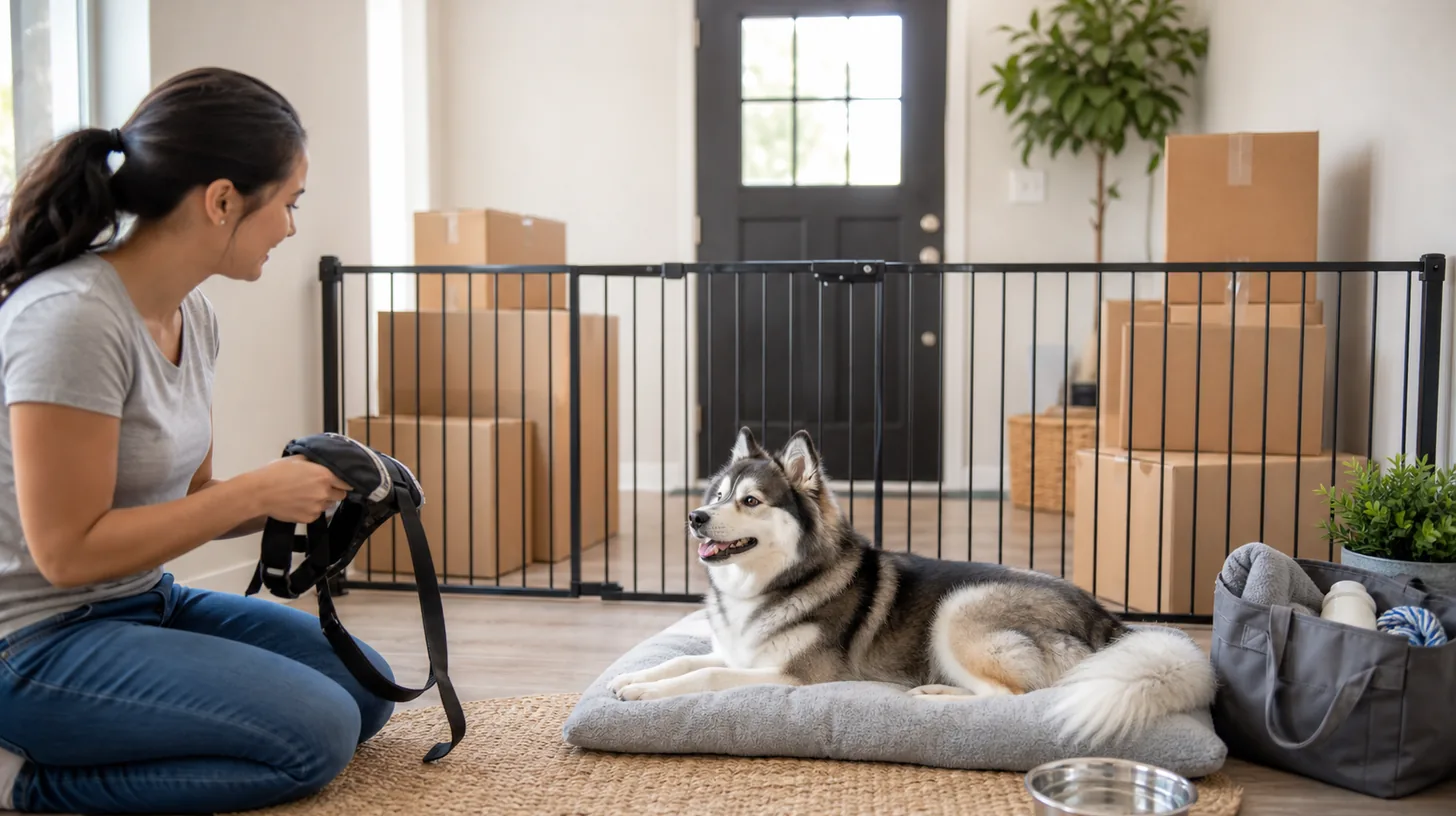
Bring out a few boxes at a time and reward calm investigation. Keep at least one familiar bed, water location, and quiet retreat available until the final day. Avoid stacking boxes where they can fall, narrowing escape routes, or blocking the dog’s normal toilet exit. Secure tape, string, packing peanuts, cleaning products, and small hardware because they can become ingestion or injury hazards.
Maintain ordinary walks and rest as closely as practical. If visitors, agents, or contractors enter the home, use a closed room, gate, or conditioned carrier rather than expecting the dog to manage repeated door traffic. Do not punish barking or following behavior caused by disruption. Adjust distance, add predictable settling practice, and arrange care away from the house when activity is too intense.
Build a moving-day containment plan
Moving day has open doors, unfamiliar people, noise, and objects in motion. Assign one adult to the dog or arrange a verified off-site caregiver. If the Pomsky remains at home, use a quiet locked room or secure conditioned enclosure with water, familiar bedding, and a clear sign for movers. A second barrier between the dog and the exterior door reduces escape risk.
Fit the collar or harness and inspect hardware before loading begins. Keep visible identification attached and the leash under adult control during every transfer. Never tether the dog near vehicles or leave it loose while doors are open. Pack food, water, medication, waste bags, records, and a resting mat in a clearly labeled bag that travels with the household, not inside an inaccessible moving truck.
Travel using the existing safety routine
Use the restraint method the dog has already practiced, such as a correctly fitted secured carrier or vehicle restraint appropriate to the individual and equipment instructions. Plan toilet and water stops in secure locations. Do not open a carrier or vehicle door until the leash is attached and the surroundings are checked. Avoid changing food or introducing untested calming products during the trip.
Monitor temperature, breathing, posture, vomiting, and distress. Never leave the dog in a parked vehicle. For long-distance or air travel, obtain individualized veterinary advice and verify current carrier and destination rules. If the Pomsky has motion sickness, panic, or medical limitations, address those before moving day; the trip itself is not the time to test an improvised solution.
Pet-proof the new home before exploration
Before the dog enters, inspect exterior doors, windows, balcony rails, gates, fences, stairs, cords, chemicals, pest products, plants, construction debris, and objects left by previous occupants. Confirm that every household member knows which doors must remain closed. Check the yard on leash first, including gaps under fences and access to neighboring animals.
Set up water, food, bed, and a quiet zone using familiar items and a layout similar to the previous home when possible. Keep unpacking materials out of reach. Begin with one or two rooms rather than opening the entire home. A leash indoors can guide calm exploration, but it must remain supervised and should not be used to pull the dog toward frightening areas.
Rebuild toilet and neighborhood routines
Take the Pomsky to the chosen toilet area on leash after arrival, after sleep, after meals, and more frequently than usual during the first days. Reward elimination in the correct location. Temporary accidents can reflect schedule and environmental change; clean them without punishment and increase supervision. Contact a veterinarian if accidents are accompanied by pain, straining, unusual thirst, diarrhea, or other health changes.
Walk the new neighborhood at quiet times. Start with short routes and identify traffic, loose dogs, wildlife, road salt, hot pavement, and noisy construction. Keep distance from overwhelming triggers and use the same cues and equipment practiced before the move. Gradually add route length and busier times only while the dog remains able to eat, sniff, and recover.
Reintroduce alone time and household rules
Do not assume home-alone behavior transfers immediately to a new building. Practice very short absences after the dog can settle in the new space. Use a camera only within privacy and legal boundaries, and return before pacing, howling, scratching, or panic escalates. Arrange supervision if work requires a long departure before the dog is ready.
Keep household rules consistent about furniture, doors, sleeping areas, and feeding. If a rule must change, teach a clear replacement behavior with rewards and management. Every adult should use the same cues and release words. Children should not be responsible for exterior doors or leash transfers during the adjustment period.
Monitor adjustment without using a fixed timetable
There is no universal number of days for a Pomsky to “settle.” Track appetite, water, stool, sleep, play, vocalization, recovery after walks, and willingness to rest. Improvement should be assessed against the individual dog’s baseline. Avoid forcing greetings, crowded outings, or a housewarming event as a test of adaptation.
Seek veterinary help for illness, marked appetite loss, persistent gastrointestinal signs, pain, or sudden behavior change. Seek qualified reward-based behavior help for escalating fear, aggression, escape attempts, or separation distress. A careful move plan preserves familiar anchors while the environment changes; it cannot guarantee that every dog will adjust on a predetermined schedule.
Review the plan two weeks after arrival and again after the busiest unpacking is finished. Confirm identification, gates, fence checks, local records, walking routes, alone-time comfort, and access to veterinary care. Remove temporary hazards rather than allowing boxes and tools to become permanent obstacles. A documented review catches problems that were easy to miss during the move itself.
Sources reviewed
Each source is used only for the claim scopes listed below. None establishes a guaranteed Pomsky outcome or replaces individual professional assessment.
- American Kennel Club: Moving With a Dog: Best Practices for a Seamless Move - Supports: routine preservation during a move; moving-day containment; new-home pet proofing and gradual orientation. Limit: General transition advice does not diagnose anxiety or guarantee a stress-free move.
- American Animal Hospital Association: Lifestyle and Safety Assessment - Supports: appropriate confinement; leash, collar and harness planning; lifestyle-specific safety review. Limit: Equipment selection must account for the individual dog's anatomy, behavior, health, and environment.