Written and reviewed by A Pomsky Editorial Team. Originally published 2026-07-26; substantively reviewed July 26, 2026.
Training boundary: Use humane, reward-based methods and protect safety with management. Pain, panic, aggression, a bite history, or serious handling risk requires a veterinarian or qualified behavior professional. Read the editorial policy.
Direct answer: Prepare dog-free cat resources and reliable elevated escape routes before the animals meet. Begin with scent exchange and space rotation, then use secure barriers at a distance where both animals can eat, move, and disengage. Prevent every chase, keep direct sessions brief and supervised, and pause for professional help after fixation, barrier breaches, contact, or sustained stress.
Introduce a Pomsky to a resident cat through separation, scent, protected visual access, and short supervised sessions. The cat needs reliable elevated and dog-free escape routes; the dog needs management that prevents chasing. Progress depends on both animals remaining able to eat, move, and disengage, not on completing a fixed timetable.
Start With Separate Safe Zones
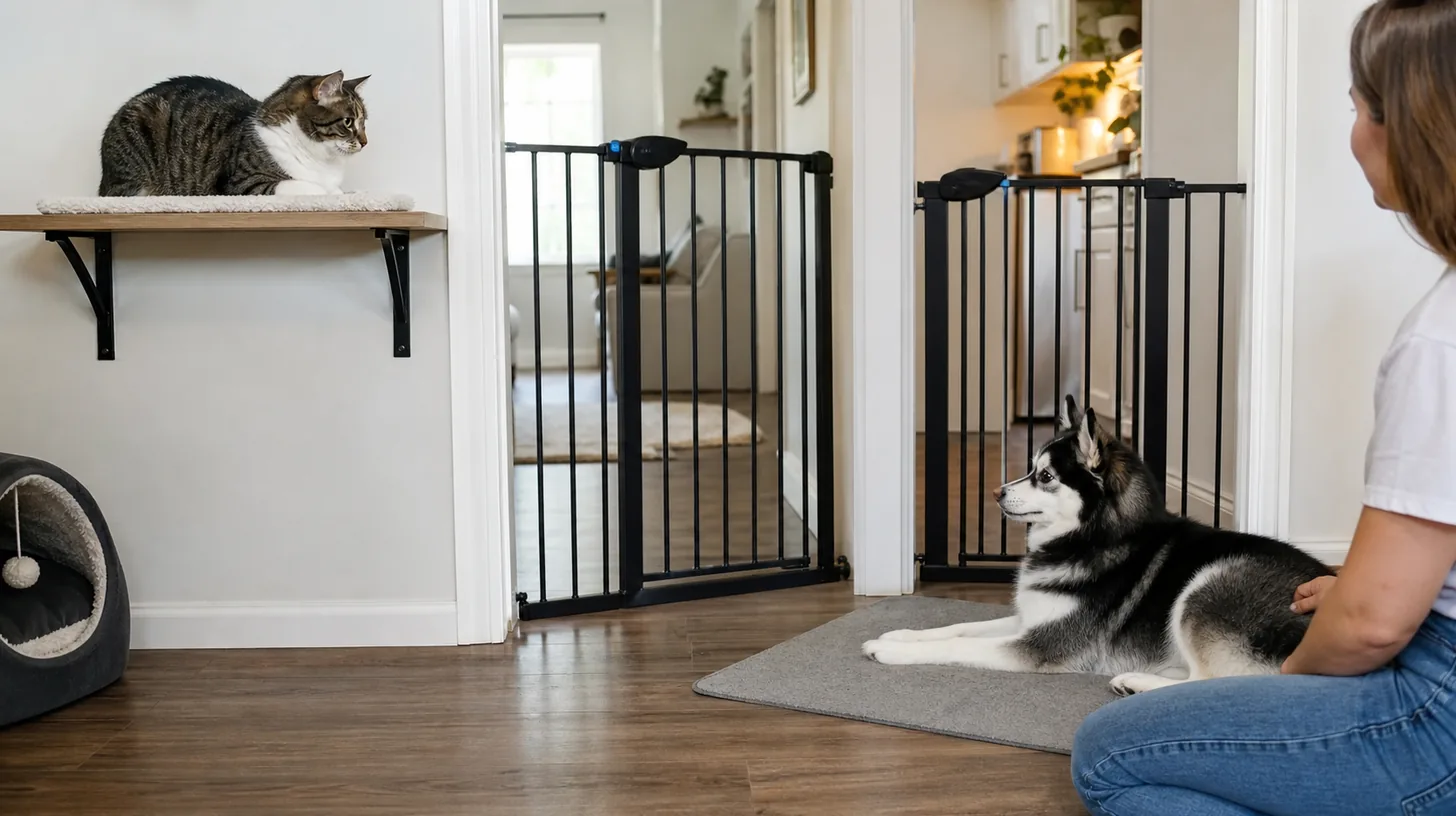
Before the animals see each other, create a closed dog area and a cat area with food, water, resting places, hiding options, and litter facilities. The cat must be able to reach essential resources without passing the Pomsky. Use doors and tall, secure barriers that neither animal can push through.
Inspect gaps, furniture routes, and gate height. A Pomsky may jump or squeeze through an arrangement that appears adequate. A cat escape shelf must be stable and easy to access from more than one direction. Separation is an active safety layer, not a punishment.
Assess Each Animal's Starting Point
Record how the Pomsky responds to movement, small animals outdoors, barriers, and interrupted access. Record whether the cat hides, approaches barriers, eats, plays, and uses the litter box normally. Do not provoke either animal to “test prey drive” or tolerance.
Age, health, pain, mobility, previous experience, and current stress can affect the introduction. A cat with limited jumping ability needs floor-level escape routes. A Pomsky with intense fixation, chasing history, or poor recovery may require professional planning before visual contact.
Exchange Scent Without Confrontation
Move bedding or a clean cloth carrying ordinary scent between safe zones, placing it at a distance where the receiving animal can investigate or ignore it. Pair calm investigation with a familiar valued activity. Remove the item if either animal avoids the area or becomes persistently vigilant.
Do not rub one animal with the other’s bedding or place scent beside food when it causes hesitation. Scent exchange is a low-pressure information step, not a requirement to approach. Continue normal individual routines so the new scent does not predict loss of attention or resources.
Rotate Spaces Safely
When both animals can remain settled, allow the cat to explore the dog’s empty area while the Pomsky is secured elsewhere, then reverse the arrangement if safe. Check every door before moving an animal. This lets each animal investigate scent and layout without direct pressure.
Keep food bowls, litter, and high-value items separate. Do not allow the dog to access the litter box or cat food. Space rotation should be brief and optional. If either animal marks, stops eating, or remains agitated afterward, return to ordinary separation and adjust the setup.
Begin Protected Visual Access
Use a secure gate arrangement that prevents contact. In some homes, two barriers with space between them are safer than one. Start at a distance where the Pomsky can look and turn away and the cat can remain, retreat, or move above floor level.
Reward the dog for voluntary orientation back to the handler, relaxed movement, and disengagement. Give the cat food or play only if the cat chooses to participate. End before staring, stalking posture, barrier rushing, swatting, or sustained hiding develops. Cover the barrier between sessions.
Prevent Chasing Rehearsal
Chasing can become more likely each time it is practiced. Use a leash attached to a well-fitted harness during early same-room work, while maintaining a clear cat escape route and a second physical barrier nearby. The leash is a backup, not a tool for corrections.
Do not hold the cat, place the cat in a small carrier for the dog to inspect, or allow a “quick sniff” at close range. A trapped cat cannot create distance, and a restrained Pomsky may become more frustrated. Distance and voluntary disengagement are central safety measures.
Progress to Short Shared-Room Sessions
Begin with the Pomsky engaged in an easy station or scatter activity at one side of a large room while the cat has access to elevated routes. Use two adults when possible: one observes the dog and one protects the cat’s choices. Keep the first sessions very short.
Increase freedom only after repeated calm sessions. Change one variable at a time, such as leash slack, room size, or cat movement. Do not remove barriers simply because both animals rested once. Movement at a different time of day may produce a different response.
Manage Resources and Daily Traffic
Feed separately behind closed doors. Provide multiple water locations, resting areas, and passage routes. Prevent the Pomsky from guarding doorways, beds, toys, people, or access to the cat. Avoid crowding during arrivals, cooking, play, and nighttime routines.
Supervision means an attentive adult is able to intervene with barriers and distance. Being elsewhere in the home is not supervision. When no adult can watch, return to secure separation until the household has extensive evidence that shared access is safe.
Read Stress and Recovery in Both Animals
For the Pomsky, watch for hard staring, weight shift forward, closed mouth, stalking, trembling, whining, barrier frustration, or inability to respond. For the cat, watch for crouching, flattened ears, tail lashing, prolonged hiding, reduced eating, litter changes, or blocked routes.
End the session by increasing distance, not by scolding. Record trigger distance, movement, recovery time, and which management worked. Improvement includes easier disengagement and normal behavior after a session. Quietness alone does not prove comfort.
Know When to Pause or Seek Help
Stop direct work after any chase, contact, injury, repeated barrier breach, intense fixation, or sustained stress. Separate the animals securely and avoid staging another encounter to see whether it happens again. Injuries require appropriate veterinary care.
A qualified reward-based behavior professional can assess the environment and design safer steps. Some dog-cat pairings require lifelong separation, and safety matters more than a shared-room goal. The general question of whether Pomskies can live with cats cannot predict this specific dog, cat, home, or management capacity.
Review the physical setup after furniture moves, visitors, illness, or changes in mobility. A route that worked yesterday may become blocked by a closed door or moved chair. Confirm that every caregiver understands the separation plan and that emergency contacts know both animals live in the home.
Sources reviewed
Each source is used only for the claim scopes listed below. None establishes a guaranteed Pomsky outcome or replaces individual professional assessment.
- American Veterinary Society of Animal Behavior: Puppy Socialization Position Statement - Supports: puppy socialization window; safe exposure; puppy classes. Limit: Vaccination and exposure decisions still require the puppy's veterinarian.
- American Veterinary Society of Animal Behavior: Humane Dog Training Position Statement - Supports: reward-based training; aversive-method risk; behavior change principles. Limit: Does not guarantee outcomes for an individual dog.