Written and reviewed by A Pomsky Editorial Team. Originally published 2026-07-26; substantively reviewed July 26, 2026.
Training boundary: Use humane, reward-based methods and protect safety with management. Pain, panic, aggression, a bite history, or serious handling risk requires a veterinarian or qualified behavior professional. Read the editorial policy.
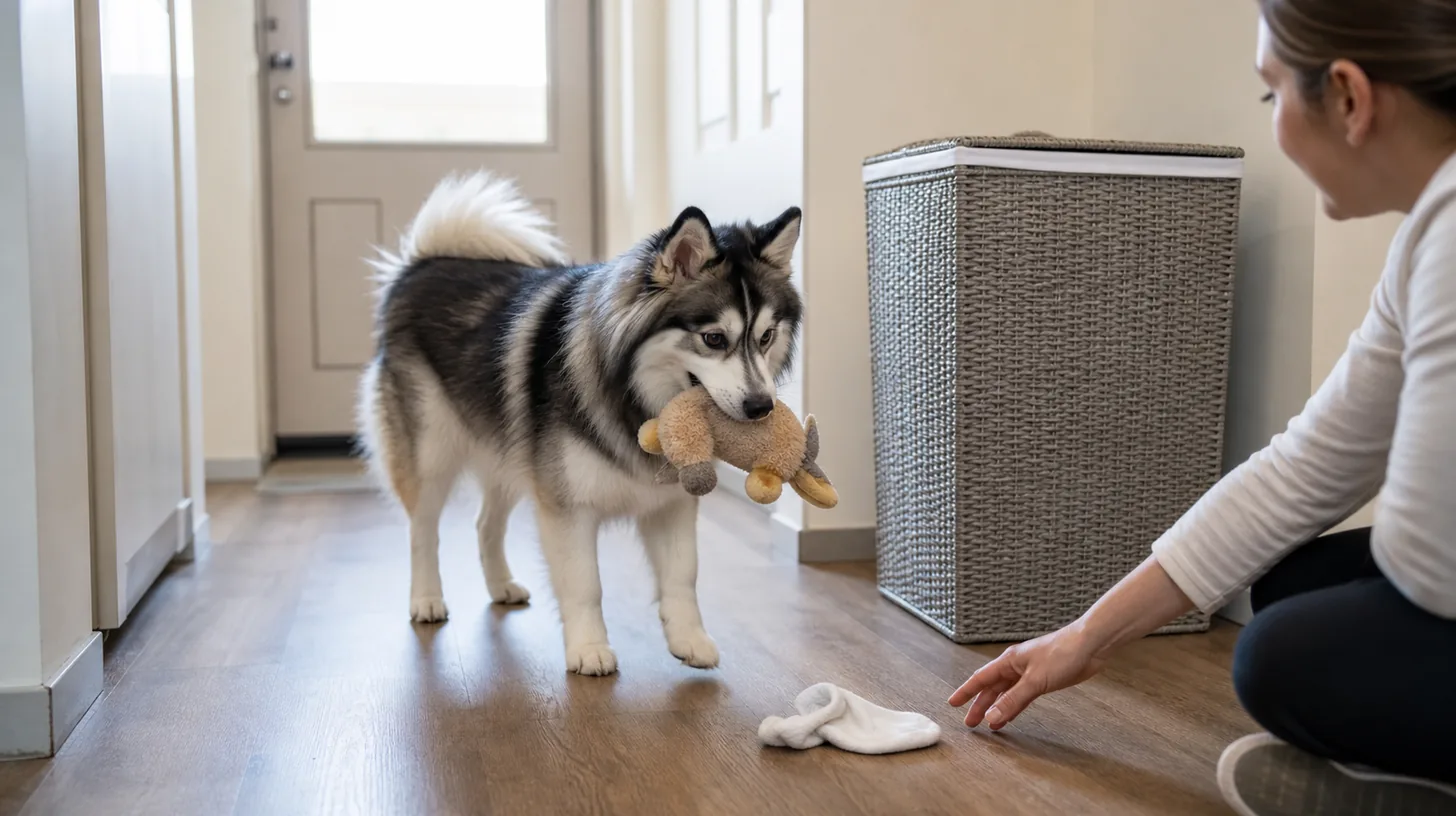
Direct answer: Make laundry unavailable before training: close hamper lids, shut room doors and pick up loose clothing. If the Pomsky has an item, do not chase, corner or pry the mouth open. Use a previously practiced trade, move the recovered item out of reach and check whether any fabric is missing. Reinforce appropriate toys and supervised enrichment away from the laundry area. If a sock or fabric may have been swallowed, or the dog shows choking, vomiting, pain, appetite change or lethargy, contact a veterinarian promptly rather than waiting for a training solution.
This page manages the household pattern of obtaining and carrying laundry; drop-it and leave-it teach component cues, while the laundry-room audit covers appliance and room hazards rather than repeated item stealing and possible ingestion. Make laundry unavailable before training: close hamper lids, shut room doors and pick up loose clothing. If the Pomsky has an item, do not chase, corner or pry the mouth open. Use a previously practiced trade, move the recovered item out of reach and check whether any fabric is missing. Reinforce appropriate toys and supervised enrichment away from the laundry area. If a sock or fabric may have been swallowed, or the dog shows choking, vomiting, pain, appetite change or lethargy, contact a veterinarian promptly rather than waiting for a training solution. This guide uses prevention, observable behavior, voluntary choices and explicit stop rules. It does not diagnose a Pomsky or promise that one household technique will fit every dog.
Direct answer
Make laundry unavailable before training: close hamper lids, shut room doors and pick up loose clothing. If the Pomsky has an item, do not chase, corner or pry the mouth open. Use a previously practiced trade, move the recovered item out of reach and check whether any fabric is missing. Reinforce appropriate toys and supervised enrichment away from the laundry area. If a sock or fabric may have been swallowed, or the dog shows choking, vomiting, pain, appetite change or lethargy, contact a veterinarian promptly rather than waiting for a training solution.
Use this plan for the specific task described as: Block access to hampers and loose clothing, avoid chasing or cornering the Pomsky, use a practiced voluntary trade for a safe reward, return only appropriate items, inspect the environment for missing fabric, provide suitable enrichment, and contact a veterinarian promptly when swallowing or obstruction risk is possible. If the setting, trigger or risk is different, follow the nearest owner page or ask the relevant professional instead of combining several protocols into one improvised response.
Inventory the Laundry Access Points
Map hampers, bedrooms, bathrooms, bags, drying racks and floor-drop locations before changing the behavior.
In stop a pomsky from stealing socks and laundry, the inventory the laundry access points checkpoint has a narrow purpose. Use a visible pass condition rather than a reassuring guess. Note what was observed, what was controlled and what remains uncertain before changing access or asking for behavior. Complete this checkpoint before adding the next variable.
Install Physical Prevention
Use closed storage, reliable doors and caregiver pickup routines that do not depend on verbal cues.
In stop a pomsky from stealing socks and laundry, the install physical prevention checkpoint has a narrow purpose. Write the place, timing, preceding event and first observable response in neutral language. That context makes the record useful without assigning motive or diagnosis. Complete this checkpoint before adding the next variable.
Distinguish Carrying From Possible Ingestion
Count missing pieces and note chewing or swallowing without assuming the item remains intact.
In stop a pomsky from stealing socks and laundry, the distinguish carrying from possible ingestion checkpoint has a narrow purpose. Check the arrangement from dog height. It should prevent rehearsal, preserve an open retreat and avoid dependence on speed, grabbing, an open exit or another participant tolerating contact. Complete this checkpoint before adding the next variable.
Do Not Start a Chase
Freeze the chase pattern, create space and keep exits controlled so the Pomsky is not rewarded by pursuit.
In stop a pomsky from stealing socks and laundry, the do not start a chase checkpoint has a narrow purpose. Change one variable while distance, duration, equipment and caregiver position remain stable. End while the Pomsky can still disengage rather than repeating until failure. Complete this checkpoint before adding the next variable.
Use a Practiced Voluntary Trade
Present an appropriate reward at safe distance and retrieve the item only after the dog releases and moves away.
In stop a pomsky from stealing socks and laundry, the use a practiced voluntary trade checkpoint has a narrow purpose. The alternative must already be easy in a quiet setting. Mark the first voluntary choice, place reinforcement where it supports the next safe position and provide a clear release. Complete this checkpoint before adding the next variable.
Protect the Recovered Item
Remove it immediately and reset the room instead of returning it as a play object.
In stop a pomsky from stealing socks and laundry, the protect the recovered item checkpoint has a narrow purpose. Practice away from the full trigger. Preserve loose movement, ordinary breathing and the option to decline reinforcement; return to an easier version after confusion or rising arousal. Complete this checkpoint before adding the next variable.
Build a Legal Carrying Outlet
Offer intact suitable toys and reinforce carrying, delivering or settling with those items.
In stop a pomsky from stealing socks and laundry, the build a legal carrying outlet checkpoint has a narrow purpose. Give every caregiver the same prevention step, alternative response and stop rule. Identify prohibited actions, storage locations and the person responsible for professional contact. Complete this checkpoint before adding the next variable.
Track Time and Context
Record whether stealing follows arrivals, boredom, laundry handling or household attention.
In stop a pomsky from stealing socks and laundry, the track time and context checkpoint has a narrow purpose. A reset should lower exposure and restore choice. Reopen access after the environment is controlled and ordinary movement returns, not after an arbitrary timer or forced stillness. Complete this checkpoint before adding the next variable.
Coordinate Every Caregiver
Use the same storage and trade plan so one person does not chase while another rewards calm release.
In stop a pomsky from stealing socks and laundry, the coordinate every caregiver checkpoint has a narrow purpose. Compare frequency, distance, duration and recovery with the Pomsky's own baseline. One incident-free session is not proof if management opened or the dog was simply unable to act. Complete this checkpoint before adding the next variable.
Escalate Suspected Swallowing
Contact a veterinarian promptly for a missing item, choking, vomiting, abdominal discomfort, lethargy or other concerning change.
In stop a pomsky from stealing socks and laundry, the escalate suspected swallowing checkpoint has a narrow purpose. Stop collecting examples when pain, ingestion, breathing change, injury, panic, aggression, sudden onset or prolonged recovery is possible. Preserve the factual timeline for the responsible professional. Complete this checkpoint before adding the next variable.
What to record
Keep a dated record for stop a pomsky from stealing socks and laundry that covers Inventory the Laundry Access Points, Install Physical Prevention, Distinguish Carrying From Possible Ingestion, Do Not Start a Chase, Use a Practiced Voluntary Trade, then Protect the Recovered Item, Build a Legal Carrying Outlet, Track Time and Context, Coordinate Every Caregiver, Escalate Suspected Swallowing. Record direct observations, the physical management in place, the first safe alternative response, recovery and every unresolved question. Avoid labels about dominance, stubbornness, guilt, anxiety or intent unless a qualified professional supplied that interpretation.
When to stop and escalate
Stop when the Pomsky, another animal, a person or the environment can no longer remain safe while pursuing this goal: Block access to hampers and loose clothing, avoid chasing or cornering the Pomsky, use a practiced voluntary trade for a safe reward, return only appropriate items, inspect the environment for missing fabric, provide suitable enrichment, and contact a veterinarian promptly when swallowing or obstruction risk is possible. The risk boundary for this page is behavior and foreign body escalation. Do not continue through pain, ingestion concern, breathing change, injury, panic, aggression, forced contact, equipment failure or a sudden change from the dog's ordinary baseline.
For stop a pomsky from stealing socks and laundry, bring the veterinarian or qualified reward-based behavior professional a concise factual timeline, relevant original photos or videos captured without provoking the event, current medication and health context when requested, and a description of management already in place. Professional escalation is part of the plan, not evidence that the household failed.
Keep the plan current
Recheck stop a pomsky from stealing socks and laundry whenever the Pomsky's health, household, equipment, environment, caregivers or trigger pattern changes. Retire stale assumptions, preserve current source instructions and update only one variable at a time. The useful outcome is safer daily management and clearer evidence, not a staged demonstration for the camera or a claim that the behavior can never recur.
Sources reviewed
Each source is used only for the claim scopes listed below. None establishes a guaranteed Pomsky outcome or replaces individual professional assessment.
- American Veterinary Society of Animal Behavior: Humane Dog Training Position Statement - Supports: reward-based training; aversive-method risk; behavior change principles. Limit: Does not guarantee outcomes for an individual dog.
- ASPCA: Emergency Care for Your Pet - Supports: heatstroke as a veterinary emergency; emergency clinic planning; professional escalation. Limit: A general article cannot assess stability or replace emergency veterinary examination and treatment.
- American Veterinary Society of Animal Behavior: How to Select a Behavior Consultant - Supports: trainer credentials; behavior consultant selection; red flags. Limit: Avoid implying that a title alone proves competence.