Written and reviewed by A Pomsky Editorial Team. Originally published 2026-07-26; substantively reviewed July 26, 2026.
Safety boundary: This guide is educational and cannot diagnose, treat, or replace veterinary, medical, public-health, emergency-dispatch, animal-control, or jurisdiction-specific legal guidance. Use the health disclaimer and contact the appropriate professional for the actual situation.
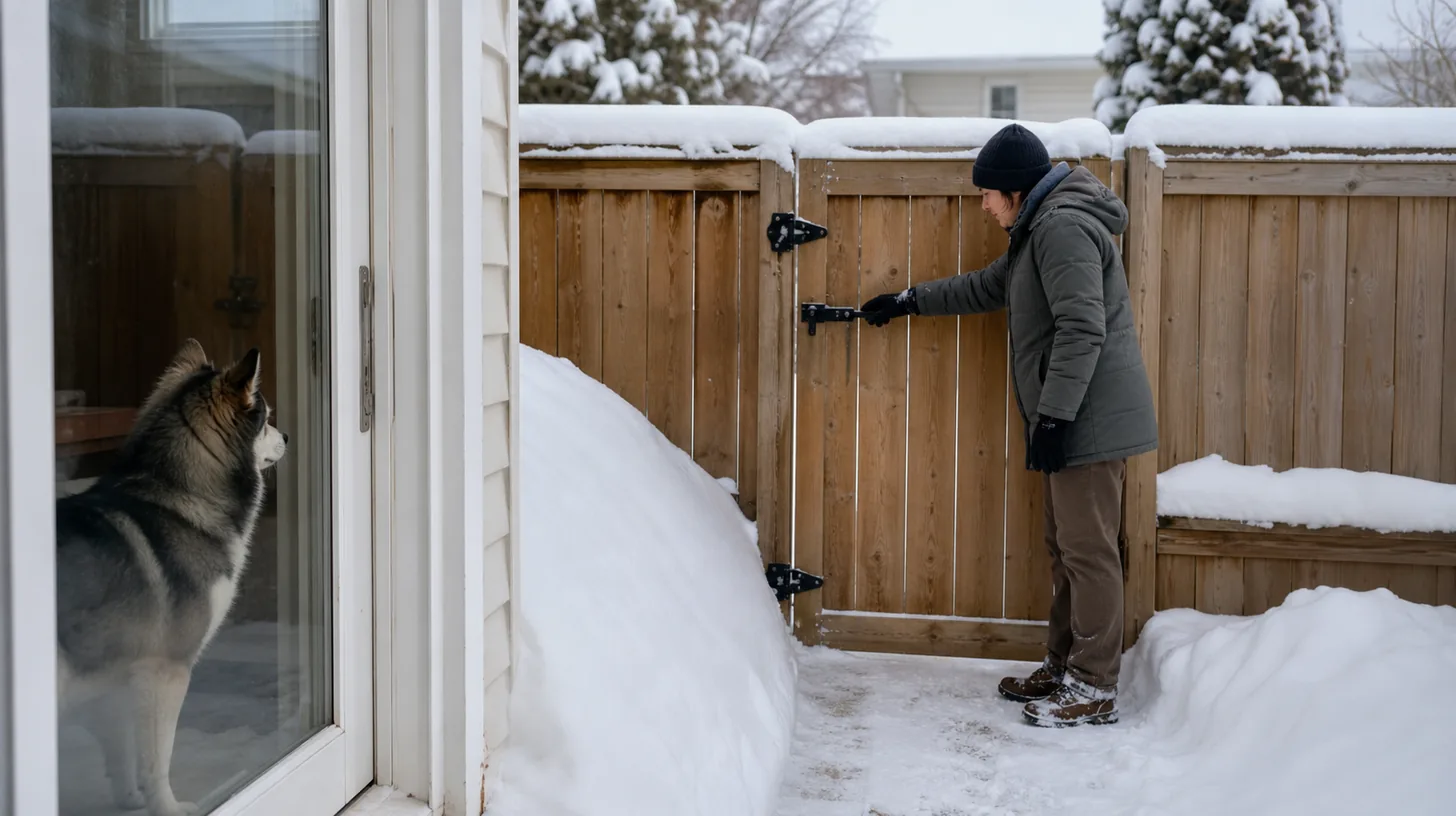
Direct answer: Keep the Pomsky indoors while inspecting the entire yard after heavy or plowed snow. Look for drifts that reduce effective fence height, snow packed under or against gates, hidden gaps, blocked latch movement, ice and unsafe footing. Clear only an ordinary safe inspection route and keep equipment away from the dog. Correct every escape or traction concern before release, and use a leash for the first verified yard entry rather than trusting the familiar boundary.
This page evaluates how a completed snowfall changes an otherwise familiar fenced yard; the fence inspection is season-neutral, the snow-blower page governs machine operation, and the sidewalk page decides whether an off-property walk route is usable. Close all dog access before inspecting gates, moving snow, handling tools or walking a boundary whose effective height may have changed. Check whether the gate opens, closes and latches fully without snow, ice or ground movement obstructing its intended travel. The workflow keeps the decision tied to current conditions, the individual dog and an observable release or stop point.
Keep the Pomsky Indoors
Close all dog access before inspecting gates, moving snow, handling tools or walking a boundary whose effective height may have changed.
Pause long enough to inspect the result rather than assuming the action worked. Look at the dog, the physical boundary, and the next movement available to the caregiver. Continue only when the arrangement still supports Keep the Pomsky indoors while inspecting how accumulated or plowed snow changes effective fence height, gate swing, latch closure, gaps, drift access and footing, clear one controlled route without unsafe equipment exposure, and use a leash until every escape and traction concern is resolved.. In this routine, step 1 is the keep the pomsky indoors decision.
Stop when the expected condition is absent or the situation begins to depend on force, luck, or an open boundary. Specifically avoid skipping check the complete lower boundary, losing control of identify ice and traction changes, continuing after recheck latches after clearing fails, relying on stale alerts, inventing thresholds, or exposing the Pomsky to verify a hazard. The follow-up record should cover For Pomsky Snow Fence and Gate Audit, record Keep the Pomsky Indoors, Start at the Main Gate, Inspect Effective Fence Height, Check the Complete Lower Boundary; then reconcile Identify Ice and Traction Changes, Separate Snow Equipment and Fuel, Clear One Controlled Route; and close with Recheck Latches After Clearing, Use a Leash for First Reentry, Record and Reinspect After Change. Keep the entry factual, dated, private and linked to its current source.. Record the result of keep the pomsky indoors before continuing.
Start at the Main Gate
Check whether the gate opens, closes and latches fully without snow, ice or ground movement obstructing its intended travel.
A second capable adult can verify the boundary during early practice or higher-risk situations. That person should follow the same sequence and avoid adding prompts, handling, or access that changes the task. The shared standard remains Keep the Pomsky indoors while inspecting how accumulated or plowed snow changes effective fence height, gate swing, latch closure, gaps, drift access and footing, clear one controlled route without unsafe equipment exposure, and use a leash until every escape and traction concern is resolved.. In this routine, step 2 is the start at the main gate decision.
The absence of an incident is not proof that the arrangement is sound. Recheck for skipping check the complete lower boundary, losing control of identify ice and traction changes, continuing after recheck latches after clearing fails, relying on stale alerts, inventing thresholds, or exposing the Pomsky to verify a hazard. Document For Pomsky Snow Fence and Gate Audit, record Keep the Pomsky Indoors, Start at the Main Gate, Inspect Effective Fence Height, Check the Complete Lower Boundary; then reconcile Identify Ice and Traction Changes, Separate Snow Equipment and Fuel, Clear One Controlled Route; and close with Recheck Latches After Clearing, Use a Leash for First Reentry, Record and Reinspect After Change. Keep the entry factual, dated, private and linked to its current source. so a later caregiver can distinguish a passed step from one that was skipped. Record the result of start at the main gate before continuing.
Inspect Effective Fence Height
Look from both sides where authorized for drifts, plowed piles, furniture or objects that create a new step or climb route.
Perform this check before adding the next variable. The target remains Keep the Pomsky indoors while inspecting how accumulated or plowed snow changes effective fence height, gate swing, latch closure, gaps, drift access and footing, clear one controlled route without unsafe equipment exposure, and use a leash until every escape and traction concern is resolved.. Work in the controlled weather-response setting needed to keep the pomsky indoors, start at the main gate, and inspect effective fence height, with identification, physical control, a safe alternative and current authority guidance available. If the setup cannot preserve that condition, simplify it or stop rather than relying on speed or physical control. In this routine, step 3 is the inspect effective fence height decision.
If the Pomsky cannot remain comfortable or the equipment and environment cannot remain controlled, end the attempt. Do not proceed through skipping check the complete lower boundary, losing control of identify ice and traction changes, continuing after recheck latches after clearing fails, relying on stale alerts, inventing thresholds, or exposing the Pomsky to verify a hazard. Capture For Pomsky Snow Fence and Gate Audit, record Keep the Pomsky Indoors, Start at the Main Gate, Inspect Effective Fence Height, Check the Complete Lower Boundary; then reconcile Identify Ice and Traction Changes, Separate Snow Equipment and Fuel, Clear One Controlled Route; and close with Recheck Latches After Clearing, Use a Leash for First Reentry, Record and Reinspect After Change. Keep the entry factual, dated, private and linked to its current source. before deciding what changes next. Record the result of inspect effective fence height before continuing.
Check the Complete Lower Boundary
Inspect packed snow, buried gaps, heaved panels, digging points, drainage channels and places where snow hides damage.
Use an observable pass condition: the relevant item is checked, the boundary is closed, and the Pomsky can remain safe without being used as a test. This protects the main objective, Keep the Pomsky indoors while inspecting how accumulated or plowed snow changes effective fence height, gate swing, latch closure, gaps, drift access and footing, clear one controlled route without unsafe equipment exposure, and use a leash until every escape and traction concern is resolved., while leaving a clear point at which the caregiver can step back. In this routine, step 4 is the check the complete lower boundary decision.
Do not convert this step into a stress test. The principal avoidable risks are skipping check the complete lower boundary, losing control of identify ice and traction changes, continuing after recheck latches after clearing fails, relying on stale alerts, inventing thresholds, or exposing the Pomsky to verify a hazard. Write down For Pomsky Snow Fence and Gate Audit, record Keep the Pomsky Indoors, Start at the Main Gate, Inspect Effective Fence Height, Check the Complete Lower Boundary; then reconcile Identify Ice and Traction Changes, Separate Snow Equipment and Fuel, Clear One Controlled Route; and close with Recheck Latches After Clearing, Use a Leash for First Reentry, Record and Reinspect After Change. Keep the entry factual, dated, private and linked to its current source.; a short factual note is more useful than a reassuring guess. Record the result of check the complete lower boundary before continuing.
Identify Ice and Traction Changes
Map glazed surfaces, steps, slopes, deck edges, compacted paths and locations where the caregiver cannot control the dog safely.
Keep the sequence repeatable across caregivers. Say what is being checked, complete it, and return equipment and people to neutral before continuing. In this page's context, success means Keep the Pomsky indoors while inspecting how accumulated or plowed snow changes effective fence height, gate swing, latch closure, gaps, drift access and footing, clear one controlled route without unsafe equipment exposure, and use a leash until every escape and traction concern is resolved.; it does not mean proving that a known risk can be tolerated. In this routine, step 5 is the identify ice and traction changes decision.
Stop when the expected condition is absent or the situation begins to depend on force, luck, or an open boundary. Specifically avoid skipping check the complete lower boundary, losing control of identify ice and traction changes, continuing after recheck latches after clearing fails, relying on stale alerts, inventing thresholds, or exposing the Pomsky to verify a hazard. The follow-up record should cover For Pomsky Snow Fence and Gate Audit, record Keep the Pomsky Indoors, Start at the Main Gate, Inspect Effective Fence Height, Check the Complete Lower Boundary; then reconcile Identify Ice and Traction Changes, Separate Snow Equipment and Fuel, Clear One Controlled Route; and close with Recheck Latches After Clearing, Use a Leash for First Reentry, Record and Reinspect After Change. Keep the entry factual, dated, private and linked to its current source.. Record the result of identify ice and traction changes before continuing.
Separate Snow Equipment and Fuel
Follow exact equipment directions, operate with the dog indoors, and secure machines, cords, batteries, fuel and tools before any release.
Treat this as one part of the complete routine, not an isolated trick. The surrounding setup is the controlled weather-response setting needed to keep the pomsky indoors, start at the main gate, and inspect effective fence height, with identification, physical control, a safe alternative and current authority guidance available. A clean transition reduces ambiguity and makes it easier to notice when the dog, equipment, environment, or records differ from the previous attempt. In this routine, step 6 is the separate snow equipment and fuel decision.
The absence of an incident is not proof that the arrangement is sound. Recheck for skipping check the complete lower boundary, losing control of identify ice and traction changes, continuing after recheck latches after clearing fails, relying on stale alerts, inventing thresholds, or exposing the Pomsky to verify a hazard. Document For Pomsky Snow Fence and Gate Audit, record Keep the Pomsky Indoors, Start at the Main Gate, Inspect Effective Fence Height, Check the Complete Lower Boundary; then reconcile Identify Ice and Traction Changes, Separate Snow Equipment and Fuel, Clear One Controlled Route; and close with Recheck Latches After Clearing, Use a Leash for First Reentry, Record and Reinspect After Change. Keep the entry factual, dated, private and linked to its current source. so a later caregiver can distinguish a passed step from one that was skipped. Record the result of separate snow equipment and fuel before continuing.
Clear One Controlled Route
Create only the needed path to a suitable toilet area and gate-check point without piling snow against the fence or blocking drainage.
Pause long enough to inspect the result rather than assuming the action worked. Look at the dog, the physical boundary, and the next movement available to the caregiver. Continue only when the arrangement still supports Keep the Pomsky indoors while inspecting how accumulated or plowed snow changes effective fence height, gate swing, latch closure, gaps, drift access and footing, clear one controlled route without unsafe equipment exposure, and use a leash until every escape and traction concern is resolved.. In this routine, step 7 is the clear one controlled route decision.
If the Pomsky cannot remain comfortable or the equipment and environment cannot remain controlled, end the attempt. Do not proceed through skipping check the complete lower boundary, losing control of identify ice and traction changes, continuing after recheck latches after clearing fails, relying on stale alerts, inventing thresholds, or exposing the Pomsky to verify a hazard. Capture For Pomsky Snow Fence and Gate Audit, record Keep the Pomsky Indoors, Start at the Main Gate, Inspect Effective Fence Height, Check the Complete Lower Boundary; then reconcile Identify Ice and Traction Changes, Separate Snow Equipment and Fuel, Clear One Controlled Route; and close with Recheck Latches After Clearing, Use a Leash for First Reentry, Record and Reinspect After Change. Keep the entry factual, dated, private and linked to its current source. before deciding what changes next. Record the result of clear one controlled route before continuing.
Recheck Latches After Clearing
Remove ordinary obstruction, test the full close-and-latch sequence and stop for structural misalignment or damaged hardware.
A second capable adult can verify the boundary during early practice or higher-risk situations. That person should follow the same sequence and avoid adding prompts, handling, or access that changes the task. The shared standard remains Keep the Pomsky indoors while inspecting how accumulated or plowed snow changes effective fence height, gate swing, latch closure, gaps, drift access and footing, clear one controlled route without unsafe equipment exposure, and use a leash until every escape and traction concern is resolved.. In this routine, step 8 is the recheck latches after clearing decision.
Do not convert this step into a stress test. The principal avoidable risks are skipping check the complete lower boundary, losing control of identify ice and traction changes, continuing after recheck latches after clearing fails, relying on stale alerts, inventing thresholds, or exposing the Pomsky to verify a hazard. Write down For Pomsky Snow Fence and Gate Audit, record Keep the Pomsky Indoors, Start at the Main Gate, Inspect Effective Fence Height, Check the Complete Lower Boundary; then reconcile Identify Ice and Traction Changes, Separate Snow Equipment and Fuel, Clear One Controlled Route; and close with Recheck Latches After Clearing, Use a Leash for First Reentry, Record and Reinspect After Change. Keep the entry factual, dated, private and linked to its current source.; a short factual note is more useful than a reassuring guess. Record the result of recheck latches after clearing before continuing.
Use a Leash for First Reentry
Walk the verified route slowly, prevent access to uninspected drifts and stop when snow, ice, fence or dog movement differs from the audit.
Perform this check before adding the next variable. The target remains Keep the Pomsky indoors while inspecting how accumulated or plowed snow changes effective fence height, gate swing, latch closure, gaps, drift access and footing, clear one controlled route without unsafe equipment exposure, and use a leash until every escape and traction concern is resolved.. Work in the controlled weather-response setting needed to keep the pomsky indoors, start at the main gate, and inspect effective fence height, with identification, physical control, a safe alternative and current authority guidance available. If the setup cannot preserve that condition, simplify it or stop rather than relying on speed or physical control. In this routine, step 9 is the use a leash for first reentry decision.
Stop when the expected condition is absent or the situation begins to depend on force, luck, or an open boundary. Specifically avoid skipping check the complete lower boundary, losing control of identify ice and traction changes, continuing after recheck latches after clearing fails, relying on stale alerts, inventing thresholds, or exposing the Pomsky to verify a hazard. The follow-up record should cover For Pomsky Snow Fence and Gate Audit, record Keep the Pomsky Indoors, Start at the Main Gate, Inspect Effective Fence Height, Check the Complete Lower Boundary; then reconcile Identify Ice and Traction Changes, Separate Snow Equipment and Fuel, Clear One Controlled Route; and close with Recheck Latches After Clearing, Use a Leash for First Reentry, Record and Reinspect After Change. Keep the entry factual, dated, private and linked to its current source.. Record the result of use a leash for first reentry before continuing.
Record and Reinspect After Change
Document defects and corrections, use qualified repair when needed, and repeat the audit after plowing, thaw, refreeze or more accumulation.
Use an observable pass condition: the relevant item is checked, the boundary is closed, and the Pomsky can remain safe without being used as a test. This protects the main objective, Keep the Pomsky indoors while inspecting how accumulated or plowed snow changes effective fence height, gate swing, latch closure, gaps, drift access and footing, clear one controlled route without unsafe equipment exposure, and use a leash until every escape and traction concern is resolved., while leaving a clear point at which the caregiver can step back. In this routine, step 10 is the record and reinspect after change decision.
The absence of an incident is not proof that the arrangement is sound. Recheck for skipping check the complete lower boundary, losing control of identify ice and traction changes, continuing after recheck latches after clearing fails, relying on stale alerts, inventing thresholds, or exposing the Pomsky to verify a hazard. Document For Pomsky Snow Fence and Gate Audit, record Keep the Pomsky Indoors, Start at the Main Gate, Inspect Effective Fence Height, Check the Complete Lower Boundary; then reconcile Identify Ice and Traction Changes, Separate Snow Equipment and Fuel, Clear One Controlled Route; and close with Recheck Latches After Clearing, Use a Leash for First Reentry, Record and Reinspect After Change. Keep the entry factual, dated, private and linked to its current source. so a later caregiver can distinguish a passed step from one that was skipped. Record the result of record and reinspect after change before continuing.
When to Stop and Escalate
Stop when the Pomsky, caregiver, equipment, records, or environment no longer supports Keep the Pomsky indoors while inspecting how accumulated or plowed snow changes effective fence height, gate swing, latch closure, gaps, drift access and footing, clear one controlled route without unsafe equipment exposure, and use a leash until every escape and traction concern is resolved.. Do not improvise through skipping check the complete lower boundary, losing control of identify ice and traction changes, continuing after recheck latches after clearing fails, relying on stale alerts, inventing thresholds, or exposing the Pomsky to verify a hazard. Seek the responsible local emergency authority, veterinarian, poison service, utility, property manager or qualified contractor for exceptions found during clear one controlled route, use a leash for first reentry or record and reinspect after change. Bring the factual observations already collected rather than recreating the event.
Before another attempt, review For Pomsky Snow Fence and Gate Audit, record Keep the Pomsky Indoors, Start at the Main Gate, Inspect Effective Fence Height, Check the Complete Lower Boundary; then reconcile Identify Ice and Traction Changes, Separate Snow Equipment and Fuel, Clear One Controlled Route; and close with Recheck Latches After Clearing, Use a Leash for First Reentry, Record and Reinspect After Change. Keep the entry factual, dated, private and linked to its current source.. Resume only after the responsible person, physical setup, and controlling instructions are clear. A stop is part of the protocol: it preserves useful evidence and prevents uncertainty from becoming exposure.
Keep the Routine Current
Recheck the complete setup whenever the dog, household, product, instructions, environment, or purpose changes. The intended outcome remains Keep the Pomsky indoors while inspecting how accumulated or plowed snow changes effective fence height, gate swing, latch closure, gaps, drift access and footing, clear one controlled route without unsafe equipment exposure, and use a leash until every escape and traction concern is resolved., not a perfect-looking performance. Use the newest primary instruction, retain dated records, and retire superseded assumptions so every caregiver begins from the same current plan.
Sources reviewed
Each source is used only for the claim scopes listed below. None establishes a guaranteed Pomsky outcome or replaces individual professional assessment.
- U.S. Centers for Disease Control and Prevention: Pet Emergency Preparedness - Supports: evacuation planning; pet records; emergency supplies; disaster readiness. Limit: Local emergency authority instructions take priority.
- ASPCA: Walking Your Dog in a Winter Wonderland? Protect Your Pet's Paws With These Tips - Supports: post-walk paw rinsing and drying; ice and salt removal; paw-pad inspection. Limit: Persistent irritation, cracking, bleeding, ingestion, or illness requires veterinary or poison-control advice.