Written and reviewed by A Pomsky Editorial Team. Originally published 2026-07-26; substantively reviewed July 26, 2026.
Safety boundary: This guide is educational and cannot diagnose, treat, or replace veterinary, medical, public-health, emergency-dispatch, animal-control, or jurisdiction-specific legal guidance. Use the health disclaimer and contact the appropriate professional for the actual situation.
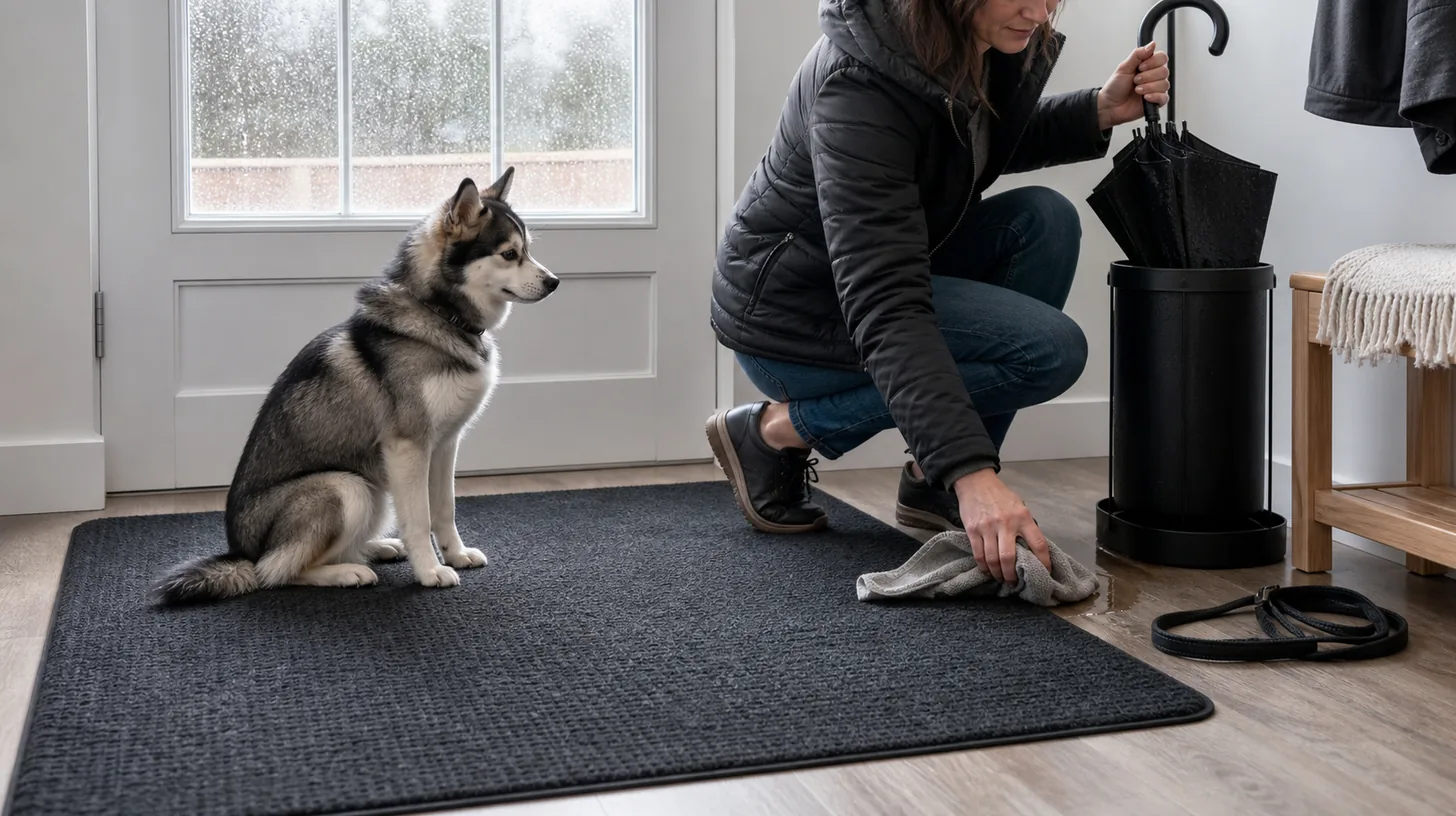
Direct answer: Prepare the entry before going out: use a large nonslip mat, towel and stable wet-gear location while keeping the interior route dry. Choose the shortest practical exit and maintain leash control on icy surfaces. On return, close and secure the door before handling umbrellas or paw cleanup. Follow current veterinary guidance for ordinary paw rinsing or drying, contain meltwater, and keep the Pomsky on the dry zone until the entire floor and next route have safe traction.
This page handles the combined ice, meltwater and traction reset after freezing rain; the rain-entry station addresses wet gear without ice, the snow route page is a pre-departure decision, and the road-salt page focuses on deicer exposure rather than the whole entry floor. Place a large nonslip mat, towel, stable umbrella stand and ordinary cleanup supplies where they do not narrow the doorway. Check ice, steps, handholds, drainage, lighting, door swing and the first indoor surface before attaching the Pomsky. The workflow keeps the decision tied to current conditions, the individual dog and an observable release or stop point.
Prepare the Entry Before Departure
Place a large nonslip mat, towel, stable umbrella stand and ordinary cleanup supplies where they do not narrow the doorway.
Pause long enough to inspect the result rather than assuming the action worked. Look at the dog, the physical boundary, and the next movement available to the caregiver. Continue only when the arrangement still supports Prepare a controlled doorway before a freezing-rain exit, preserve traction on the shortest route, secure the Pomsky before handling wet gear, inspect and clean paws under current guidance, contain umbrellas and meltwater, dry the complete floor, and verify the next safe route before normal access resumes.. In this routine, step 1 is the prepare the entry before departure decision.
Stop when the expected condition is absent or the situation begins to depend on force, luck, or an open boundary. Specifically avoid skipping fit and attach equipment indoors, losing control of cross the doorway one team at a time, continuing after contain wet gear and meltwater fails, relying on stale alerts, inventing thresholds, or exposing the Pomsky to verify a hazard. The follow-up record should cover For Pomsky Freezing Rain Entry Reset, record Prepare the Entry Before Departure, Inspect Both Sides of the Threshold, Choose the Shortest Controlled Route, Fit and Attach Equipment Indoors; then reconcile Cross the Doorway One Team at a Time, Secure the Pomsky on the Dry Mat, Inspect and Clean Paws Conservatively; and close with Contain Wet Gear and Meltwater, Dry the Complete Floor Route, Verify the Next Exit Setup. Keep the entry factual, dated, private and linked to its current source.. Record the result of prepare the entry before departure before continuing.
Inspect Both Sides of the Threshold
Check ice, steps, handholds, drainage, lighting, door swing and the first indoor surface before attaching the Pomsky.
A second capable adult can verify the boundary during early practice or higher-risk situations. That person should follow the same sequence and avoid adding prompts, handling, or access that changes the task. The shared standard remains Prepare a controlled doorway before a freezing-rain exit, preserve traction on the shortest route, secure the Pomsky before handling wet gear, inspect and clean paws under current guidance, contain umbrellas and meltwater, dry the complete floor, and verify the next safe route before normal access resumes.. In this routine, step 2 is the inspect both sides of the threshold decision.
The absence of an incident is not proof that the arrangement is sound. Recheck for skipping fit and attach equipment indoors, losing control of cross the doorway one team at a time, continuing after contain wet gear and meltwater fails, relying on stale alerts, inventing thresholds, or exposing the Pomsky to verify a hazard. Document For Pomsky Freezing Rain Entry Reset, record Prepare the Entry Before Departure, Inspect Both Sides of the Threshold, Choose the Shortest Controlled Route, Fit and Attach Equipment Indoors; then reconcile Cross the Doorway One Team at a Time, Secure the Pomsky on the Dry Mat, Inspect and Clean Paws Conservatively; and close with Contain Wet Gear and Meltwater, Dry the Complete Floor Route, Verify the Next Exit Setup. Keep the entry factual, dated, private and linked to its current source. so a later caregiver can distinguish a passed step from one that was skipped. Record the result of inspect both sides of the threshold before continuing.
Choose the Shortest Controlled Route
Avoid unnecessary distance, slopes and untreated uncertainty, and use an indoor alternative when safe footing cannot be maintained.
Perform this check before adding the next variable. The target remains Prepare a controlled doorway before a freezing-rain exit, preserve traction on the shortest route, secure the Pomsky before handling wet gear, inspect and clean paws under current guidance, contain umbrellas and meltwater, dry the complete floor, and verify the next safe route before normal access resumes.. Work in the controlled weather-response setting needed to prepare the entry before departure, inspect both sides of the threshold, and choose the shortest controlled route, with identification, physical control, a safe alternative and current authority guidance available. If the setup cannot preserve that condition, simplify it or stop rather than relying on speed or physical control. In this routine, step 3 is the choose the shortest controlled route decision.
If the Pomsky cannot remain comfortable or the equipment and environment cannot remain controlled, end the attempt. Do not proceed through skipping fit and attach equipment indoors, losing control of cross the doorway one team at a time, continuing after contain wet gear and meltwater fails, relying on stale alerts, inventing thresholds, or exposing the Pomsky to verify a hazard. Capture For Pomsky Freezing Rain Entry Reset, record Prepare the Entry Before Departure, Inspect Both Sides of the Threshold, Choose the Shortest Controlled Route, Fit and Attach Equipment Indoors; then reconcile Cross the Doorway One Team at a Time, Secure the Pomsky on the Dry Mat, Inspect and Clean Paws Conservatively; and close with Contain Wet Gear and Meltwater, Dry the Complete Floor Route, Verify the Next Exit Setup. Keep the entry factual, dated, private and linked to its current source. before deciding what changes next. Record the result of choose the shortest controlled route before continuing.
Fit and Attach Equipment Indoors
Use inspected identification and leash equipment with enough control for the route without adding tangles or loose wet gear.
Use an observable pass condition: the relevant item is checked, the boundary is closed, and the Pomsky can remain safe without being used as a test. This protects the main objective, Prepare a controlled doorway before a freezing-rain exit, preserve traction on the shortest route, secure the Pomsky before handling wet gear, inspect and clean paws under current guidance, contain umbrellas and meltwater, dry the complete floor, and verify the next safe route before normal access resumes., while leaving a clear point at which the caregiver can step back. In this routine, step 4 is the fit and attach equipment indoors decision.
Do not convert this step into a stress test. The principal avoidable risks are skipping fit and attach equipment indoors, losing control of cross the doorway one team at a time, continuing after contain wet gear and meltwater fails, relying on stale alerts, inventing thresholds, or exposing the Pomsky to verify a hazard. Write down For Pomsky Freezing Rain Entry Reset, record Prepare the Entry Before Departure, Inspect Both Sides of the Threshold, Choose the Shortest Controlled Route, Fit and Attach Equipment Indoors; then reconcile Cross the Doorway One Team at a Time, Secure the Pomsky on the Dry Mat, Inspect and Clean Paws Conservatively; and close with Contain Wet Gear and Meltwater, Dry the Complete Floor Route, Verify the Next Exit Setup. Keep the entry factual, dated, private and linked to its current source.; a short factual note is more useful than a reassuring guess. Record the result of fit and attach equipment indoors before continuing.
Cross the Doorway One Team at a Time
Keep the leash controlled, avoid holding an open umbrella over the dog and prevent the door from remaining open during equipment changes.
Keep the sequence repeatable across caregivers. Say what is being checked, complete it, and return equipment and people to neutral before continuing. In this page's context, success means Prepare a controlled doorway before a freezing-rain exit, preserve traction on the shortest route, secure the Pomsky before handling wet gear, inspect and clean paws under current guidance, contain umbrellas and meltwater, dry the complete floor, and verify the next safe route before normal access resumes.; it does not mean proving that a known risk can be tolerated. In this routine, step 5 is the cross the doorway one team at a time decision.
Stop when the expected condition is absent or the situation begins to depend on force, luck, or an open boundary. Specifically avoid skipping fit and attach equipment indoors, losing control of cross the doorway one team at a time, continuing after contain wet gear and meltwater fails, relying on stale alerts, inventing thresholds, or exposing the Pomsky to verify a hazard. The follow-up record should cover For Pomsky Freezing Rain Entry Reset, record Prepare the Entry Before Departure, Inspect Both Sides of the Threshold, Choose the Shortest Controlled Route, Fit and Attach Equipment Indoors; then reconcile Cross the Doorway One Team at a Time, Secure the Pomsky on the Dry Mat, Inspect and Clean Paws Conservatively; and close with Contain Wet Gear and Meltwater, Dry the Complete Floor Route, Verify the Next Exit Setup. Keep the entry factual, dated, private and linked to its current source.. Record the result of cross the doorway one team at a time before continuing.
Secure the Pomsky on the Dry Mat
After return, close and lock the door, then keep the dog in the stable dry zone before moving umbrellas, coats or bags.
Treat this as one part of the complete routine, not an isolated trick. The surrounding setup is the controlled weather-response setting needed to prepare the entry before departure, inspect both sides of the threshold, and choose the shortest controlled route, with identification, physical control, a safe alternative and current authority guidance available. A clean transition reduces ambiguity and makes it easier to notice when the dog, equipment, environment, or records differ from the previous attempt. In this routine, step 6 is the secure the pomsky on the dry mat decision.
The absence of an incident is not proof that the arrangement is sound. Recheck for skipping fit and attach equipment indoors, losing control of cross the doorway one team at a time, continuing after contain wet gear and meltwater fails, relying on stale alerts, inventing thresholds, or exposing the Pomsky to verify a hazard. Document For Pomsky Freezing Rain Entry Reset, record Prepare the Entry Before Departure, Inspect Both Sides of the Threshold, Choose the Shortest Controlled Route, Fit and Attach Equipment Indoors; then reconcile Cross the Doorway One Team at a Time, Secure the Pomsky on the Dry Mat, Inspect and Clean Paws Conservatively; and close with Contain Wet Gear and Meltwater, Dry the Complete Floor Route, Verify the Next Exit Setup. Keep the entry factual, dated, private and linked to its current source. so a later caregiver can distinguish a passed step from one that was skipped. Record the result of secure the pomsky on the dry mat before continuing.
Inspect and Clean Paws Conservatively
Follow current veterinary or product guidance for ordinary residue removal and stop for pain, cracking, bleeding or suspected ingestion.
Pause long enough to inspect the result rather than assuming the action worked. Look at the dog, the physical boundary, and the next movement available to the caregiver. Continue only when the arrangement still supports Prepare a controlled doorway before a freezing-rain exit, preserve traction on the shortest route, secure the Pomsky before handling wet gear, inspect and clean paws under current guidance, contain umbrellas and meltwater, dry the complete floor, and verify the next safe route before normal access resumes.. In this routine, step 7 is the inspect and clean paws conservatively decision.
If the Pomsky cannot remain comfortable or the equipment and environment cannot remain controlled, end the attempt. Do not proceed through skipping fit and attach equipment indoors, losing control of cross the doorway one team at a time, continuing after contain wet gear and meltwater fails, relying on stale alerts, inventing thresholds, or exposing the Pomsky to verify a hazard. Capture For Pomsky Freezing Rain Entry Reset, record Prepare the Entry Before Departure, Inspect Both Sides of the Threshold, Choose the Shortest Controlled Route, Fit and Attach Equipment Indoors; then reconcile Cross the Doorway One Team at a Time, Secure the Pomsky on the Dry Mat, Inspect and Clean Paws Conservatively; and close with Contain Wet Gear and Meltwater, Dry the Complete Floor Route, Verify the Next Exit Setup. Keep the entry factual, dated, private and linked to its current source. before deciding what changes next. Record the result of inspect and clean paws conservatively before continuing.
Contain Wet Gear and Meltwater
Close umbrellas in a stable drip location, hang garments securely and collect water without leaving an open bucket or loose cord.
A second capable adult can verify the boundary during early practice or higher-risk situations. That person should follow the same sequence and avoid adding prompts, handling, or access that changes the task. The shared standard remains Prepare a controlled doorway before a freezing-rain exit, preserve traction on the shortest route, secure the Pomsky before handling wet gear, inspect and clean paws under current guidance, contain umbrellas and meltwater, dry the complete floor, and verify the next safe route before normal access resumes.. In this routine, step 8 is the contain wet gear and meltwater decision.
Do not convert this step into a stress test. The principal avoidable risks are skipping fit and attach equipment indoors, losing control of cross the doorway one team at a time, continuing after contain wet gear and meltwater fails, relying on stale alerts, inventing thresholds, or exposing the Pomsky to verify a hazard. Write down For Pomsky Freezing Rain Entry Reset, record Prepare the Entry Before Departure, Inspect Both Sides of the Threshold, Choose the Shortest Controlled Route, Fit and Attach Equipment Indoors; then reconcile Cross the Doorway One Team at a Time, Secure the Pomsky on the Dry Mat, Inspect and Clean Paws Conservatively; and close with Contain Wet Gear and Meltwater, Dry the Complete Floor Route, Verify the Next Exit Setup. Keep the entry factual, dated, private and linked to its current source.; a short factual note is more useful than a reassuring guess. Record the result of contain wet gear and meltwater before continuing.
Dry the Complete Floor Route
Inspect mat edges, flooring seams, steps and adjacent paths for invisible moisture or refreeze risk before normal household traffic resumes.
Perform this check before adding the next variable. The target remains Prepare a controlled doorway before a freezing-rain exit, preserve traction on the shortest route, secure the Pomsky before handling wet gear, inspect and clean paws under current guidance, contain umbrellas and meltwater, dry the complete floor, and verify the next safe route before normal access resumes.. Work in the controlled weather-response setting needed to prepare the entry before departure, inspect both sides of the threshold, and choose the shortest controlled route, with identification, physical control, a safe alternative and current authority guidance available. If the setup cannot preserve that condition, simplify it or stop rather than relying on speed or physical control. In this routine, step 9 is the dry the complete floor route decision.
Stop when the expected condition is absent or the situation begins to depend on force, luck, or an open boundary. Specifically avoid skipping fit and attach equipment indoors, losing control of cross the doorway one team at a time, continuing after contain wet gear and meltwater fails, relying on stale alerts, inventing thresholds, or exposing the Pomsky to verify a hazard. The follow-up record should cover For Pomsky Freezing Rain Entry Reset, record Prepare the Entry Before Departure, Inspect Both Sides of the Threshold, Choose the Shortest Controlled Route, Fit and Attach Equipment Indoors; then reconcile Cross the Doorway One Team at a Time, Secure the Pomsky on the Dry Mat, Inspect and Clean Paws Conservatively; and close with Contain Wet Gear and Meltwater, Dry the Complete Floor Route, Verify the Next Exit Setup. Keep the entry factual, dated, private and linked to its current source.. Record the result of dry the complete floor route before continuing.
Verify the Next Exit Setup
Record route problems, replace saturated materials and leave the doorway ready for the next caregiver rather than carrying uncertainty forward.
Use an observable pass condition: the relevant item is checked, the boundary is closed, and the Pomsky can remain safe without being used as a test. This protects the main objective, Prepare a controlled doorway before a freezing-rain exit, preserve traction on the shortest route, secure the Pomsky before handling wet gear, inspect and clean paws under current guidance, contain umbrellas and meltwater, dry the complete floor, and verify the next safe route before normal access resumes., while leaving a clear point at which the caregiver can step back. In this routine, step 10 is the verify the next exit setup decision.
The absence of an incident is not proof that the arrangement is sound. Recheck for skipping fit and attach equipment indoors, losing control of cross the doorway one team at a time, continuing after contain wet gear and meltwater fails, relying on stale alerts, inventing thresholds, or exposing the Pomsky to verify a hazard. Document For Pomsky Freezing Rain Entry Reset, record Prepare the Entry Before Departure, Inspect Both Sides of the Threshold, Choose the Shortest Controlled Route, Fit and Attach Equipment Indoors; then reconcile Cross the Doorway One Team at a Time, Secure the Pomsky on the Dry Mat, Inspect and Clean Paws Conservatively; and close with Contain Wet Gear and Meltwater, Dry the Complete Floor Route, Verify the Next Exit Setup. Keep the entry factual, dated, private and linked to its current source. so a later caregiver can distinguish a passed step from one that was skipped. Record the result of verify the next exit setup before continuing.
When to Stop and Escalate
Stop when the Pomsky, caregiver, equipment, records, or environment no longer supports Prepare a controlled doorway before a freezing-rain exit, preserve traction on the shortest route, secure the Pomsky before handling wet gear, inspect and clean paws under current guidance, contain umbrellas and meltwater, dry the complete floor, and verify the next safe route before normal access resumes.. Do not improvise through skipping fit and attach equipment indoors, losing control of cross the doorway one team at a time, continuing after contain wet gear and meltwater fails, relying on stale alerts, inventing thresholds, or exposing the Pomsky to verify a hazard. Seek the responsible local emergency authority, veterinarian, poison service, utility, property manager or qualified contractor for exceptions found during inspect and clean paws conservatively, dry the complete floor route or verify the next exit setup. Bring the factual observations already collected rather than recreating the event.
Before another attempt, review For Pomsky Freezing Rain Entry Reset, record Prepare the Entry Before Departure, Inspect Both Sides of the Threshold, Choose the Shortest Controlled Route, Fit and Attach Equipment Indoors; then reconcile Cross the Doorway One Team at a Time, Secure the Pomsky on the Dry Mat, Inspect and Clean Paws Conservatively; and close with Contain Wet Gear and Meltwater, Dry the Complete Floor Route, Verify the Next Exit Setup. Keep the entry factual, dated, private and linked to its current source.. Resume only after the responsible person, physical setup, and controlling instructions are clear. A stop is part of the protocol: it preserves useful evidence and prevents uncertainty from becoming exposure.
Keep the Routine Current
Recheck the complete setup whenever the dog, household, product, instructions, environment, or purpose changes. The intended outcome remains Prepare a controlled doorway before a freezing-rain exit, preserve traction on the shortest route, secure the Pomsky before handling wet gear, inspect and clean paws under current guidance, contain umbrellas and meltwater, dry the complete floor, and verify the next safe route before normal access resumes., not a perfect-looking performance. Use the newest primary instruction, retain dated records, and retire superseded assumptions so every caregiver begins from the same current plan.
Sources reviewed
Each source is used only for the claim scopes listed below. None establishes a guaranteed Pomsky outcome or replaces individual professional assessment.
- ASPCA: Walking Your Dog in a Winter Wonderland? Protect Your Pet's Paws With These Tips - Supports: post-walk paw rinsing and drying; ice and salt removal; paw-pad inspection. Limit: Persistent irritation, cracking, bleeding, ingestion, or illness requires veterinary or poison-control advice.
- U.S. Centers for Disease Control and Prevention: Pet Emergency Preparedness - Supports: evacuation planning; pet records; emergency supplies; disaster readiness. Limit: Local emergency authority instructions take priority.