Written and reviewed by A Pomsky Editorial Team. Originally published 2026-07-26; substantively reviewed July 26, 2026.
Safety boundary: This guide is educational and cannot diagnose, treat, or replace veterinary, medical, public-health, emergency-dispatch, animal-control, or jurisdiction-specific legal guidance. Use the health disclaimer and contact the appropriate professional for the actual situation.
Direct answer: Verify the exact airline, route, destination, documentation, and carrier limits first. Then teach voluntary entry, turning, lying down, door closure, lifting, movement, and under-seat rehearsal in small steps. Stop if fit, health, ventilation, or distress fails; training cannot waive airline or government requirements.
Verify trip requirements before training
Carrier training should begin with the actual itinerary, not a generic “airline-approved” label. Confirm the airline’s current pet policy, whether the dog may travel in the cabin or another approved arrangement, carrier dimension and weight limits, ventilation rules, documentation, check-in timing, destination entry requirements, and any restrictions on connections. Policies can change, and government requirements may differ by route.
Discuss fitness for air travel with the dog’s veterinarian well before departure, especially for puppies, seniors, dogs with respiratory or cardiac concerns, anxiety, motion sickness, or current illness. Do not sedate a dog for flight unless the veterinarian and carrier rules specifically support the plan. Save written policy pages and contact the airline again close to travel. Training cannot correct a carrier that is too small or an itinerary that is not permitted.
Select and measure the carrier
Measure the individual Pomsky in the posture required by the carrier: standing height, body length, width at the shoulders, and ability to turn and lie down. Compare those measurements with the carrier’s usable internal space, not only exterior dimensions. Soft-sided carriers may compress under a seat, so account for the lowest usable height. Check zippers, seams, ventilation, waterproof base, and a secure internal attachment only if the design and airline allow it.
Place the carrier on a stable surface with every opening secured so it cannot collapse or swing. Add a thin familiar mat that does not reduce necessary space. Remove dangling tags or loose items that could snag. Never attach a leash in a way that could entangle the dog inside. The carrier is transport equipment, not a substitute for a properly fitted walking harness during transfers outside it.
Build voluntary entry
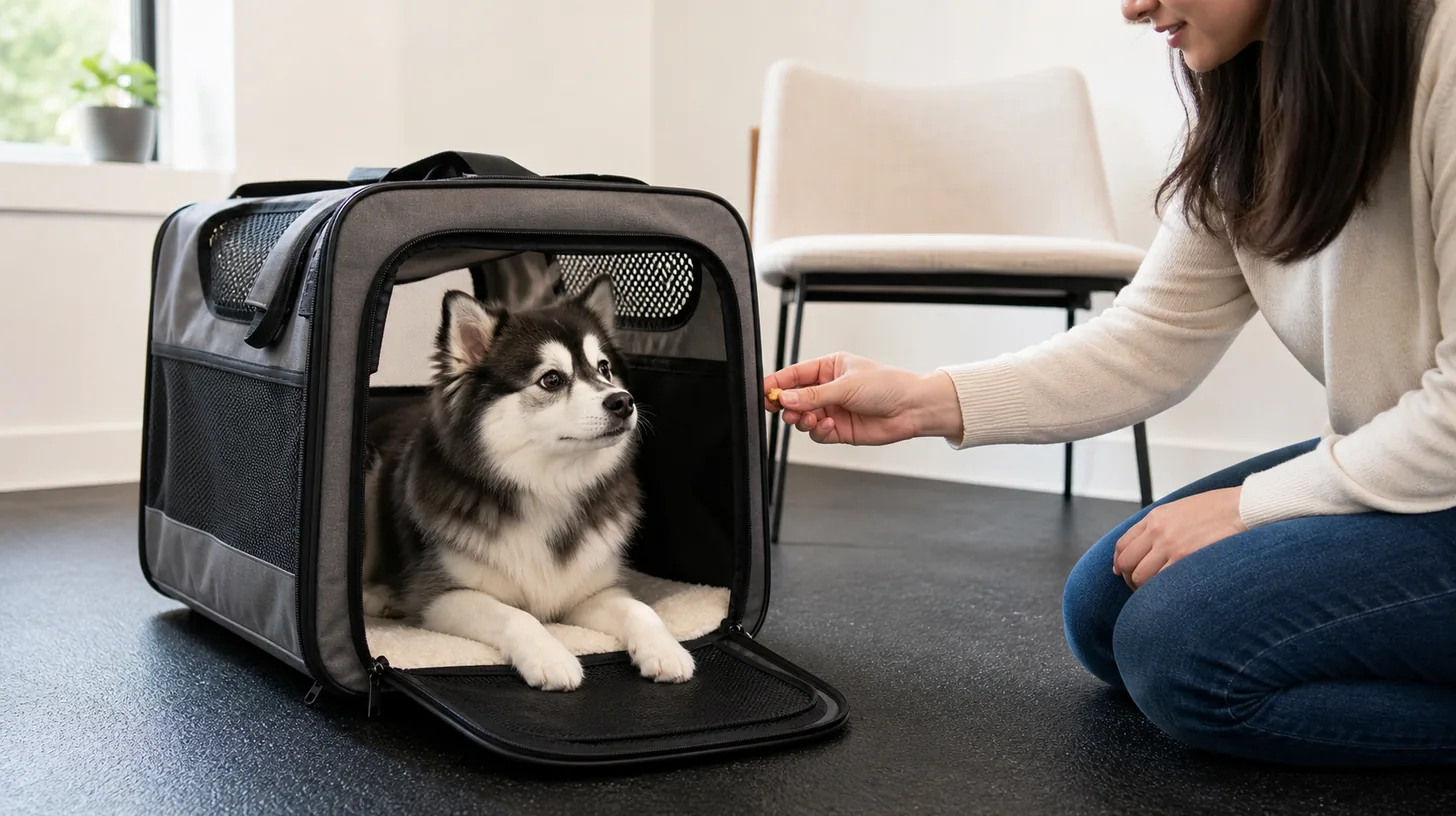
Leave the carrier open in a quiet room and reward looking toward it, approaching, and placing paws inside. Toss a treat near the entrance, then gradually farther back. Feed some meals beside or inside the carrier if the dog remains relaxed. Do not push, pull, zip the opening, or lift the carrier during this stage. The Pomsky should be able to exit freely.
Add a cue such as “carrier” only after entry is predictable. Reward the dog for turning around and orienting toward the exit rather than remaining twisted. If the dog backs out immediately, reduce difficulty and reward one extra second at a time. Sessions should end before panting, scratching, frantic turning, vocal escalation, or refusal to approach. Those signs mean the current step is too difficult or the space needs reassessment.
Teach settling and position changes
Air travel requires more than entering. Reinforce lying down, shifting position, and remaining quiet while the carrier stays open. Deliver rewards through the opening at varied intervals. Gradually practice with the handler sitting farther away. Include normal household sounds at low intensity, but keep enough distance that the dog can still eat, relax, and respond.
Observe whether the Pomsky can stand, turn, and lie naturally without the coat pressing tightly against every surface. Recheck fit after grooming changes, growth, or weight change. If the dog cannot perform those movements, training should stop until equipment is corrected. Do not use prolonged confinement to make the dog “get used to it.” Comfort and fit are prerequisites.
Add closure movement and travel sounds
Close the door for one second, reward, and open it before concern appears. Increase duration gradually and vary it so every repetition is not harder. Then lift the carrier a few centimeters, set it down smoothly, reward, and release. Later practice walking a short distance, placing the carrier under a chair that matches the expected clearance, and waiting quietly in a different room.
Introduce recordings of airport sounds at a low level while the dog completes easy carrier behavior. Real environments are more complex, so recordings are only preparation. Practice safe car transport to a neutral location if the veterinarian considers travel appropriate. Do not swing the carrier, place it on unstable luggage, block ventilation, or leave it unattended in a vehicle.
Rehearse the travel-day sequence
Run a complete low-stress rehearsal: toilet break, harness and identification check, carrier entry, a short wait, movement through the house, placement under a chair, water plan, and release in a secure area. Time the sequence and note where the dog becomes unsettled. Fix that step rather than repeatedly rehearsing distress.
Prepare a travel folder with current documents, airline contacts, veterinarian details, destination requirements, medication instructions if prescribed, and emergency alternatives. Pack absorbent material and cleaning supplies within the airline rules. Feed and water according to individualized veterinary and carrier guidance rather than following an internet fasting schedule.
Protect the dog during the actual trip
Use secure doors and a leash or contained transfer procedure whenever the carrier must open. Ask security personnel how screening will occur before removing the dog. Keep the carrier ventilated and positioned exactly as required. Monitor breathing, posture, temperature, responsiveness, and signs of escalating distress without repeatedly opening the carrier in an unsecured area.
If the airline, aircraft, weather, dog’s condition, or carrier differs from the verified plan, pause and reassess. A missed trip is preferable to forcing an unsafe setup. Know the location of veterinary care at the destination and during long connections. Never assume that a previous successful flight proves the next one will be suitable.
Stop when fit health or distress fails
Stop training and seek veterinary advice if the Pomsky shows breathing difficulty, collapse, repeated vomiting, marked lethargy, or other acute illness. Reassess the plan for persistent panic, escape attempts, self-injury, or inability to settle despite gradual work. A qualified behavior professional can help with conditioning, but cannot waive carrier, airline, or government requirements.
The practical standard is not silence at any cost. It is a dog that can enter voluntarily, change position, rest for the expected interval, and recover after movement in correctly sized equipment. Keep alternate transport or care arrangements available. Airline carrier training reduces uncertainty; it does not guarantee acceptance by a carrier or a stress-free flight.
Sources reviewed
Each source is used only for the claim scopes listed below. None establishes a guaranteed Pomsky outcome or replaces individual professional assessment.
- USDA Animal and Plant Health Inspection Service: Preparing Your Pet for Air Travel - Supports: carrier suitability; air-travel readiness; health and documentation planning. Limit: Airline, destination, and timing requirements vary; readers must verify current carrier and government rules for the exact trip.
- American Veterinary Society of Animal Behavior: Humane Dog Training Position Statement - Supports: reward-based training; aversive-method risk; behavior change principles. Limit: Does not guarantee outcomes for an individual dog.