Written and reviewed by A Pomsky Editorial Team. Originally published 2026-07-26; substantively reviewed July 26, 2026.
Safety boundary: This guide is educational and cannot diagnose, treat, or replace veterinary, medical, public-health, emergency-dispatch, animal-control, or jurisdiction-specific legal guidance. Use the health disclaimer and contact the appropriate professional for the actual situation.
Direct answer: Prepare boundaries and routines before the baby arrives, manage the first observations at a comfortable distance behind a secure barrier, and reward calm behavior. Keep infant hygiene and dog supplies separate, provide the dog with uninterrupted rest, and use active adult supervision or complete physical separation in every shared space.
Prepare boundaries before the baby arrives
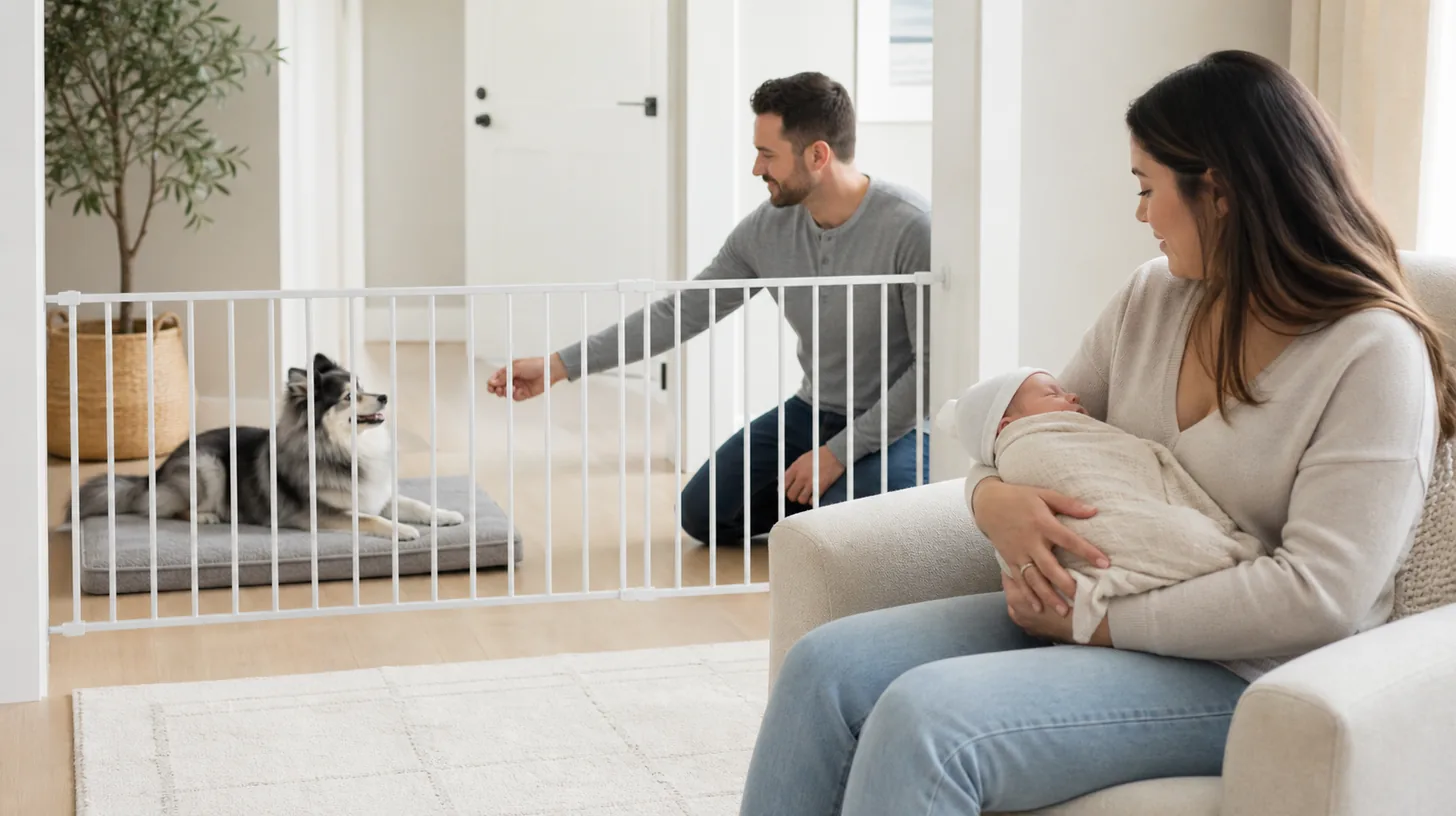
Decide which rooms and furniture will be accessible after the baby comes home, then teach those rules in advance. Use gates, closed doors, a mat, and a comfortable resting area so the Pomsky has a predictable place away from feeding, floor play, and sleep spaces. Reward calm use of the area; do not send the dog there only after conflict.
Review leash skills, settling, leave it, drop it, and moving away on cue with reward-based methods. Make changes to walk, meal, or sleep routines gradually. If another adult will take over care, begin that handoff early. A new baby should not arrive at the same moment that the dog loses every familiar routine and source of attention.
Arrange infant hygiene and dog care
Wash hands after handling dog food, waste, bowls, toys, or medication and before preparing bottles, pacifiers, or infant food. Store dog supplies away from baby items. Prevent access to diapers, formula, breast-pump parts, medication, lotions, and small objects. Clean dog waste promptly and maintain routine veterinary care and parasite prevention.
Keep the baby’s face, hands, bottles, and sleep surfaces away from licking. Do not allow the dog into a crib, bassinet, or infant sleep space. These boundaries apply even when the Pomsky is healthy and familiar. General hygiene reduces exposure risk but does not make unsupervised contact safe.
Introduce new sounds and equipment gradually
Set up the stroller, changing station, gates, and other equipment before the birth. Reward the dog for calm behavior at a distance while wheels move, alarms sound, or adults carry a bundled object. Use recordings of infant sounds at very low volume only while the dog remains relaxed, then increase gradually. Stop if the dog cannot eat, settle, or move away comfortably.
Do not force sniffing of baby items or place clothing directly against the dog’s face. Scent exposure may be included as one calm experience, but it does not predict behavior with the infant. The more important preparation is a rehearsed pattern: adults manage the environment, the dog has distance and choice, and calm behavior earns reinforcement.
Manage the first arrival
Give the Pomsky exercise and a toilet break suited to its normal needs before the arrival, without exhausting the dog. One adult can greet the dog calmly while another remains with the baby. Begin with the dog behind a gate or on leash at a comfortable distance. Reward looking calmly and orienting back to the handler.
Do not carry the infant toward a tense or highly aroused dog, invite face-to-face contact, or stage a photograph. The first session can end without close contact. Several short, quiet observations are safer and more informative than one prolonged introduction. If the dog barks, lunges, freezes, hides, or cannot settle, increase distance and end the session.
Supervise every shared space
Active supervision means an alert adult is close enough to intervene and is not sleeping, using a phone, cooking, or leaving the room. If active supervision is unavailable, use a physical barrier and separate spaces. Never leave an infant or young child alone with a dog, including a trusted family Pomsky.
Position the dog so it has an exit route and is not trapped between furniture and people. Keep food bowls, chews, toys, and resting areas out of the baby’s reach. As the baby becomes mobile, management must increase because crawling, grabbing, sudden sounds, and unpredictable movement can change the dog’s comfort.
Read the dog's body language
Look for loose muscles, normal breathing, soft eyes, voluntary approach and retreat, and ability to respond to familiar cues. Concern signs can include freezing, hard staring, whale eye, tucked posture, repeated lip licking, yawning outside a rest context, turning away, hiding, growling, or rapid arousal. A growl is information that distance is needed; punishing it can remove a warning without improving comfort.
Record the context of concerning behavior: distance, infant activity, dog location, food or toys present, and recovery time. Do not diagnose jealousy or assume the behavior reflects a Pomsky trait. Pain, fear, resource concerns, sleep disruption, and environmental stress may contribute. Sudden or escalating change deserves veterinary and qualified behavior assessment.
Protect routines and rest
Schedule predictable toilet breaks, walks, meals, and quiet contact with adults. Provide uninterrupted sleep in a child-free zone. Use food puzzles or training only when they are safe for the individual dog and supervised appropriately. Include the dog in calm household routines without requiring constant proximity to the baby.
Avoid compensating with high-arousal play immediately beside infant spaces. Do not let visitors crowd the dog while also greeting the baby. A gate, separate room, or trusted caregiver can reduce pressure during busy periods. Welfare includes permission to rest away from family activity.
Know when to involve professionals
Consult the veterinarian for pain, illness, sleep or appetite change, or sudden behavior differences. Seek a qualified reward-based behavior professional before close introductions when there is a bite history, guarding, predatory behavior toward small animals, severe fear, or inability to recover around infant sounds or movement. Urgent threats require immediate separation and local professional help.
No article can certify that an individual dog is safe with a baby. The durable plan is layered: hygiene, trained routines, physical barriers, active supervision, body-language observation, and early escalation. Those layers should remain in place as the child develops; a calm newborn stage does not guarantee comfort once crawling and walking begin.
Write an emergency separation plan and place it where every caregiver can follow it. Identify which adult takes the baby, which adult secures the dog, which gates or doors create complete separation, and whom to call. Practice the movement without the baby present. During a tense event, do not reach between the dog and child, grab the collar beside the face, or argue about whether a warning was “serious.” Create distance first, check for injury, and obtain appropriate medical, veterinary, and behavior guidance.
Reassess the home at each developmental change. Rolling, crawling, standing, walking, food throwing, and visiting children create different exposures. Move gates, bowls, toys, and rest areas before the new behavior starts. The management plan should develop faster than the child’s access.
Sources reviewed
Each source is used only for the claim scopes listed below. None establishes a guaranteed Pomsky outcome or replaces individual professional assessment.
- U.S. Centers for Disease Control and Prevention: Dogs: Healthy Pets, Healthy People - Supports: supervision around young children; bite prevention; household hygiene and routine veterinary care. Limit: General prevention guidance does not assess an individual dog's behavior or replace pediatric, veterinary, or qualified behavior advice.
- American Veterinary Society of Animal Behavior: Humane Dog Training Position Statement - Supports: reward-based training; aversive-method risk; behavior change principles. Limit: Does not guarantee outcomes for an individual dog.
- American Veterinary Society of Animal Behavior: How to Select a Behavior Consultant - Supports: trainer credentials; behavior consultant selection; red flags. Limit: Avoid implying that a title alone proves competence.