Written and reviewed by A Pomsky Editorial Team. Originally published 2026-07-26; substantively reviewed July 26, 2026.
Training boundary: Use humane, reward-based methods and protect safety with management. Pain, panic, aggression, a bite history, or serious handling risk requires a veterinarian or qualified behavior professional. Read the editorial policy.
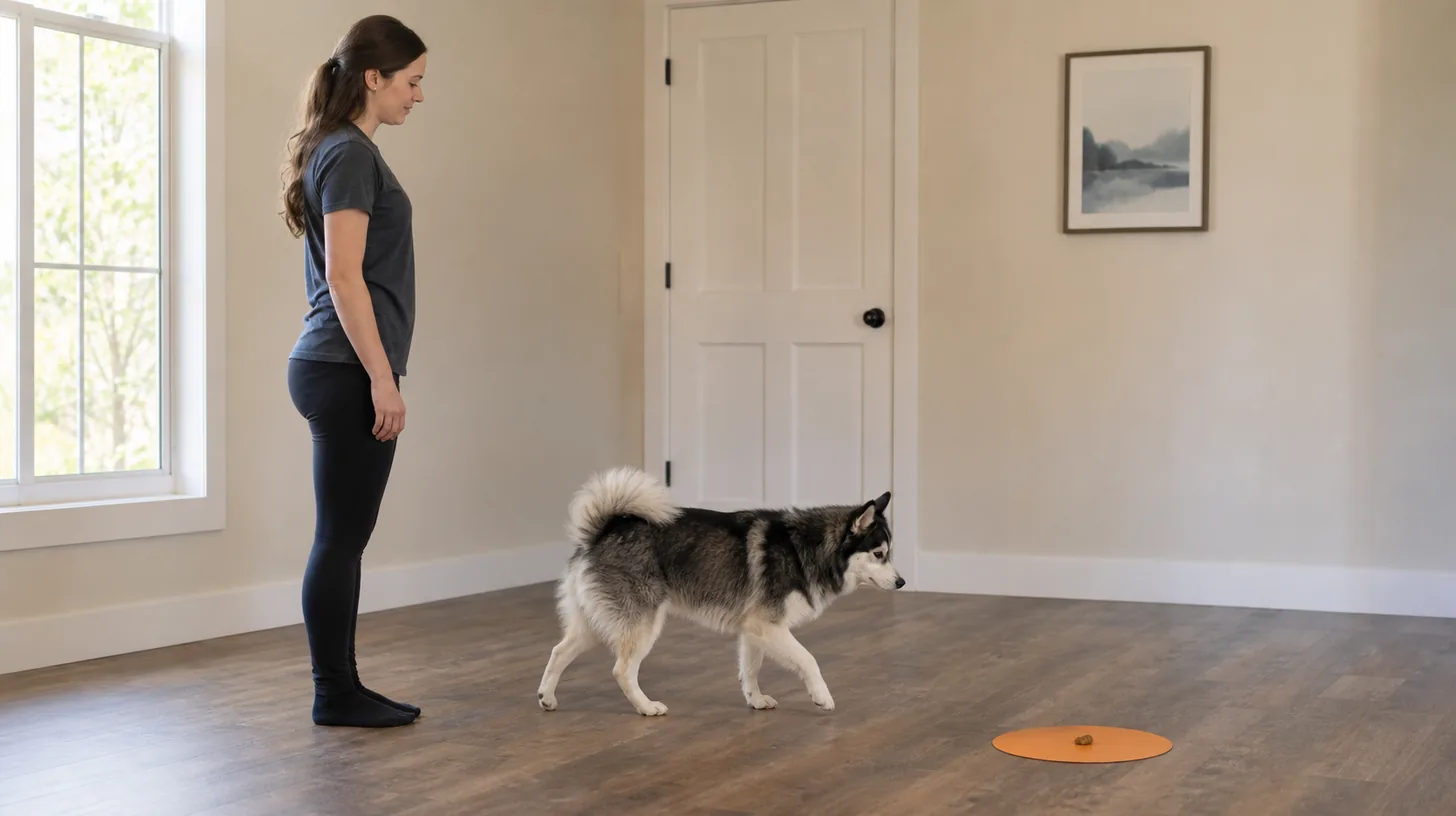
Direct answer: Place a large flat nonslip marker one step away in a closed quiet room. Stand side-on and wait for any voluntary movement toward it, or place a reward on the marker before the Pomsky enters the setup. Mark when the dog moves away from your body and creates comfortable space, then reinforce at the marker. Reset by moving yourself rather than crowding the dog. Once the same short route is predictable, say move away immediately before the movement. Add distance one step at a time and release from the marker separately. Never walk into, point at, scold or push the Pomsky away. Stop for avoidance, freezing, guarding, slipping or unsafe access beyond the marker.
This page teaches forward travel away from the caregiver to one visible temporary marker; back-up owns reverse steps, hand targeting brings the nose toward a palm, and two-mat switching alternates between two established stations. Use a broad flat nonslip marker in open indoor space with no food, doorway, stairs or disputed resource beyond it. Keep shoulders and feet neutral so the Pomsky can move toward or away from the marker without being trapped. The plan keeps management, voluntary behavior, reinforcement and transition criteria explicit.
Choose One Safe Destination Marker
Use a broad flat nonslip marker in open indoor space with no food, doorway, stairs or disputed resource beyond it.
Treat this as one part of the complete routine, not an isolated trick. The surrounding setup is a controlled low-distraction setup for choose one safe destination marker, stand side-on with an open route and capture one voluntary step away, with nonslip footing, an open exit, suitable rewards and one adult handler. A clean transition reduces ambiguity and makes it easier to notice when the dog, equipment, environment, or records differ from the previous attempt. In this routine, step 1 is the choose one safe destination marker decision.
Do not convert this step into a stress test. The principal avoidable risks are adding reset by moving the caregiver before reward directly at the marker is stable, skipping build distance one step at a time, or continuing through pain, fear, guarding, unsafe equipment, loss of control or prolonged avoidance. Write down For How to Teach a Pomsky a Move-Away Cue, record Choose One Safe Destination Marker, Stand Side-On With an Open Route, Capture One Voluntary Step Away, Reward Directly at the Marker; compare Reset by Moving the Caregiver, Add the Cue Before the Known Route, Build Distance One Step at a Time; then close with Release From the Marker Separately, Audit the Space Beyond the Marker, Stop for Avoidance or Conflict. Use dates, direct observations, transition quality and recovery.; a short factual note is more useful than a reassuring guess. Record the result of choose one safe destination marker before continuing.
Stand Side-On With an Open Route
Keep shoulders and feet neutral so the Pomsky can move toward or away from the marker without being trapped.
Pause long enough to inspect the result rather than assuming the action worked. Look at the dog, the physical boundary, and the next movement available to the caregiver. Continue only when the arrangement still supports Place one visible nonslip floor marker a single step away, reward voluntary movement from the caregiver toward that marker, mark when all four paws create comfortable space, deliver reinforcement at the marker, add the move-away cue only after the route is predictable, release from the marker, and never drive the dog away with body pressure or test the skill around hazards.. In this routine, step 2 is the stand side-on with an open route decision.
Stop when the expected condition is absent or the situation begins to depend on force, luck, or an open boundary. Specifically avoid adding reset by moving the caregiver before reward directly at the marker is stable, skipping build distance one step at a time, or continuing through pain, fear, guarding, unsafe equipment, loss of control or prolonged avoidance. The follow-up record should cover For How to Teach a Pomsky a Move-Away Cue, record Choose One Safe Destination Marker, Stand Side-On With an Open Route, Capture One Voluntary Step Away, Reward Directly at the Marker; compare Reset by Moving the Caregiver, Add the Cue Before the Known Route, Build Distance One Step at a Time; then close with Release From the Marker Separately, Audit the Space Beyond the Marker, Stop for Avoidance or Conflict. Use dates, direct observations, transition quality and recovery.. Record the result of stand side-on with an open route before continuing.
Capture One Voluntary Step Away
Mark the first forward movement that increases distance from the caregiver instead of leaning or walking into the dog.
A second capable adult can verify the boundary during early practice or higher-risk situations. That person should follow the same sequence and avoid adding prompts, handling, or access that changes the task. The shared standard remains Place one visible nonslip floor marker a single step away, reward voluntary movement from the caregiver toward that marker, mark when all four paws create comfortable space, deliver reinforcement at the marker, add the move-away cue only after the route is predictable, release from the marker, and never drive the dog away with body pressure or test the skill around hazards.. In this routine, step 3 is the capture one voluntary step away decision.
The absence of an incident is not proof that the arrangement is sound. Recheck for adding reset by moving the caregiver before reward directly at the marker is stable, skipping build distance one step at a time, or continuing through pain, fear, guarding, unsafe equipment, loss of control or prolonged avoidance. Document For How to Teach a Pomsky a Move-Away Cue, record Choose One Safe Destination Marker, Stand Side-On With an Open Route, Capture One Voluntary Step Away, Reward Directly at the Marker; compare Reset by Moving the Caregiver, Add the Cue Before the Known Route, Build Distance One Step at a Time; then close with Release From the Marker Separately, Audit the Space Beyond the Marker, Stop for Avoidance or Conflict. Use dates, direct observations, transition quality and recovery. so a later caregiver can distinguish a passed step from one that was skipped. Record the result of capture one voluntary step away before continuing.
Reward Directly at the Marker
Place reinforcement on the destination so the movement outcome is clear and does not immediately draw the dog back.
Perform this check before adding the next variable. The target remains Place one visible nonslip floor marker a single step away, reward voluntary movement from the caregiver toward that marker, mark when all four paws create comfortable space, deliver reinforcement at the marker, add the move-away cue only after the route is predictable, release from the marker, and never drive the dog away with body pressure or test the skill around hazards.. Work in a controlled low-distraction setup for choose one safe destination marker, stand side-on with an open route and capture one voluntary step away, with nonslip footing, an open exit, suitable rewards and one adult handler. If the setup cannot preserve that condition, simplify it or stop rather than relying on speed or physical control. In this routine, step 4 is the reward directly at the marker decision.
If the Pomsky cannot remain comfortable or the equipment and environment cannot remain controlled, end the attempt. Do not proceed through adding reset by moving the caregiver before reward directly at the marker is stable, skipping build distance one step at a time, or continuing through pain, fear, guarding, unsafe equipment, loss of control or prolonged avoidance. Capture For How to Teach a Pomsky a Move-Away Cue, record Choose One Safe Destination Marker, Stand Side-On With an Open Route, Capture One Voluntary Step Away, Reward Directly at the Marker; compare Reset by Moving the Caregiver, Add the Cue Before the Known Route, Build Distance One Step at a Time; then close with Release From the Marker Separately, Audit the Space Beyond the Marker, Stop for Avoidance or Conflict. Use dates, direct observations, transition quality and recovery. before deciding what changes next. Record the result of reward directly at the marker before continuing.
Reset by Moving the Caregiver
Step to a new neutral start while the Pomsky remains free rather than pulling or repositioning the dog.
Use an observable pass condition: the relevant item is checked, the boundary is closed, and the Pomsky can remain safe without being used as a test. This protects the main objective, Place one visible nonslip floor marker a single step away, reward voluntary movement from the caregiver toward that marker, mark when all four paws create comfortable space, deliver reinforcement at the marker, add the move-away cue only after the route is predictable, release from the marker, and never drive the dog away with body pressure or test the skill around hazards., while leaving a clear point at which the caregiver can step back. In this routine, step 5 is the reset by moving the caregiver decision.
Do not convert this step into a stress test. The principal avoidable risks are adding reset by moving the caregiver before reward directly at the marker is stable, skipping build distance one step at a time, or continuing through pain, fear, guarding, unsafe equipment, loss of control or prolonged avoidance. Write down For How to Teach a Pomsky a Move-Away Cue, record Choose One Safe Destination Marker, Stand Side-On With an Open Route, Capture One Voluntary Step Away, Reward Directly at the Marker; compare Reset by Moving the Caregiver, Add the Cue Before the Known Route, Build Distance One Step at a Time; then close with Release From the Marker Separately, Audit the Space Beyond the Marker, Stop for Avoidance or Conflict. Use dates, direct observations, transition quality and recovery.; a short factual note is more useful than a reassuring guess. Record the result of reset by moving the caregiver before continuing.
Add the Cue Before the Known Route
Say move away once only after the same marker and starting picture reliably produce the step.
Keep the sequence repeatable across caregivers. Say what is being checked, complete it, and return equipment and people to neutral before continuing. In this page's context, success means Place one visible nonslip floor marker a single step away, reward voluntary movement from the caregiver toward that marker, mark when all four paws create comfortable space, deliver reinforcement at the marker, add the move-away cue only after the route is predictable, release from the marker, and never drive the dog away with body pressure or test the skill around hazards.; it does not mean proving that a known risk can be tolerated. In this routine, step 6 is the add the cue before the known route decision.
Stop when the expected condition is absent or the situation begins to depend on force, luck, or an open boundary. Specifically avoid adding reset by moving the caregiver before reward directly at the marker is stable, skipping build distance one step at a time, or continuing through pain, fear, guarding, unsafe equipment, loss of control or prolonged avoidance. The follow-up record should cover For How to Teach a Pomsky a Move-Away Cue, record Choose One Safe Destination Marker, Stand Side-On With an Open Route, Capture One Voluntary Step Away, Reward Directly at the Marker; compare Reset by Moving the Caregiver, Add the Cue Before the Known Route, Build Distance One Step at a Time; then close with Release From the Marker Separately, Audit the Space Beyond the Marker, Stop for Avoidance or Conflict. Use dates, direct observations, transition quality and recovery.. Record the result of add the cue before the known route before continuing.
Build Distance One Step at a Time
Move the marker slightly farther while preserving traction, open access and immediate reinforcement at the destination.
Treat this as one part of the complete routine, not an isolated trick. The surrounding setup is a controlled low-distraction setup for choose one safe destination marker, stand side-on with an open route and capture one voluntary step away, with nonslip footing, an open exit, suitable rewards and one adult handler. A clean transition reduces ambiguity and makes it easier to notice when the dog, equipment, environment, or records differ from the previous attempt. In this routine, step 7 is the build distance one step at a time decision.
The absence of an incident is not proof that the arrangement is sound. Recheck for adding reset by moving the caregiver before reward directly at the marker is stable, skipping build distance one step at a time, or continuing through pain, fear, guarding, unsafe equipment, loss of control or prolonged avoidance. Document For How to Teach a Pomsky a Move-Away Cue, record Choose One Safe Destination Marker, Stand Side-On With an Open Route, Capture One Voluntary Step Away, Reward Directly at the Marker; compare Reset by Moving the Caregiver, Add the Cue Before the Known Route, Build Distance One Step at a Time; then close with Release From the Marker Separately, Audit the Space Beyond the Marker, Stop for Avoidance or Conflict. Use dates, direct observations, transition quality and recovery. so a later caregiver can distinguish a passed step from one that was skipped. Record the result of build distance one step at a time before continuing.
Release From the Marker Separately
Use another cue to end the destination pause so move away does not also mean return.
Pause long enough to inspect the result rather than assuming the action worked. Look at the dog, the physical boundary, and the next movement available to the caregiver. Continue only when the arrangement still supports Place one visible nonslip floor marker a single step away, reward voluntary movement from the caregiver toward that marker, mark when all four paws create comfortable space, deliver reinforcement at the marker, add the move-away cue only after the route is predictable, release from the marker, and never drive the dog away with body pressure or test the skill around hazards.. In this routine, step 8 is the release from the marker separately decision.
If the Pomsky cannot remain comfortable or the equipment and environment cannot remain controlled, end the attempt. Do not proceed through adding reset by moving the caregiver before reward directly at the marker is stable, skipping build distance one step at a time, or continuing through pain, fear, guarding, unsafe equipment, loss of control or prolonged avoidance. Capture For How to Teach a Pomsky a Move-Away Cue, record Choose One Safe Destination Marker, Stand Side-On With an Open Route, Capture One Voluntary Step Away, Reward Directly at the Marker; compare Reset by Moving the Caregiver, Add the Cue Before the Known Route, Build Distance One Step at a Time; then close with Release From the Marker Separately, Audit the Space Beyond the Marker, Stop for Avoidance or Conflict. Use dates, direct observations, transition quality and recovery. before deciding what changes next. Record the result of release from the marker separately before continuing.
Audit the Space Beyond the Marker
Keep hazards, exits, people, animals and guarded items outside the complete route and landing area.
A second capable adult can verify the boundary during early practice or higher-risk situations. That person should follow the same sequence and avoid adding prompts, handling, or access that changes the task. The shared standard remains Place one visible nonslip floor marker a single step away, reward voluntary movement from the caregiver toward that marker, mark when all four paws create comfortable space, deliver reinforcement at the marker, add the move-away cue only after the route is predictable, release from the marker, and never drive the dog away with body pressure or test the skill around hazards.. In this routine, step 9 is the audit the space beyond the marker decision.
Do not convert this step into a stress test. The principal avoidable risks are adding reset by moving the caregiver before reward directly at the marker is stable, skipping build distance one step at a time, or continuing through pain, fear, guarding, unsafe equipment, loss of control or prolonged avoidance. Write down For How to Teach a Pomsky a Move-Away Cue, record Choose One Safe Destination Marker, Stand Side-On With an Open Route, Capture One Voluntary Step Away, Reward Directly at the Marker; compare Reset by Moving the Caregiver, Add the Cue Before the Known Route, Build Distance One Step at a Time; then close with Release From the Marker Separately, Audit the Space Beyond the Marker, Stop for Avoidance or Conflict. Use dates, direct observations, transition quality and recovery.; a short factual note is more useful than a reassuring guess. Record the result of audit the space beyond the marker before continuing.
Stop for Avoidance or Conflict
End for freezing, cowering, guarding, barking, slipping, fleeing, pain or any need to drive the Pomsky with body pressure.
Perform this check before adding the next variable. The target remains Place one visible nonslip floor marker a single step away, reward voluntary movement from the caregiver toward that marker, mark when all four paws create comfortable space, deliver reinforcement at the marker, add the move-away cue only after the route is predictable, release from the marker, and never drive the dog away with body pressure or test the skill around hazards.. Work in a controlled low-distraction setup for choose one safe destination marker, stand side-on with an open route and capture one voluntary step away, with nonslip footing, an open exit, suitable rewards and one adult handler. If the setup cannot preserve that condition, simplify it or stop rather than relying on speed or physical control. In this routine, step 10 is the stop for avoidance or conflict decision.
Stop when the expected condition is absent or the situation begins to depend on force, luck, or an open boundary. Specifically avoid adding reset by moving the caregiver before reward directly at the marker is stable, skipping build distance one step at a time, or continuing through pain, fear, guarding, unsafe equipment, loss of control or prolonged avoidance. The follow-up record should cover For How to Teach a Pomsky a Move-Away Cue, record Choose One Safe Destination Marker, Stand Side-On With an Open Route, Capture One Voluntary Step Away, Reward Directly at the Marker; compare Reset by Moving the Caregiver, Add the Cue Before the Known Route, Build Distance One Step at a Time; then close with Release From the Marker Separately, Audit the Space Beyond the Marker, Stop for Avoidance or Conflict. Use dates, direct observations, transition quality and recovery.. Record the result of stop for avoidance or conflict before continuing.
When to Stop and Escalate
Stop when the Pomsky, caregiver, equipment, records, or environment no longer supports Place one visible nonslip floor marker a single step away, reward voluntary movement from the caregiver toward that marker, mark when all four paws create comfortable space, deliver reinforcement at the marker, add the move-away cue only after the route is predictable, release from the marker, and never drive the dog away with body pressure or test the skill around hazards.. Do not improvise through adding reset by moving the caregiver before reward directly at the marker is stable, skipping build distance one step at a time, or continuing through pain, fear, guarding, unsafe equipment, loss of control or prolonged avoidance. Seek a veterinarian for health or pain concerns and a qualified reward-based professional for exceptions during audit the space beyond the marker or stop for avoidance or conflict. Bring the factual observations already collected rather than recreating the event.
Before another attempt, review For How to Teach a Pomsky a Move-Away Cue, record Choose One Safe Destination Marker, Stand Side-On With an Open Route, Capture One Voluntary Step Away, Reward Directly at the Marker; compare Reset by Moving the Caregiver, Add the Cue Before the Known Route, Build Distance One Step at a Time; then close with Release From the Marker Separately, Audit the Space Beyond the Marker, Stop for Avoidance or Conflict. Use dates, direct observations, transition quality and recovery.. Resume only after the responsible person, physical setup, and controlling instructions are clear. A stop is part of the protocol: it preserves useful evidence and prevents uncertainty from becoming exposure.
Keep the Routine Current
Recheck the complete setup whenever the dog, household, product, instructions, environment, or purpose changes. The intended outcome remains Place one visible nonslip floor marker a single step away, reward voluntary movement from the caregiver toward that marker, mark when all four paws create comfortable space, deliver reinforcement at the marker, add the move-away cue only after the route is predictable, release from the marker, and never drive the dog away with body pressure or test the skill around hazards., not a perfect-looking performance. Use the newest primary instruction, retain dated records, and retire superseded assumptions so every caregiver begins from the same current plan.
Sources reviewed
Each source is used only for the claim scopes listed below. None establishes a guaranteed Pomsky outcome or replaces individual professional assessment.
- American Veterinary Society of Animal Behavior: Humane Dog Training Position Statement - Supports: reward-based training; aversive-method risk; behavior change principles. Limit: Does not guarantee outcomes for an individual dog.
- American Animal Hospital Association: Lifestyle and Safety Assessment - Supports: appropriate confinement; leash, collar and harness planning; lifestyle-specific safety review. Limit: Equipment selection must account for the individual dog's anatomy, behavior, health, and environment.