Written and reviewed by A Pomsky Editorial Team. Originally published 2026-07-26; substantively reviewed July 26, 2026.
Training boundary: Use humane, reward-based methods and protect safety with management. Pain, panic, aggression, a bite history, or serious handling risk requires a veterinarian or qualified behavior professional. Read the editorial policy.
Direct answer: Confirm the shelter's current meeting rules and match the exact Pomsky to the available identifier and source records. Explain the real household context, let staff control barriers and handling, and observe ordinary behavior without provoking reactions or forcing touch. Ask what is known, unknown, and source-documented about care, health, behavior, and transition needs, then leave with written follow-up questions rather than treating one meeting as a guarantee.
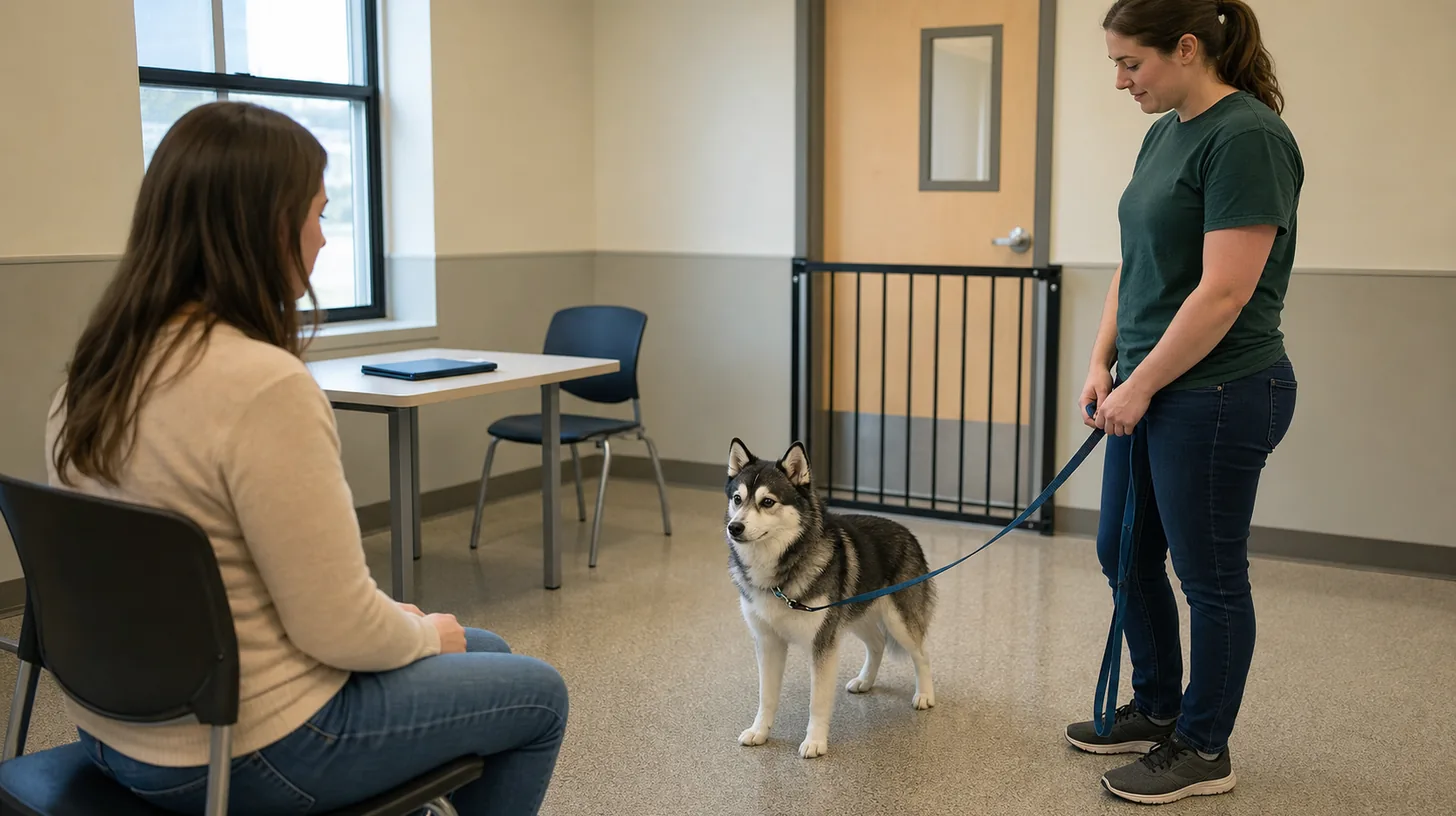
A shelter meet-and-greet is a structured information-gathering session under the organization's current rules. It is not a stress test and cannot guarantee future health, behavior, ancestry, or household fit. The adopter should verify the exact Pomsky and available records, ask what is known and unknown, observe ordinary behavior in the provided context, protect people and animals, and leave with documented follow-up questions rather than pressure for an immediate conclusion.
Verify the Organization and Appointment
Use the shelter's official contact route to confirm location, time, participants, required identification, animal policy, fees, and decision process.
Use an observable pass condition: the relevant item is checked, the boundary is closed, and the Pomsky can remain safe without being used as a test. This protects the main objective, a factual shelter-controlled meeting that identifies known records, observable responses, household constraints, and unresolved follow-up, while leaving a clear point at which the caregiver can step back. In this routine, step 1 is the verify the organization and appointment decision.
The absence of an incident is not proof that the arrangement is sound. Recheck for provoking reactions, forced touch, crowding, bringing animals without approval, treating one session as a guarantee, hiding household constraints, or rushed paperwork. Document organization contact, dog identity, record sources, meeting rules, participants, context, observations, handling limits, household questions, unknowns, and follow-up so a later caregiver can distinguish a passed step from one that was skipped. Record the result of verify the organization and appointment before continuing.
Match the Exact Pomsky to Records
Compare shelter identifier, name, photo, markings, sex, age estimate, microchip reference, intake history, and available veterinary documents.
Keep the sequence repeatable across caregivers. Say what is being checked, complete it, and return equipment and people to neutral before continuing. In this page's context, success means a factual shelter-controlled meeting that identifies known records, observable responses, household constraints, and unresolved follow-up; it does not mean proving that a known risk can be tolerated. In this routine, step 2 is the match the exact pomsky to records decision.
The absence of an incident is not proof that the arrangement is sound. Recheck for provoking reactions, forced touch, crowding, bringing animals without approval, treating one session as a guarantee, hiding household constraints, or rushed paperwork. Document organization contact, dog identity, record sources, meeting rules, participants, context, observations, handling limits, household questions, unknowns, and follow-up so a later caregiver can distinguish a passed step from one that was skipped. Record the result of match the exact pomsky to records before continuing.
Separate Known Facts From Unknowns
Ask staff to identify the source and date of each statement and preserve uncertainty when prior home, parentage, health, or behavior information is unavailable.
Treat this as one part of the complete routine, not an isolated trick. The surrounding setup is the shelter's approved meeting area with staff direction, secure barriers, household decision-makers, and no unapproved resident animals. A clean transition reduces ambiguity and makes it easier to notice when the dog, equipment, environment, or records differ from the previous attempt. In this routine, step 3 is the separate known facts from unknowns decision.
The absence of an incident is not proof that the arrangement is sound. Recheck for provoking reactions, forced touch, crowding, bringing animals without approval, treating one session as a guarantee, hiding household constraints, or rushed paperwork. Document organization contact, dog identity, record sources, meeting rules, participants, context, observations, handling limits, household questions, unknowns, and follow-up so a later caregiver can distinguish a passed step from one that was skipped. Record the result of separate known facts from unknowns before continuing.
Disclose the Real Household Context
Describe adults, children, animals, housing, doors, work schedule, travel, care capacity, and restrictions accurately so staff can address relevant concerns.
Pause long enough to inspect the result rather than assuming the action worked. Look at the dog, the physical boundary, and the next movement available to the caregiver. Continue only when the arrangement still supports a factual shelter-controlled meeting that identifies known records, observable responses, household constraints, and unresolved follow-up. In this routine, step 4 is the disclose the real household context decision.
The absence of an incident is not proof that the arrangement is sound. Recheck for provoking reactions, forced touch, crowding, bringing animals without approval, treating one session as a guarantee, hiding household constraints, or rushed paperwork. Document organization contact, dog identity, record sources, meeting rules, participants, context, observations, handling limits, household questions, unknowns, and follow-up so a later caregiver can distinguish a passed step from one that was skipped. Record the result of disclose the real household context before continuing.
Follow the Shelter's Handling Rules
Allow staff to control entrances, leash changes, barriers, toys, food, touch, and movement and do not improvise a test.
A second capable adult can verify the boundary during early practice or higher-risk situations. That person should follow the same sequence and avoid adding prompts, handling, or access that changes the task. The shared standard remains a factual shelter-controlled meeting that identifies known records, observable responses, household constraints, and unresolved follow-up. In this routine, step 5 is the follow the shelter's handling rules decision.
The absence of an incident is not proof that the arrangement is sound. Recheck for provoking reactions, forced touch, crowding, bringing animals without approval, treating one session as a guarantee, hiding household constraints, or rushed paperwork. Document organization contact, dog identity, record sources, meeting rules, participants, context, observations, handling limits, household questions, unknowns, and follow-up so a later caregiver can distinguish a passed step from one that was skipped. Record the result of follow the shelter's handling rules before continuing.
Observe Without Provoking
Record ordinary approach, distance, movement, recovery, environmental scanning, handling response, and ability to disengage without cornering or startling the dog.
Perform this check before adding the next variable. The target remains a factual shelter-controlled meeting that identifies known records, observable responses, household constraints, and unresolved follow-up. Work in the shelter's approved meeting area with staff direction, secure barriers, household decision-makers, and no unapproved resident animals. If the setup cannot preserve that condition, simplify it or stop rather than relying on speed or physical control. In this routine, step 6 is the observe without provoking decision.
The absence of an incident is not proof that the arrangement is sound. Recheck for provoking reactions, forced touch, crowding, bringing animals without approval, treating one session as a guarantee, hiding household constraints, or rushed paperwork. Document organization contact, dog identity, record sources, meeting rules, participants, context, observations, handling limits, household questions, unknowns, and follow-up so a later caregiver can distinguish a passed step from one that was skipped. Record the result of observe without provoking before continuing.
Ask About Daily Care and Transitions
Review current food, medication, elimination, rest, walking, equipment, transport, alone time, known triggers, and transition support.
Use an observable pass condition: the relevant item is checked, the boundary is closed, and the Pomsky can remain safe without being used as a test. This protects the main objective, a factual shelter-controlled meeting that identifies known records, observable responses, household constraints, and unresolved follow-up, while leaving a clear point at which the caregiver can step back. In this routine, step 7 is the ask about daily care and transitions decision.
The absence of an incident is not proof that the arrangement is sound. Recheck for provoking reactions, forced touch, crowding, bringing animals without approval, treating one session as a guarantee, hiding household constraints, or rushed paperwork. Document organization contact, dog identity, record sources, meeting rules, participants, context, observations, handling limits, household questions, unknowns, and follow-up so a later caregiver can distinguish a passed step from one that was skipped. Record the result of ask about daily care and transitions before continuing.
Discuss Other Animals Separately
Do not bring or introduce a resident animal unless the shelter approves and controls a separate process with appropriate handlers and exit routes.
Keep the sequence repeatable across caregivers. Say what is being checked, complete it, and return equipment and people to neutral before continuing. In this page's context, success means a factual shelter-controlled meeting that identifies known records, observable responses, household constraints, and unresolved follow-up; it does not mean proving that a known risk can be tolerated. In this routine, step 8 is the discuss other animals separately decision.
The absence of an incident is not proof that the arrangement is sound. Recheck for provoking reactions, forced touch, crowding, bringing animals without approval, treating one session as a guarantee, hiding household constraints, or rushed paperwork. Document organization contact, dog identity, record sources, meeting rules, participants, context, observations, handling limits, household questions, unknowns, and follow-up so a later caregiver can distinguish a passed step from one that was skipped. Record the result of discuss other animals separately before continuing.
Review Medical and Legal Follow-Up
Identify available veterinary review, microchip transfer, licensing, contract, return, disclosure, and post-adoption support requirements.
Treat this as one part of the complete routine, not an isolated trick. The surrounding setup is the shelter's approved meeting area with staff direction, secure barriers, household decision-makers, and no unapproved resident animals. A clean transition reduces ambiguity and makes it easier to notice when the dog, equipment, environment, or records differ from the previous attempt. In this routine, step 9 is the review medical and legal follow-up decision.
The absence of an incident is not proof that the arrangement is sound. Recheck for provoking reactions, forced touch, crowding, bringing animals without approval, treating one session as a guarantee, hiding household constraints, or rushed paperwork. Document organization contact, dog identity, record sources, meeting rules, participants, context, observations, handling limits, household questions, unknowns, and follow-up so a later caregiver can distinguish a passed step from one that was skipped. Record the result of review medical and legal follow-up before continuing.
Leave With Written Unknowns
Document unresolved records, questions, professional reviews, household changes, deadlines, and the official next step instead of inventing certainty.
Pause long enough to inspect the result rather than assuming the action worked. Look at the dog, the physical boundary, and the next movement available to the caregiver. Continue only when the arrangement still supports a factual shelter-controlled meeting that identifies known records, observable responses, household constraints, and unresolved follow-up. In this routine, step 10 is the leave with written unknowns decision.
The absence of an incident is not proof that the arrangement is sound. Recheck for provoking reactions, forced touch, crowding, bringing animals without approval, treating one session as a guarantee, hiding household constraints, or rushed paperwork. Document organization contact, dog identity, record sources, meeting rules, participants, context, observations, handling limits, household questions, unknowns, and follow-up so a later caregiver can distinguish a passed step from one that was skipped. Record the result of leave with written unknowns before continuing.
When to Stop and Escalate
Stop when the Pomsky, caregiver, equipment, records, or environment no longer supports a factual shelter-controlled meeting that identifies known records, observable responses, household constraints, and unresolved follow-up. Do not improvise through provoking reactions, forced touch, crowding, bringing animals without approval, treating one session as a guarantee, hiding household constraints, or rushed paperwork. Seek shelter staff for current records and policy, a veterinarian for independent health review, and a qualified behavior professional for material behavior concerns. Bring the factual observations already collected rather than recreating the event.
Before another attempt, review organization contact, dog identity, record sources, meeting rules, participants, context, observations, handling limits, household questions, unknowns, and follow-up. Resume only after the responsible person, physical setup, and controlling instructions are clear. A stop is part of the protocol: it preserves useful evidence and prevents uncertainty from becoming exposure.
Keep the Routine Current
Recheck the complete setup whenever the dog, household, product, instructions, environment, or purpose changes. The intended outcome remains a factual shelter-controlled meeting that identifies known records, observable responses, household constraints, and unresolved follow-up, not a perfect-looking performance. Use the newest primary instruction, retain dated records, and retire superseded assumptions so every caregiver begins from the same current plan.
Sources reviewed
Each source is used only for the claim scopes listed below. None establishes a guaranteed Pomsky outcome or replaces individual professional assessment.
- American Animal Hospital Association: AAHA-AVMA Canine Preventive Healthcare Guidelines - Supports: preventive exams; individual risk assessment; parasite and vaccination planning. Limit: The veterinarian sets the schedule for the individual dog and location.
- American Animal Hospital Association: Animal Identification and Microchipping - Supports: current microchip registration; visible ID tags; annual chip scan; lost-pet search limits. Limit: Microchips are not GPS devices and do not replace secure containment, a leash, visible ID, or active search.
- American Veterinary Society of Animal Behavior: Humane Dog Training Position Statement - Supports: reward-based training; aversive-method risk; behavior change principles. Limit: Does not guarantee outcomes for an individual dog.
- U.S. Centers for Disease Control and Prevention: Dogs: Healthy Pets, Healthy People - Supports: unfamiliar-dog approach safety; bite prevention; wound cleaning; medical and animal-control escalation. Limit: An active attack is unpredictable; prioritize immediate human safety and local emergency instructions.