Written and reviewed by A Pomsky Editorial Team. Originally published 2026-07-26; substantively reviewed July 26, 2026.
Training boundary: Use humane, reward-based methods and protect safety with management. Pain, panic, aggression, a bite history, or serious handling risk requires a veterinarian or qualified behavior professional. Read the editorial policy.
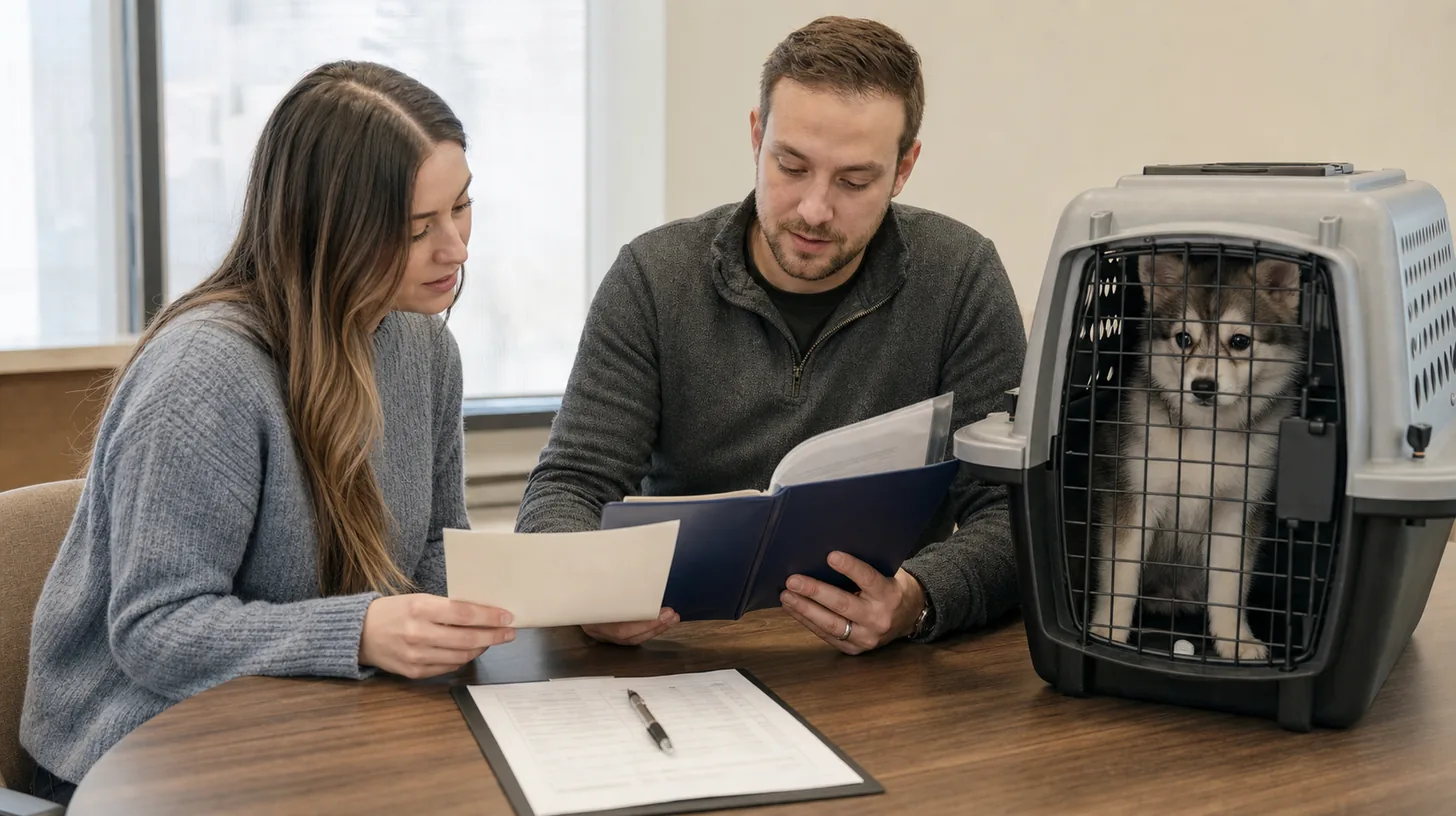
Direct answer: Before taking custody, match the puppy to the agreed identity and records, reconcile veterinary and microchip documents, review current food and care instructions, and confirm the signed contract, receipt, and contact details. Prepare a secure carrier before the meeting. Pause the handoff when the puppy, documents, price, payment recipient, or pickup location changes unexpectedly.
Pickup day should confirm the puppy and agreement already evaluated, not introduce a new animal, new payment recipient, or missing history under time pressure. A careful handoff matches identity, records, contract, care information, contacts, and transport before custody changes. The buyer should be willing to pause when a discrepancy cannot be resolved with primary documentation and appropriate professional advice.
Reconfirm the Appointment Independently
Use the previously verified contact channel to confirm time, place, people attending, puppy identity, balance, accepted payment method, and documents expected.
A second capable adult can verify the boundary during early practice or higher-risk situations. That person should follow the same sequence and avoid adding prompts, handling, or access that changes the task. The shared standard remains a documented identity and custody transfer into secure prepared transport. For this page, step 1 is specifically the reconfirm the appointment independently check.
Stop when the expected condition is absent or the situation begins to depend on force, luck, or an open boundary. Specifically avoid last-minute substitution, unverifiable documents, changed payment details, missing veterinary history, pressure to sign, loose transport, or no return contact. The follow-up record should cover puppy identity, date and place, parties, contract version, receipt, records received, supplies, contacts, discrepancy, and resolution. Record the outcome of reconfirm the appointment independently separately before moving on.
Prepare Transport Before Arrival
Install or stabilize the closed carrier, check door hardware, bring absorbent bedding, leash equipment for controlled use, water supplies, and an emergency contact plan.
Perform this check before adding the next variable. The target remains a documented identity and custody transfer into secure prepared transport. Work in an agreed safe location where records can be reviewed without rushing and the puppy remains contained. If the setup cannot preserve that condition, simplify it or stop rather than relying on speed or physical control. For this page, step 2 is specifically the prepare transport before arrival check.
Do not convert this step into a stress test. The principal avoidable risks are last-minute substitution, unverifiable documents, changed payment details, missing veterinary history, pressure to sign, loose transport, or no return contact. Write down puppy identity, date and place, parties, contract version, receipt, records received, supplies, contacts, discrepancy, and resolution; a short factual note is more useful than a reassuring guess. Record the outcome of prepare transport before arrival separately before moving on.
Match the Individual Puppy
Compare the puppy's agreed identifiers, appearance, sex, birth information, and microchip details with the contract and primary records without relying on a verbal assurance.
Use an observable pass condition: the relevant item is checked, the boundary is closed, and the Pomsky can remain safe without being used as a test. This protects the main objective, a documented identity and custody transfer into secure prepared transport, while leaving a clear point at which the caregiver can step back. For this page, step 3 is specifically the match the individual puppy check.
If the Pomsky cannot remain comfortable or the equipment and environment cannot remain controlled, end the attempt. Do not proceed through last-minute substitution, unverifiable documents, changed payment details, missing veterinary history, pressure to sign, loose transport, or no return contact. Capture puppy identity, date and place, parties, contract version, receipt, records received, supplies, contacts, discrepancy, and resolution before deciding what changes next. Record the outcome of match the individual puppy separately before moving on.
Review Veterinary Records
Check clinic identity, dates, findings, vaccines, preventives, medications, pending care, and instructions, then arrange independent veterinary follow-up.
Keep the sequence repeatable across caregivers. Say what is being checked, complete it, and return equipment and people to neutral before continuing. In this page's context, success means a documented identity and custody transfer into secure prepared transport; it does not mean proving that a known risk can be tolerated. For this page, step 4 is specifically the review veterinary records check.
The absence of an incident is not proof that the arrangement is sound. Recheck for last-minute substitution, unverifiable documents, changed payment details, missing veterinary history, pressure to sign, loose transport, or no return contact. Document puppy identity, date and place, parties, contract version, receipt, records received, supplies, contacts, discrepancy, and resolution so a later caregiver can distinguish a passed step from one that was skipped. Record the outcome of review veterinary records separately before moving on.
Reconcile the Microchip
Confirm the recorded number and the process for registration or transfer; do not assume a scanner result alone proves legal ownership.
Treat this as one part of the complete routine, not an isolated trick. The surrounding setup is an agreed safe location where records can be reviewed without rushing and the puppy remains contained. A clean transition reduces ambiguity and makes it easier to notice when the dog, equipment, environment, or records differ from the previous attempt. For this page, step 5 is specifically the reconcile the microchip check.
Stop when the expected condition is absent or the situation begins to depend on force, luck, or an open boundary. Specifically avoid last-minute substitution, unverifiable documents, changed payment details, missing veterinary history, pressure to sign, loose transport, or no return contact. The follow-up record should cover puppy identity, date and place, parties, contract version, receipt, records received, supplies, contacts, discrepancy, and resolution. Record the outcome of reconcile the microchip separately before moving on.
Confirm Current Food and Routine
Obtain the exact current food label, amount, schedule, recent intake, elimination, sleep, handling, and any known transition concerns.
Pause long enough to inspect the result rather than assuming the action worked. Look at the dog, the physical boundary, and the next movement available to the caregiver. Continue only when the arrangement still supports a documented identity and custody transfer into secure prepared transport. For this page, step 6 is specifically the confirm current food and routine check.
Do not convert this step into a stress test. The principal avoidable risks are last-minute substitution, unverifiable documents, changed payment details, missing veterinary history, pressure to sign, loose transport, or no return contact. Write down puppy identity, date and place, parties, contract version, receipt, records received, supplies, contacts, discrepancy, and resolution; a short factual note is more useful than a reassuring guess. Record the outcome of confirm current food and routine separately before moving on.
Read the Final Contract Version
Compare the document with the reviewed version, inspect all filled fields and attachments, and refuse blank spaces or unexplained substitutions.
A second capable adult can verify the boundary during early practice or higher-risk situations. That person should follow the same sequence and avoid adding prompts, handling, or access that changes the task. The shared standard remains a documented identity and custody transfer into secure prepared transport. For this page, step 7 is specifically the read the final contract version check.
If the Pomsky cannot remain comfortable or the equipment and environment cannot remain controlled, end the attempt. Do not proceed through last-minute substitution, unverifiable documents, changed payment details, missing veterinary history, pressure to sign, loose transport, or no return contact. Capture puppy identity, date and place, parties, contract version, receipt, records received, supplies, contacts, discrepancy, and resolution before deciding what changes next. Record the outcome of read the final contract version separately before moving on.
Document Payment and Receipt
Match the recipient and amount to the agreement, use the planned traceable method where appropriate, and retain a complete receipt without exposing credentials.
Perform this check before adding the next variable. The target remains a documented identity and custody transfer into secure prepared transport. Work in an agreed safe location where records can be reviewed without rushing and the puppy remains contained. If the setup cannot preserve that condition, simplify it or stop rather than relying on speed or physical control. For this page, step 8 is specifically the document payment and receipt check.
The absence of an incident is not proof that the arrangement is sound. Recheck for last-minute substitution, unverifiable documents, changed payment details, missing veterinary history, pressure to sign, loose transport, or no return contact. Document puppy identity, date and place, parties, contract version, receipt, records received, supplies, contacts, discrepancy, and resolution so a later caregiver can distinguish a passed step from one that was skipped. Record the outcome of document payment and receipt separately before moving on.
Verify Ongoing Contacts
Test the phone, email, clinic, emergency, registration, and return-support information before leaving the meeting.
Use an observable pass condition: the relevant item is checked, the boundary is closed, and the Pomsky can remain safe without being used as a test. This protects the main objective, a documented identity and custody transfer into secure prepared transport, while leaving a clear point at which the caregiver can step back. For this page, step 9 is specifically the verify ongoing contacts check.
Stop when the expected condition is absent or the situation begins to depend on force, luck, or an open boundary. Specifically avoid last-minute substitution, unverifiable documents, changed payment details, missing veterinary history, pressure to sign, loose transport, or no return contact. The follow-up record should cover puppy identity, date and place, parties, contract version, receipt, records received, supplies, contacts, discrepancy, and resolution. Record the outcome of verify ongoing contacts separately before moving on.
Record the Physical Handoff
List the documents, food, medication, equipment, registration material, and other property actually transferred with the puppy.
Keep the sequence repeatable across caregivers. Say what is being checked, complete it, and return equipment and people to neutral before continuing. In this page's context, success means a documented identity and custody transfer into secure prepared transport; it does not mean proving that a known risk can be tolerated. For this page, step 10 is specifically the record the physical handoff check.
Do not convert this step into a stress test. The principal avoidable risks are last-minute substitution, unverifiable documents, changed payment details, missing veterinary history, pressure to sign, loose transport, or no return contact. Write down puppy identity, date and place, parties, contract version, receipt, records received, supplies, contacts, discrepancy, and resolution; a short factual note is more useful than a reassuring guess. Record the outcome of record the physical handoff separately before moving on.
Secure the Puppy Before Departure
Move the puppy directly into the inspected carrier or restraint inside the controlled area and close it before exterior doors or vehicle doors are opened.
Treat this as one part of the complete routine, not an isolated trick. The surrounding setup is an agreed safe location where records can be reviewed without rushing and the puppy remains contained. A clean transition reduces ambiguity and makes it easier to notice when the dog, equipment, environment, or records differ from the previous attempt. For this page, step 11 is specifically the secure the puppy before departure check.
If the Pomsky cannot remain comfortable or the equipment and environment cannot remain controlled, end the attempt. Do not proceed through last-minute substitution, unverifiable documents, changed payment details, missing veterinary history, pressure to sign, loose transport, or no return contact. Capture puppy identity, date and place, parties, contract version, receipt, records received, supplies, contacts, discrepancy, and resolution before deciding what changes next. Record the outcome of secure the puppy before departure separately before moving on.
Pause for Any Material Change
Do not let travel plans, emotion, deposits, or another person's urgency override an unresolved identity, welfare, document, contract, or payment discrepancy.
Pause long enough to inspect the result rather than assuming the action worked. Look at the dog, the physical boundary, and the next movement available to the caregiver. Continue only when the arrangement still supports a documented identity and custody transfer into secure prepared transport. For this page, step 12 is specifically the pause for any material change check.
The absence of an incident is not proof that the arrangement is sound. Recheck for last-minute substitution, unverifiable documents, changed payment details, missing veterinary history, pressure to sign, loose transport, or no return contact. Document puppy identity, date and place, parties, contract version, receipt, records received, supplies, contacts, discrepancy, and resolution so a later caregiver can distinguish a passed step from one that was skipped. Record the outcome of pause for any material change separately before moving on.
When to Escalate
This routine has a defined boundary. Stop when the Pomsky, caregiver, equipment, records, or environment no longer supports a documented identity and custody transfer into secure prepared transport. Do not improvise through last-minute substitution, unverifiable documents, changed payment details, missing veterinary history, pressure to sign, loose transport, or no return contact. Seek a veterinarian, microchip registry, legal professional, payment provider, welfare authority, or law enforcement according to the unresolved issue. Bring the concise observations already recorded rather than recreating the event.
Before the next attempt, review puppy identity, date and place, parties, contract version, receipt, records received, supplies, contacts, discrepancy, and resolution. Reopen the task only after the physical setup, instructions, and responsible person are clear. A conservative stop is useful information: it prevents a manageable problem from becoming an emergency and gives the appropriate professional a factual starting point.
Sources reviewed
Each source is used only for the claim scopes listed below. None establishes a guaranteed Pomsky outcome or replaces individual professional assessment.
- American Kennel Club: Signs of a Responsible Breeder - Supports: breeder verification steps; visit and record checks; buyer safeguards. Limit: A checklist reduces risk but cannot guarantee a breeder or puppy.
- American Kennel Club: Responsible Breeders - Supports: responsible breeding practices; records; buyer questions. Limit: AKC registration alone is not proof of health, welfare, or seller quality.
- American Animal Hospital Association: Animal Identification and Microchipping - Supports: current microchip registration; visible ID tags; annual chip scan; lost-pet search limits. Limit: Microchips are not GPS devices and do not replace secure containment, a leash, visible ID, or active search.
- American Animal Hospital Association: AAHA-AVMA Canine Preventive Healthcare Guidelines - Supports: preventive exams; individual risk assessment; parasite and vaccination planning. Limit: The veterinarian sets the schedule for the individual dog and location.