Written and reviewed by A Pomsky Editorial Team. Originally published 2026-07-26; substantively reviewed July 26, 2026.
Training boundary: Use humane, reward-based methods and protect safety with management. Pain, panic, aggression, a bite history, or serious handling risk requires a veterinarian or qualified behavior professional. Read the editorial policy.
Direct answer: Build a Pomsky puppy socialization planner by selecting practical low-intensity exposures across people, surfaces, sounds, handling, transport, and suitable animals with veterinary guidance. Record distance, posture, food acceptance, retreat, and recovery. Repeat easy experiences, protect health, avoid forced greetings or flooding, and adjust before fear escalates.
A Pomsky puppy socialization planner should organize safe, positive exposure without turning development into a quota. Select people, surfaces, sounds, handling, transport, and suitable animals with veterinary guidance; keep intensity low enough that the puppy can eat, explore, and recover; and record the response before deciding what to repeat.
Coordinate Health and Exposure With a Veterinarian
Ask the puppy’s veterinarian about local infectious-disease risk, vaccination progress, parasite prevention, and safer exposure settings. Socialization is important during early development, but it should not mean uncontrolled contact with unknown dogs or contaminated areas.
Use carried observation, clean private spaces, known healthy animals, properly managed puppy classes, and other lower-risk options as advised. A universal vaccination date cannot determine every puppy’s plan. Keep records current and tell instructors about health or behavior concerns before class.
Build Categories, Not a Long Scorecard
Organize the planner into people, clothing and movement, household sounds, outdoor sounds, surfaces, handling, transport, objects, environments, and appropriate animals. A few carefully chosen examples in each category are more useful than dozens of rushed encounters.
Define the practical goal. The puppy does not need to greet every person or animal. Useful outcomes include observing calmly, choosing distance, recovering after surprise, and orienting back to the handler. Neutrality is often a successful response.
Establish the Puppy's Starting Response
For each exposure, record distance, intensity, duration, food acceptance, approach or retreat, posture, and time to resume ordinary behavior. Start with a level the puppy can notice without freezing, fleeing, persistent barking, frantic pulling, or refusing all food.
Do not label hesitation as stubbornness. Increase distance and allow observation. A puppy that approaches should still be protected from grabbing hands, crowding, or prolonged restraint. One voluntary approach does not authorize every person to touch.
Plan People Exposures With Consent
Include varied appearances and movement only in calm, controlled settings: adults, supervised children, hats, coats, mobility aids, bags, or unusual walking patterns. Ask helpers to stand sideways, avoid leaning over, and let the puppy choose whether to approach.
Children require continuous adult supervision. They should not chase, hug, lift, corner, or take items from the puppy. Use a gate or leash for distance and end early. The objective is safe observation and predictable interaction, not proving that the puppy tolerates handling.
Introduce Surfaces and Environments Gradually
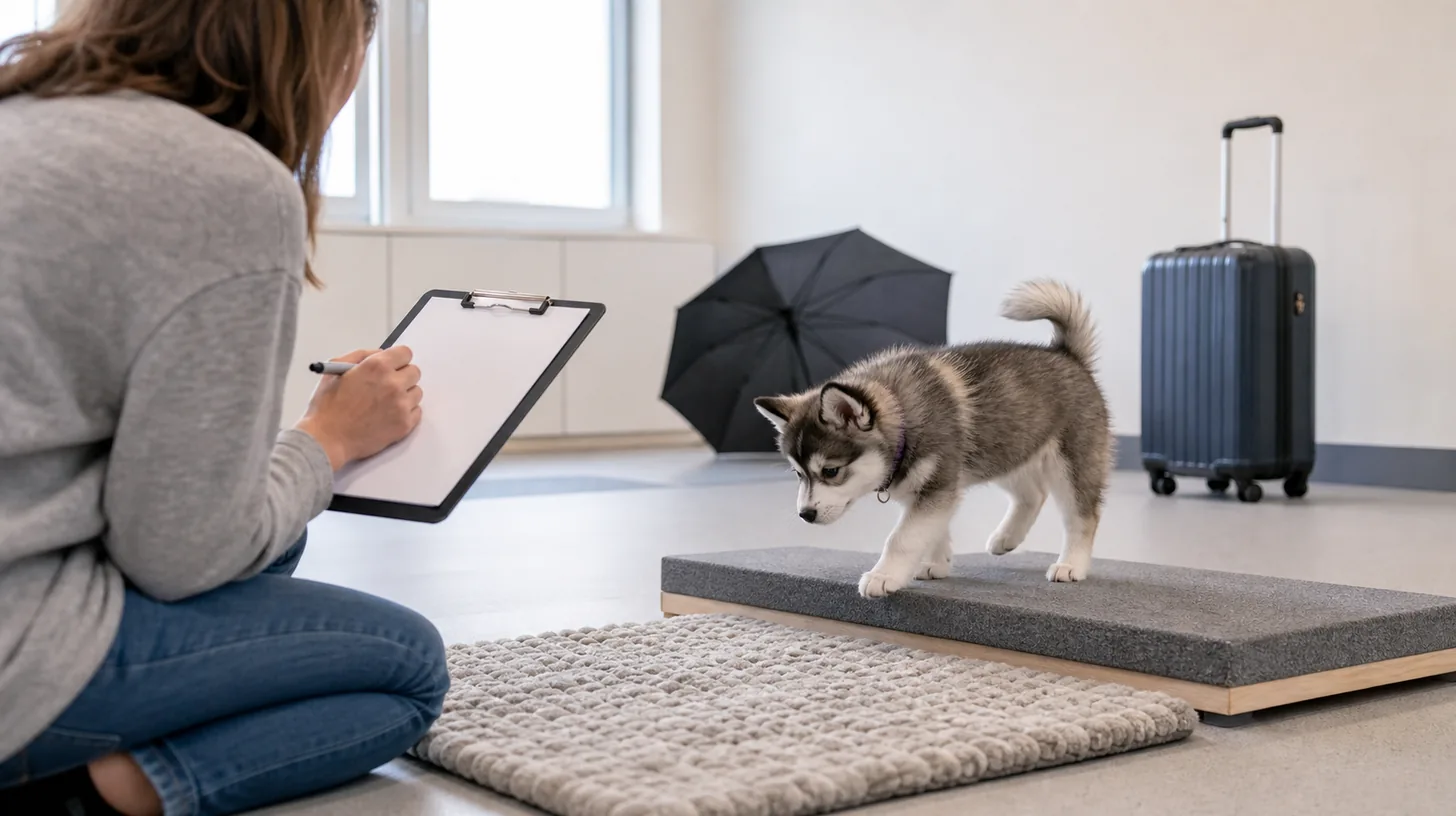
Offer stable examples such as carpet, tile with traction, grass, gravel, a low platform, an elevator lobby, a quiet parking area, or a sheltered street view. Check temperature, sharp objects, chemicals, traffic, and escape routes first.
Let the puppy investigate with a loose lead and an available retreat. Do not drag the puppy across a surface. If footing is slippery, add mats or choose another location. Difficulty should come from novelty, not from physical insecurity.
Pair Sounds With Distance and Recovery
Begin with ordinary low-intensity sounds: appliances in another room, a distant vehicle, a door closing softly, recorded traffic at low volume, or calm household movement. Present one brief sound, provide a valued activity, and allow a quiet interval.
Avoid loud playlists or continuous noise intended to make the puppy “get used to it.” If scanning, hiding, barking, or refusal begins, reduce volume or distance. Real storms, fireworks, and construction are uncontrolled events that need management rather than socialization tests.
Prepare Cooperative Handling
Include brief voluntary practice for collar touches, harness presentation, ears viewed from a distance, paw contact, lip lifts, brushing tools, and standing on a stable surface. Pair one small step with reinforcement and use a clear release.
Socialization does not justify holding the puppy still while strangers touch every body part. Pain, fear, or repeated withdrawal means stop. Veterinary and grooming procedures may require a separate cooperative-care plan and professional support.
Select Animal Interactions Carefully
Choose known, healthy, socially appropriate dogs under controlled conditions. Begin with parallel movement or protected observation. Avoid crowded dog parks, uncontrolled daycare groups, and forced greetings. Size, play style, and ability to pause matter more than the number of dogs met.
Cats and other household animals need species-appropriate escape routes and stepwise introductions. Prevent chasing. Watching animals calmly at a safe distance can be more valuable than direct contact. Wildlife should never be used as an interaction opportunity.
Use Transport and Equipment as Separate Skills
Practice entering a stationary car, resting in a secured travel setup, hearing the engine briefly, and taking very short trips before combining duration and destination. Introduce carriers, harnesses, and barriers while the puppy is calm.
Confirm fit frequently because puppies grow. Equipment should not chafe, restrict normal movement, or allow escape. Travel practice does not replace current identification, safe restraint, temperature control, or destination-specific requirements.
Review the Planner by Response
Mark each item as comfortable, needs easier repetition, paused for health or safety, or needs professional help. Do not use pass/fail labels. Repeat easy experiences in different contexts while changing one feature at a time.
Look for recovery and voluntary engagement across weeks. A single startled response is information; repeated fear or worsening recovery deserves a revised plan. Preserve rest days and normal sleep because constant outings can increase stress.
Escalate Persistent Fear or Safety Concerns
Contact a veterinarian when behavior changes suddenly, the puppy appears painful or unwell, appetite changes, or exposure planning conflicts with health protection. Seek a qualified reward-based professional when fear persists, recovery deteriorates, aggression is possible, or the household cannot create safe setups.
Avoid leash corrections, startling devices, flooding, forced greetings, and punishment for warning signals. The planner cannot guarantee adult temperament. It helps the household choose safe experiences, observe the individual puppy, and make informed adjustments during development.
Transfer Skills Into Ordinary Life
Use easy versions of successful exposures during normal routines: a short pause near a quiet elevator, calm observation from a parked car, one cooperative paw touch before grooming, or walking across a familiar mat in a new room. Keep the exit available.
Do not schedule novelty every day. Puppies need sleep, predictable meals, toilet opportunities, play, and low-pressure time at home. Review the planner weekly, retire items that no longer serve a practical purpose, and select the next exposure because it supports the puppy's likely life rather than because a checklist cell is empty.
Sources reviewed
Each source is used only for the claim scopes listed below. None establishes a guaranteed Pomsky outcome or replaces individual professional assessment.
- American Veterinary Society of Animal Behavior: Puppy Socialization Position Statement - Supports: puppy socialization window; safe exposure; puppy classes. Limit: Vaccination and exposure decisions still require the puppy's veterinarian.
- American Animal Hospital Association: AAHA-AVMA Canine Preventive Healthcare Guidelines - Supports: preventive exams; individual risk assessment; parasite and vaccination planning. Limit: The veterinarian sets the schedule for the individual dog and location.