Written and reviewed by A Pomsky Editorial Team. Originally published 2026-07-26; substantively reviewed July 26, 2026.
Training boundary: Use humane, reward-based methods and protect safety with management. Pain, panic, aggression, a bite history, or serious handling risk requires a veterinarian or qualified behavior professional. Read the editorial policy.
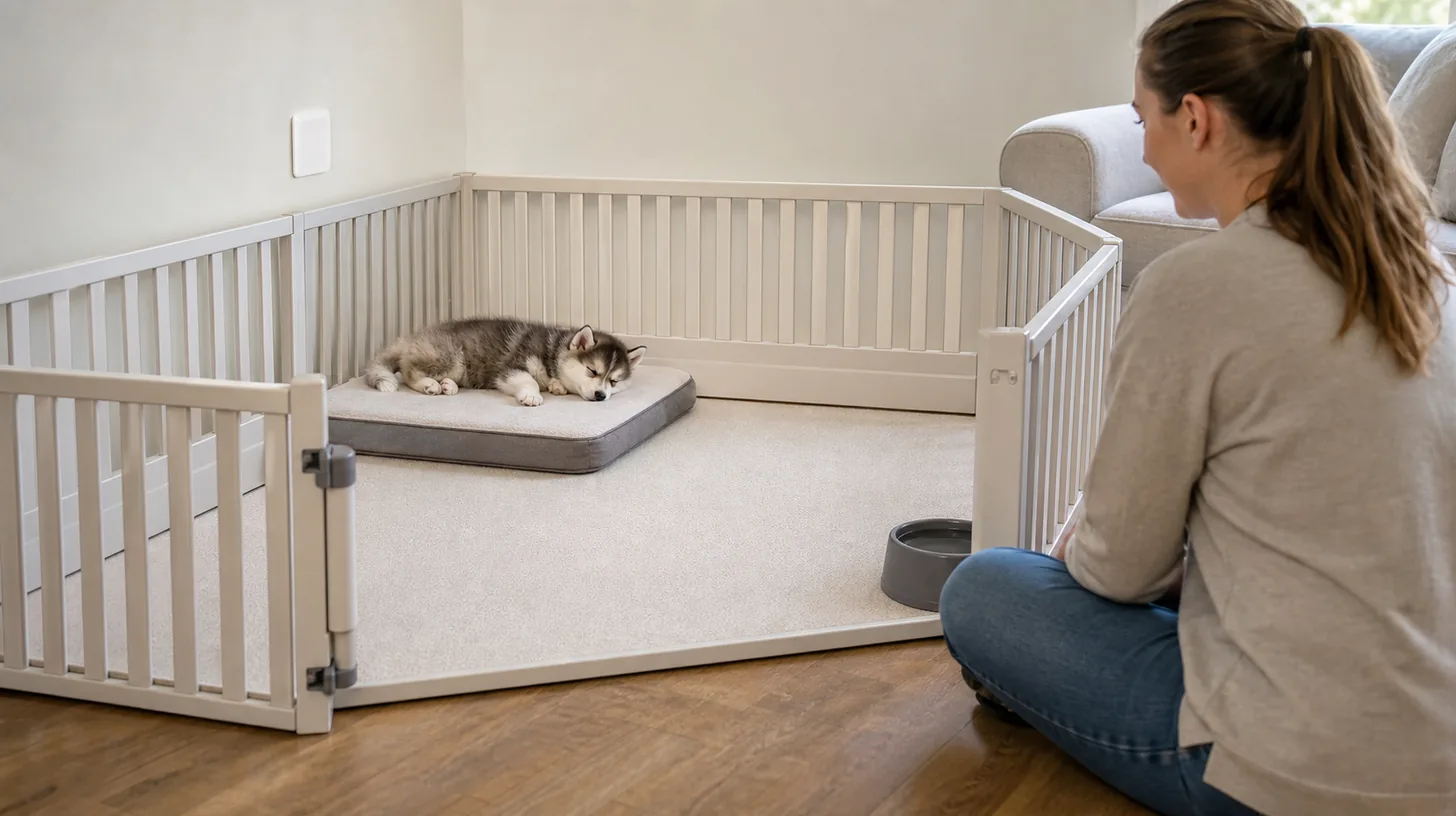
Direct answer: Choose a quiet, temperature-controlled area near normal household supervision. Add a secure puppy barrier, low washable bed, clear floor, covered cords, and no unattended chew hazards. Meet toileting, food, water, and comfort needs before the rest period, guide the puppy in calmly, and preserve nearby caregiver access. Do not force prolonged isolation or ignore unusual difficulty settling.
A puppy quiet zone is a physical setting for one protected rest period, not a promise that every puppy will sleep on command. The area should reduce foot traffic and hazards while keeping the caregiver close enough to observe and respond. A simple space with a low bed and secure barrier is easier to inspect than a crowded enclosure filled with toys, cords, fabric, and climbing opportunities.
Choose a Low-Traffic Location
Select a space away from exterior doors, stairs, cooking, loud entertainment, direct sun, and repeated visitor movement while preserving caregiver visibility.
Treat this as one part of the complete routine, not an isolated trick. The surrounding setup is an uncluttered temperature-controlled area near ordinary household supervision. A clean transition reduces ambiguity and makes it easier to notice when the dog, equipment, environment, or records differ from the previous attempt. For this page, step 1 is specifically the choose a low-traffic location check.
Stop when the expected condition is absent or the situation begins to depend on force, luck, or an open boundary. Specifically avoid loose cords, chewable bedding, unstable barriers, climbing aids, forced isolation, ignored distress, or confusing rest with punishment. The follow-up record should cover pre-nap needs, settling behavior, sleep and wake times, interruptions, toileting, appetite, and unusual signs. Record the outcome of choose a low-traffic location separately before moving on.
Inspect the Barrier From Puppy Height
Check spacing, latch, base gaps, joints, wall attachments, and nearby furniture so the puppy cannot squeeze through, climb, or trap a paw.
Pause long enough to inspect the result rather than assuming the action worked. Look at the dog, the physical boundary, and the next movement available to the caregiver. Continue only when the arrangement still supports a calm transition into safe, supervised rest with predictable waking and toileting support. For this page, step 2 is specifically the inspect the barrier from puppy height check.
Do not convert this step into a stress test. The principal avoidable risks are loose cords, chewable bedding, unstable barriers, climbing aids, forced isolation, ignored distress, or confusing rest with punishment. Write down pre-nap needs, settling behavior, sleep and wake times, interruptions, toileting, appetite, and unusual signs; a short factual note is more useful than a reassuring guess. Record the outcome of inspect the barrier from puppy height separately before moving on.
Use a Low Washable Bed
Provide a stable resting surface that does not require jumping and remove it if the puppy tears, ingests, becomes tangled in, or overheats on the material.
A second capable adult can verify the boundary during early practice or higher-risk situations. That person should follow the same sequence and avoid adding prompts, handling, or access that changes the task. The shared standard remains a calm transition into safe, supervised rest with predictable waking and toileting support. For this page, step 3 is specifically the use a low washable bed check.
If the Pomsky cannot remain comfortable or the equipment and environment cannot remain controlled, end the attempt. Do not proceed through loose cords, chewable bedding, unstable barriers, climbing aids, forced isolation, ignored distress, or confusing rest with punishment. Capture pre-nap needs, settling behavior, sleep and wake times, interruptions, toileting, appetite, and unusual signs before deciding what changes next. Record the outcome of use a low washable bed separately before moving on.
Remove Awake-Time Enrichment
Take out balls, plush toys, puzzle feeders, chews, tags, loose blankets, and other objects that are not specifically approved for unsupervised contact.
Perform this check before adding the next variable. The target remains a calm transition into safe, supervised rest with predictable waking and toileting support. Work in an uncluttered temperature-controlled area near ordinary household supervision. If the setup cannot preserve that condition, simplify it or stop rather than relying on speed or physical control. For this page, step 4 is specifically the remove awake-time enrichment check.
The absence of an incident is not proof that the arrangement is sound. Recheck for loose cords, chewable bedding, unstable barriers, climbing aids, forced isolation, ignored distress, or confusing rest with punishment. Document pre-nap needs, settling behavior, sleep and wake times, interruptions, toileting, appetite, and unusual signs so a later caregiver can distinguish a passed step from one that was skipped. Record the outcome of remove awake-time enrichment separately before moving on.
Control Cords and Household Products
Cover or relocate electrical cords, chargers, blind cords, plants, cleaners, medication, waste, and small objects beyond the barrier.
Use an observable pass condition: the relevant item is checked, the boundary is closed, and the Pomsky can remain safe without being used as a test. This protects the main objective, a calm transition into safe, supervised rest with predictable waking and toileting support, while leaving a clear point at which the caregiver can step back. For this page, step 5 is specifically the control cords and household products check.
Stop when the expected condition is absent or the situation begins to depend on force, luck, or an open boundary. Specifically avoid loose cords, chewable bedding, unstable barriers, climbing aids, forced isolation, ignored distress, or confusing rest with punishment. The follow-up record should cover pre-nap needs, settling behavior, sleep and wake times, interruptions, toileting, appetite, and unusual signs. Record the outcome of control cords and household products separately before moving on.
Meet Needs Before the Transition
Offer the planned toileting opportunity, water access, meal timing, movement, and calm social contact appropriate to the puppy's current routine.
Keep the sequence repeatable across caregivers. Say what is being checked, complete it, and return equipment and people to neutral before continuing. In this page's context, success means a calm transition into safe, supervised rest with predictable waking and toileting support; it does not mean proving that a known risk can be tolerated. For this page, step 6 is specifically the meet needs before the transition check.
Do not convert this step into a stress test. The principal avoidable risks are loose cords, chewable bedding, unstable barriers, climbing aids, forced isolation, ignored distress, or confusing rest with punishment. Write down pre-nap needs, settling behavior, sleep and wake times, interruptions, toileting, appetite, and unusual signs; a short factual note is more useful than a reassuring guess. Record the outcome of meet needs before the transition separately before moving on.
Use a Consistent Entry Sequence
Lower household activity, guide the puppy into the zone without chasing, provide a brief calm cue, and remain nearby while arousal falls.
Treat this as one part of the complete routine, not an isolated trick. The surrounding setup is an uncluttered temperature-controlled area near ordinary household supervision. A clean transition reduces ambiguity and makes it easier to notice when the dog, equipment, environment, or records differ from the previous attempt. For this page, step 7 is specifically the use a consistent entry sequence check.
If the Pomsky cannot remain comfortable or the equipment and environment cannot remain controlled, end the attempt. Do not proceed through loose cords, chewable bedding, unstable barriers, climbing aids, forced isolation, ignored distress, or confusing rest with punishment. Capture pre-nap needs, settling behavior, sleep and wake times, interruptions, toileting, appetite, and unusual signs before deciding what changes next. Record the outcome of use a consistent entry sequence separately before moving on.
Distinguish Protest From Distress
Observe whether the puppy can reposition, settle, and recover; escalating vocalization, frantic escape behavior, drooling, injury risk, or failure to recover ends the trial.
Pause long enough to inspect the result rather than assuming the action worked. Look at the dog, the physical boundary, and the next movement available to the caregiver. Continue only when the arrangement still supports a calm transition into safe, supervised rest with predictable waking and toileting support. For this page, step 8 is specifically the distinguish protest from distress check.
The absence of an incident is not proof that the arrangement is sound. Recheck for loose cords, chewable bedding, unstable barriers, climbing aids, forced isolation, ignored distress, or confusing rest with punishment. Document pre-nap needs, settling behavior, sleep and wake times, interruptions, toileting, appetite, and unusual signs so a later caregiver can distinguish a passed step from one that was skipped. Record the outcome of distinguish protest from distress separately before moving on.
Keep the Caregiver Available
Supervision means an adult can hear, see, and respond, not that the puppy is left behind a barrier while everyone leaves the area.
A second capable adult can verify the boundary during early practice or higher-risk situations. That person should follow the same sequence and avoid adding prompts, handling, or access that changes the task. The shared standard remains a calm transition into safe, supervised rest with predictable waking and toileting support. For this page, step 9 is specifically the keep the caregiver available check.
Stop when the expected condition is absent or the situation begins to depend on force, luck, or an open boundary. Specifically avoid loose cords, chewable bedding, unstable barriers, climbing aids, forced isolation, ignored distress, or confusing rest with punishment. The follow-up record should cover pre-nap needs, settling behavior, sleep and wake times, interruptions, toileting, appetite, and unusual signs. Record the outcome of keep the caregiver available separately before moving on.
Protect the Wake-Up Routine
Open the barrier only after the exterior route is secured, connect equipment when needed, and move calmly to the next toileting or care step.
Perform this check before adding the next variable. The target remains a calm transition into safe, supervised rest with predictable waking and toileting support. Work in an uncluttered temperature-controlled area near ordinary household supervision. If the setup cannot preserve that condition, simplify it or stop rather than relying on speed or physical control. For this page, step 10 is specifically the protect the wake-up routine check.
Do not convert this step into a stress test. The principal avoidable risks are loose cords, chewable bedding, unstable barriers, climbing aids, forced isolation, ignored distress, or confusing rest with punishment. Write down pre-nap needs, settling behavior, sleep and wake times, interruptions, toileting, appetite, and unusual signs; a short factual note is more useful than a reassuring guess. Record the outcome of protect the wake-up routine separately before moving on.
Adjust One Environmental Feature
If settling is difficult, change only location, light, sound, bed, proximity, or timing so the effect can be observed without confusing the puppy.
Use an observable pass condition: the relevant item is checked, the boundary is closed, and the Pomsky can remain safe without being used as a test. This protects the main objective, a calm transition into safe, supervised rest with predictable waking and toileting support, while leaving a clear point at which the caregiver can step back. For this page, step 11 is specifically the adjust one environmental feature check.
If the Pomsky cannot remain comfortable or the equipment and environment cannot remain controlled, end the attempt. Do not proceed through loose cords, chewable bedding, unstable barriers, climbing aids, forced isolation, ignored distress, or confusing rest with punishment. Capture pre-nap needs, settling behavior, sleep and wake times, interruptions, toileting, appetite, and unusual signs before deciding what changes next. Record the outcome of adjust one environmental feature separately before moving on.
Review Development and Health
Reinspect the zone as body size, jumping, chewing, coat, elimination, feeding, social needs, and medical guidance change.
Keep the sequence repeatable across caregivers. Say what is being checked, complete it, and return equipment and people to neutral before continuing. In this page's context, success means a calm transition into safe, supervised rest with predictable waking and toileting support; it does not mean proving that a known risk can be tolerated. For this page, step 12 is specifically the review development and health check.
The absence of an incident is not proof that the arrangement is sound. Recheck for loose cords, chewable bedding, unstable barriers, climbing aids, forced isolation, ignored distress, or confusing rest with punishment. Document pre-nap needs, settling behavior, sleep and wake times, interruptions, toileting, appetite, and unusual signs so a later caregiver can distinguish a passed step from one that was skipped. Record the outcome of review development and health separately before moving on.
When to Escalate
This routine has a defined boundary. Stop when the Pomsky, caregiver, equipment, records, or environment no longer supports a calm transition into safe, supervised rest with predictable waking and toileting support. Do not improvise through loose cords, chewable bedding, unstable barriers, climbing aids, forced isolation, ignored distress, or confusing rest with punishment. Seek a veterinarian for health or sleep changes and a qualified reward-based professional for persistent separation distress or unsafe barrier behavior. Bring the concise observations already recorded rather than recreating the event.
Before the next attempt, review pre-nap needs, settling behavior, sleep and wake times, interruptions, toileting, appetite, and unusual signs. Reopen the task only after the physical setup, instructions, and responsible person are clear. A conservative stop is useful information: it prevents a manageable problem from becoming an emergency and gives the appropriate professional a factual starting point.
Sources reviewed
Each source is used only for the claim scopes listed below. None establishes a guaranteed Pomsky outcome or replaces individual professional assessment.
- American Veterinary Society of Animal Behavior: Puppy Socialization Position Statement - Supports: puppy socialization window; safe exposure; puppy classes. Limit: Vaccination and exposure decisions still require the puppy's veterinarian.
- American Animal Hospital Association: Lifestyle and Safety Assessment - Supports: appropriate confinement; leash, collar and harness planning; lifestyle-specific safety review. Limit: Equipment selection must account for the individual dog's anatomy, behavior, health, and environment.
- American Animal Hospital Association: AAHA-AVMA Canine Preventive Healthcare Guidelines - Supports: preventive exams; individual risk assessment; parasite and vaccination planning. Limit: The veterinarian sets the schedule for the individual dog and location.