Written and reviewed by A Pomsky Editorial Team. Originally published 2026-07-26; substantively reviewed July 26, 2026.
Training boundary: Use humane, reward-based methods and protect safety with management. Pain, panic, aggression, a bite history, or serious handling risk requires a veterinarian or qualified behavior professional. Read the editorial policy.
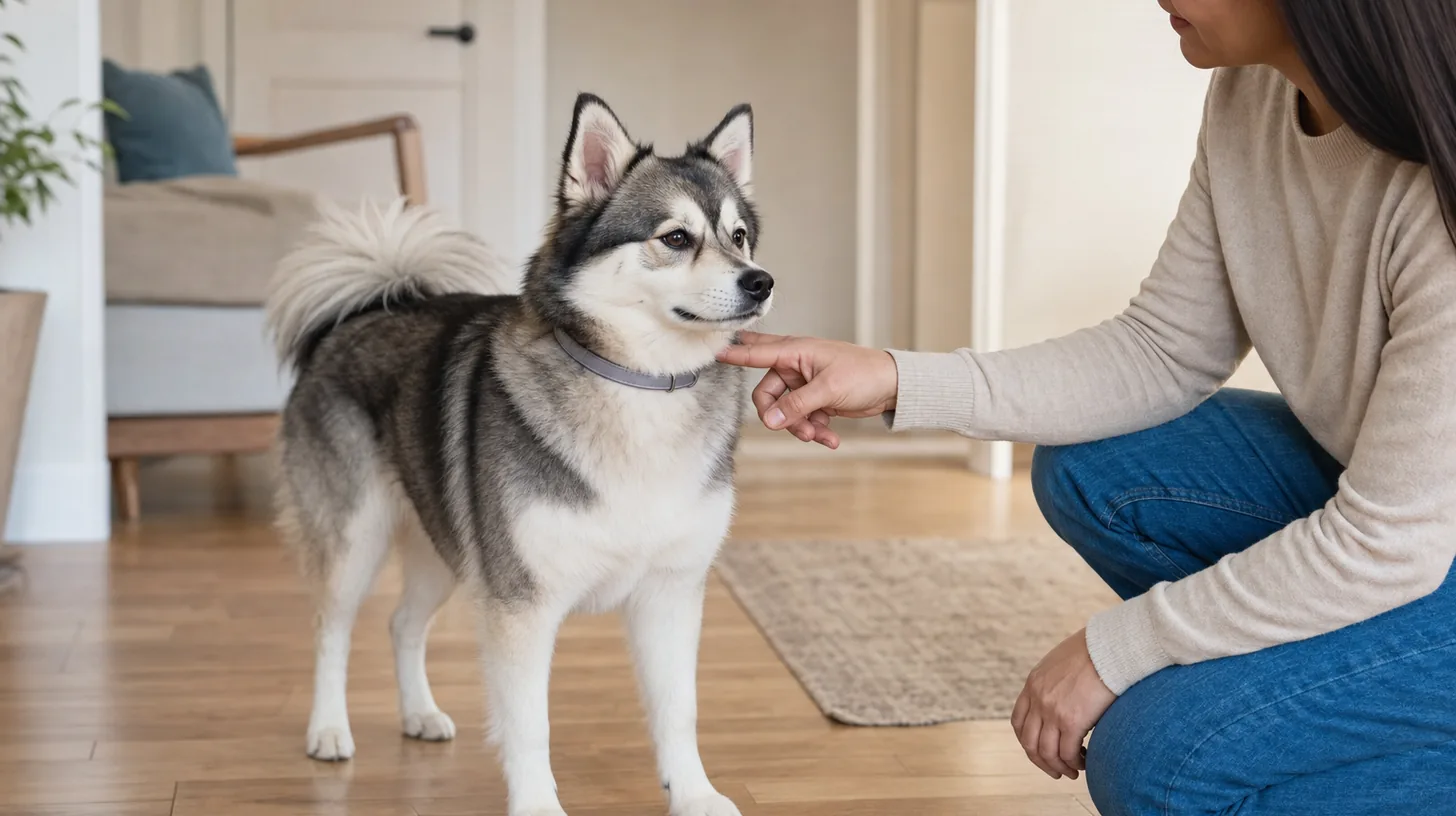
Direct answer: Check that the flat collar fits correctly and train in a closed safe area where no one needs to grab the dog. Show an open hand near the shoulder, mark calm orientation and reward. Progress to one fingertip touching the side of the collar, then to a one-second light hold with no upward or backward pressure. Release before rewarding so the Pomsky learns that contact ends predictably. Preserve an opt-out during practice and use gates, doors and a secured leash for real safety. Stop for freezing, head whipping, growling, pain, skin irritation or escalating avoidance.
This page conditions direct hand contact and a brief hold at the collar; leash clipping adds hardware and sound, harness entry teaches body movement into equipment, and chin rest positions the head without collar contact. Check that the flat collar fits correctly and train in a closed safe area where no one needs to grab the dog. Show an open hand near the shoulder, mark calm orientation and reward. Progress to one fingertip touching the side of the collar, then to a one-second light hold with no upward or backward pressure. Release before rewarding so the Pomsky learns that contact ends predictably. Preserve an opt-out during practice and use gates, doors and a secured leash for real safety. Stop for freezing, head whipping, growling, pain, skin irritation or escalating avoidance. This guide is limited to reward-based skill building in a controlled setup. It does not make a medical, temperament or guaranteed-behavior claim.
Direct answer
Check that the flat collar fits correctly and train in a closed safe area where no one needs to grab the dog. Show an open hand near the shoulder, mark calm orientation and reward. Progress to one fingertip touching the side of the collar, then to a one-second light hold with no upward or backward pressure. Release before rewarding so the Pomsky learns that contact ends predictably. Preserve an opt-out during practice and use gates, doors and a secured leash for real safety. Stop for freezing, head whipping, growling, pain, skin irritation or escalating avoidance.
The reader task is specific: Pair a visible hand approach with a reward, progress to one brief touch on a correctly fitted collar, then a momentary light hold without pulling, release immediately, preserve an opt-out during practice, and rely on doors, gates and leashes rather than an unfinished handling skill for safety. Keep the nearest owner pages separate when the real problem is prevention, release, equipment fit, confinement, travel management or professional care.
Verify Collar Fit and Skin Comfort
Check two-finger fit where appropriate, hardware position, coat matting, redness and any reason touching may be painful.
For pomsky cooperative collar-touch training, this checkpoint passes only when the Pomsky can complete the described step voluntarily and recover without crowding, restraint or repeated prompting. Keep the environment easier than the final use case. Stable footing, an open exit and one adult handler make errors observable without forcing another attempt. Do not add the next verify collar fit and skin comfort variable until that observable criterion is repeatable.
Train Inside Physical Containment
Close doors and use a safe room so an unfinished collar skill is never the only escape-prevention layer.
For pomsky cooperative collar-touch training, this checkpoint passes only when the Pomsky can complete the described step voluntarily and recover without crowding, restraint or repeated prompting. Change only one variable after three calm successes. Duration, distance, object position, caregiver posture and environmental distraction should not increase together. Do not add the next train inside physical containment variable until that observable criterion is repeatable.
Show the Hand Before Touching
Move an open hand toward the shoulder, stop several inches away and reward relaxed observation.
For pomsky cooperative collar-touch training, this checkpoint passes only when the Pomsky can complete the described step voluntarily and recover without crowding, restraint or repeated prompting. A reset is information, not correction. Return equipment and bodies to the starting picture, wait for ordinary movement and make the next repetition easier. Do not add the next show the hand before touching variable until that observable criterion is repeatable.
Touch the Collar Side Briefly
Use one fingertip for less than a second, then withdraw before delivering the reward.
For pomsky cooperative collar-touch training, this checkpoint passes only when the Pomsky can complete the described step voluntarily and recover without crowding, restraint or repeated prompting. Place reinforcement where it supports the next safe setup. Poor placement can create crowding, turning, rushing or fixation even when the marker timing was accurate. Do not add the next touch the collar side briefly variable until that observable criterion is repeatable.
Add One Finger Under the Collar
Slide a finger lightly at the side rather than reaching over the head or tightening the band.
For pomsky cooperative collar-touch training, this checkpoint passes only when the Pomsky can complete the described step voluntarily and recover without crowding, restraint or repeated prompting. End while the Pomsky can still choose the behavior. Repetition after fatigue, frustration or avoidance teaches a different pattern than the skill described here. Do not add the next add one finger under the collar variable until that observable criterion is repeatable.
Build a One-Second Hold
Maintain neutral hand position without pulling, lifting, twisting hardware or blocking the Pomsky's feet.
For pomsky cooperative collar-touch training, this checkpoint passes only when the Pomsky can complete the described step voluntarily and recover without crowding, restraint or repeated prompting. Use management for real-life risk while training remains incomplete. A cue does not replace doors, barriers, fitted equipment, adult supervision or veterinary care. Do not add the next build a one-second hold variable until that observable criterion is repeatable.
Release Before Reinforcement
Remove the hand first so release itself remains predictable and the reward does not trap the dog in contact.
For pomsky cooperative collar-touch training, this checkpoint passes only when the Pomsky can complete the described step voluntarily and recover without crowding, restraint or repeated prompting. Write direct observations rather than motive labels. Feet, head position, distance, latency, release and recovery are more useful than calling the dog stubborn or dominant. Do not add the next release before reinforcement variable until that observable criterion is repeatable.
Change Caregiver Position Separately
Practice seated, standing and side approaches one at a time while keeping touch duration short.
For pomsky cooperative collar-touch training, this checkpoint passes only when the Pomsky can complete the described step voluntarily and recover without crowding, restraint or repeated prompting. Generalization is a new lesson. Change location only after the starting setup remains predictable, and return to an easier criterion in every unfamiliar place. Do not add the next change caregiver position separately variable until that observable criterion is repeatable.
Use Management in Real Emergencies
Rely on secured equipment and barriers; do not stage escapes or frightening events to test collar handling.
For pomsky cooperative collar-touch training, this checkpoint passes only when the Pomsky can complete the described step voluntarily and recover without crowding, restraint or repeated prompting. Stop rules protect the learner and the evidence. Pain, startle, guarding, panic, equipment failure or repeated avoidance requires a different plan, not a harder repetition. Do not add the next use management in real emergencies variable until that observable criterion is repeatable.
Stop for Fear Pain or Conflict
End practice and seek appropriate help for freezing, avoidance, growling, snapping, skin pain or sudden sensitivity.
For pomsky cooperative collar-touch training, this checkpoint passes only when the Pomsky can complete the described step voluntarily and recover without crowding, restraint or repeated prompting. Set a pass condition before the repetition begins. Record the starting position, the exact cue or object movement and the first response that earned reinforcement. Do not add the next stop for fear pain or conflict variable until that observable criterion is repeatable.
Training record
Record the date, location, setup and reward used for pomsky cooperative collar-touch training. Track the first three checkpoints (Verify Collar Fit and Skin Comfort, Train Inside Physical Containment, Show the Hand Before Touching), the middle progression (Touch the Collar Side Briefly, Add One Finger Under the Collar, Build a One-Second Hold, Release Before Reinforcement) and the final safety checks (Change Caregiver Position Separately, Use Management in Real Emergencies, Stop for Fear Pain or Conflict). Note latency, repetitions, release quality and recovery in direct language. A successful record also documents when the session ended early.
When to pause or get help
The risk boundary for this page is collar contact hand safety and no restraint claim. Stop for pain, lameness, breathing change, guarding, fear, a bite or snap, equipment failure, loss of physical control or a sudden change from the Pomsky's ordinary behavior. Use a veterinarian for health questions and a qualified reward-based professional when the setup cannot be completed without conflict or distress.
Keep the skill distinct
This page conditions direct hand contact and a brief hold at the collar; leash clipping adds hardware and sound, harness entry teaches body movement into equipment, and chin rest positions the head without collar contact. Review that boundary before changing the page or combining exercises. The useful outcome is one clear voluntary behavior with a reliable release and safe management around it, not a staged demonstration or proof that the cue works in every setting.
Sources reviewed
Each source is used only for the claim scopes listed below. None establishes a guaranteed Pomsky outcome or replaces individual professional assessment.
- American Veterinary Society of Animal Behavior: Humane Dog Training Position Statement - Supports: reward-based training; aversive-method risk; behavior change principles. Limit: Does not guarantee outcomes for an individual dog.
- American Animal Hospital Association: Humane Restraint of Animals - Supports: least-stress handling; basket muzzle preparation; positive behavior modification. Limit: Does not authorize forceful restraint or replace veterinary handling decisions.
- American Kennel Club: Finding and Choosing the Right Dog Collar for Your Dog - Supports: neck measurement; flat-collar fit; routine cleaning and rechecking. Limit: A two-finger check is a starting fit check, not a guarantee against escape, injury, or coat compression.