Written and reviewed by A Pomsky Editorial Team. Originally published 2026-07-26; substantively reviewed July 26, 2026.
Training boundary: Use humane, reward-based methods and protect safety with management. Pain, panic, aggression, a bite history, or serious handling risk requires a veterinarian or qualified behavior professional. Read the editorial policy.
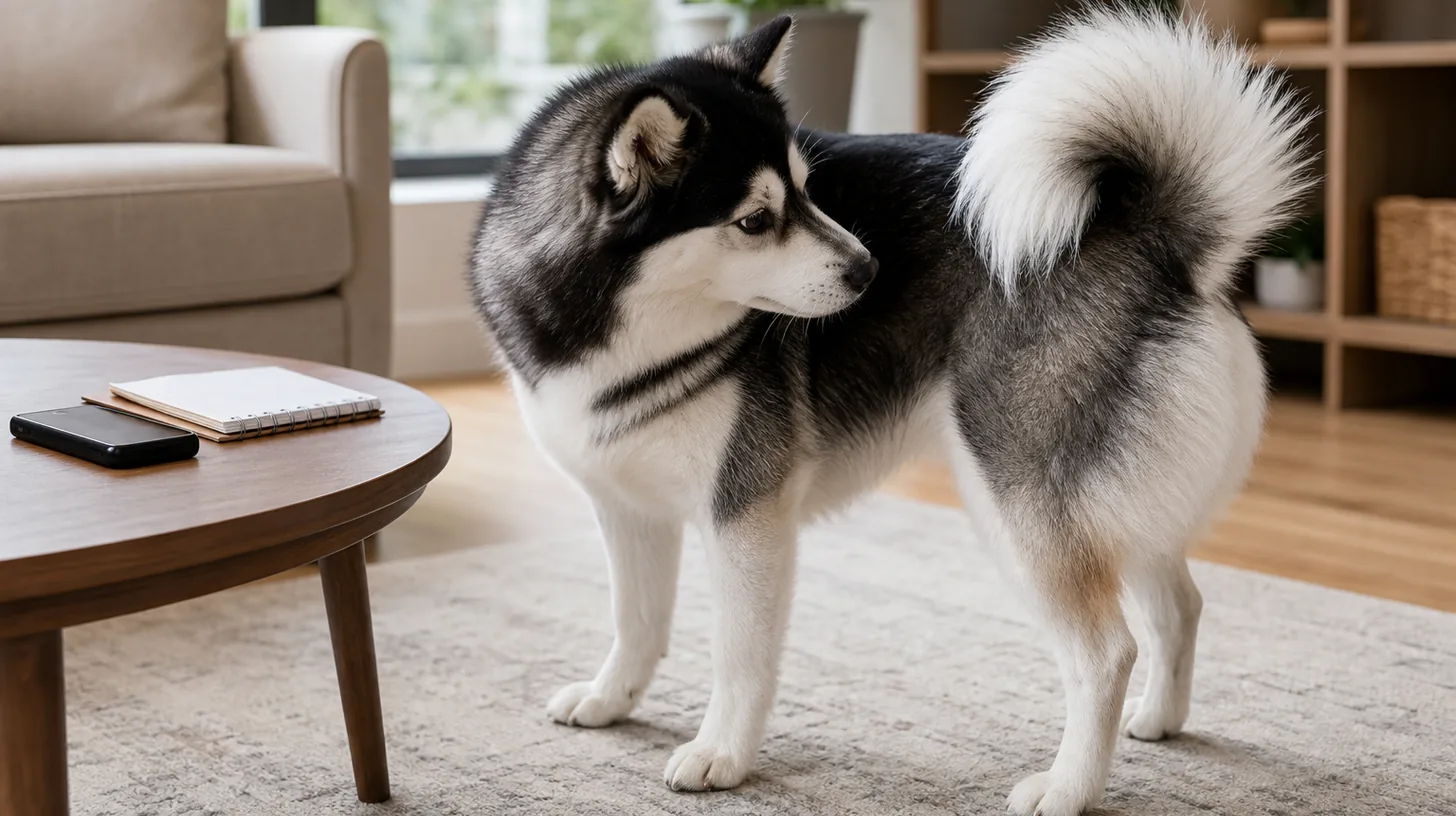
Direct answer: Clear furniture edges, stairs and other collision hazards, then observe without grabbing the Pomsky or tail. Record when the episode starts, how long it lasts, what happened beforehand, whether the dog can disengage and how recovery looks. Capture a short video only if doing so does not prolong or provoke the behavior. Do not turn spinning into a game, repeatedly cue an interruption or assume boredom, anxiety or a medical cause from the behavior alone. Review routine changes with a veterinarian. Sudden onset, increasing frequency, injury, skin changes, distress or episodes that are difficult to interrupt require prompt veterinary assessment and may also need qualified behavior support.
This page owns structured observation and safe routing of repeated tail-directed circling; shadow chasing follows external light movement, the symptom worksheet is general documentation, and the photo/video checklist does not provide a tail-chasing-specific environment protocol. Move people and movable hazards away while keeping stairs and exterior doors secured. Do not restrain, reach into the circle or physically interrupt the Pomsky. The plan separates direct observation, exposure control, management and professional routing.
Clear the Immediate Collision Zone
Move people and movable hazards away while keeping stairs and exterior doors secured.
Keep the sequence repeatable across caregivers. Say what is being checked, complete it, and return equipment and people to neutral before continuing. In this page's context, success means Clear nearby hazards, observe without grabbing the tail or restraining the Pomsky, record context, duration, frequency, interruptibility and recovery, capture a short video only when safe, review exercise, rest and environmental triggers without assigning one cause, stop games that provoke spinning, and arrange veterinary assessment for sudden, frequent, injurious, uninterruptible or worsening episodes.; it does not mean proving that a known risk can be tolerated. In this routine, step 1 is the clear the immediate collision zone decision.
Stop when the expected condition is absent or the situation begins to depend on force, luck, or an open boundary. Specifically avoid adding assess voluntary disengagement before measure duration and frequency is stable, skipping review exercise rest and routine, or continuing through pain, illness, fear, aggression, ingestion risk, unsafe equipment or prolonged avoidance. The follow-up record should cover For Pomsky Tail-Chasing and Spinning Observation Plan, record Clear the Immediate Collision Zone, Observe Without Touching the Tail, Record the Starting Context, Measure Duration and Frequency; compare Assess Voluntary Disengagement, Capture a Short Video When Safe, Review Exercise Rest and Routine; then close with Avoid Games That Provoke Spinning, Share the Pattern With a Veterinarian, Stop for Injury Distress or Poor Interruption. Use dates, direct observations, transition quality and recovery.. Record the result of clear the immediate collision zone before continuing.
Observe Without Touching the Tail
Do not restrain, reach into the circle or physically interrupt the Pomsky.
Treat this as one part of the complete routine, not an isolated trick. The surrounding setup is a controlled low-distraction setup for clear the immediate collision zone, observe without touching the tail and record the starting context, with secure footing, an open retreat, suitable records and one adult handler. A clean transition reduces ambiguity and makes it easier to notice when the dog, equipment, environment, or records differ from the previous attempt. In this routine, step 2 is the observe without touching the tail decision.
The absence of an incident is not proof that the arrangement is sound. Recheck for adding assess voluntary disengagement before measure duration and frequency is stable, skipping review exercise rest and routine, or continuing through pain, illness, fear, aggression, ingestion risk, unsafe equipment or prolonged avoidance. Document For Pomsky Tail-Chasing and Spinning Observation Plan, record Clear the Immediate Collision Zone, Observe Without Touching the Tail, Record the Starting Context, Measure Duration and Frequency; compare Assess Voluntary Disengagement, Capture a Short Video When Safe, Review Exercise Rest and Routine; then close with Avoid Games That Provoke Spinning, Share the Pattern With a Veterinarian, Stop for Injury Distress or Poor Interruption. Use dates, direct observations, transition quality and recovery. so a later caregiver can distinguish a passed step from one that was skipped. Record the result of observe without touching the tail before continuing.
Record the Starting Context
Note time, location, preceding activity, people, sounds and visible environmental change.
Pause long enough to inspect the result rather than assuming the action worked. Look at the dog, the physical boundary, and the next movement available to the caregiver. Continue only when the arrangement still supports Clear nearby hazards, observe without grabbing the tail or restraining the Pomsky, record context, duration, frequency, interruptibility and recovery, capture a short video only when safe, review exercise, rest and environmental triggers without assigning one cause, stop games that provoke spinning, and arrange veterinary assessment for sudden, frequent, injurious, uninterruptible or worsening episodes.. In this routine, step 3 is the record the starting context decision.
If the Pomsky cannot remain comfortable or the equipment and environment cannot remain controlled, end the attempt. Do not proceed through adding assess voluntary disengagement before measure duration and frequency is stable, skipping review exercise rest and routine, or continuing through pain, illness, fear, aggression, ingestion risk, unsafe equipment or prolonged avoidance. Capture For Pomsky Tail-Chasing and Spinning Observation Plan, record Clear the Immediate Collision Zone, Observe Without Touching the Tail, Record the Starting Context, Measure Duration and Frequency; compare Assess Voluntary Disengagement, Capture a Short Video When Safe, Review Exercise Rest and Routine; then close with Avoid Games That Provoke Spinning, Share the Pattern With a Veterinarian, Stop for Injury Distress or Poor Interruption. Use dates, direct observations, transition quality and recovery. before deciding what changes next. Record the result of record the starting context before continuing.
Measure Duration and Frequency
Use direct timing and a dated log rather than estimates based on memorable episodes.
A second capable adult can verify the boundary during early practice or higher-risk situations. That person should follow the same sequence and avoid adding prompts, handling, or access that changes the task. The shared standard remains Clear nearby hazards, observe without grabbing the tail or restraining the Pomsky, record context, duration, frequency, interruptibility and recovery, capture a short video only when safe, review exercise, rest and environmental triggers without assigning one cause, stop games that provoke spinning, and arrange veterinary assessment for sudden, frequent, injurious, uninterruptible or worsening episodes.. In this routine, step 4 is the measure duration and frequency decision.
Do not convert this step into a stress test. The principal avoidable risks are adding assess voluntary disengagement before measure duration and frequency is stable, skipping review exercise rest and routine, or continuing through pain, illness, fear, aggression, ingestion risk, unsafe equipment or prolonged avoidance. Write down For Pomsky Tail-Chasing and Spinning Observation Plan, record Clear the Immediate Collision Zone, Observe Without Touching the Tail, Record the Starting Context, Measure Duration and Frequency; compare Assess Voluntary Disengagement, Capture a Short Video When Safe, Review Exercise Rest and Routine; then close with Avoid Games That Provoke Spinning, Share the Pattern With a Veterinarian, Stop for Injury Distress or Poor Interruption. Use dates, direct observations, transition quality and recovery.; a short factual note is more useful than a reassuring guess. Record the result of measure duration and frequency before continuing.
Assess Voluntary Disengagement
Record whether ordinary environmental change ends the episode without repeated prompting.
Perform this check before adding the next variable. The target remains Clear nearby hazards, observe without grabbing the tail or restraining the Pomsky, record context, duration, frequency, interruptibility and recovery, capture a short video only when safe, review exercise, rest and environmental triggers without assigning one cause, stop games that provoke spinning, and arrange veterinary assessment for sudden, frequent, injurious, uninterruptible or worsening episodes.. Work in a controlled low-distraction setup for clear the immediate collision zone, observe without touching the tail and record the starting context, with secure footing, an open retreat, suitable records and one adult handler. If the setup cannot preserve that condition, simplify it or stop rather than relying on speed or physical control. In this routine, step 5 is the assess voluntary disengagement decision.
Stop when the expected condition is absent or the situation begins to depend on force, luck, or an open boundary. Specifically avoid adding assess voluntary disengagement before measure duration and frequency is stable, skipping review exercise rest and routine, or continuing through pain, illness, fear, aggression, ingestion risk, unsafe equipment or prolonged avoidance. The follow-up record should cover For Pomsky Tail-Chasing and Spinning Observation Plan, record Clear the Immediate Collision Zone, Observe Without Touching the Tail, Record the Starting Context, Measure Duration and Frequency; compare Assess Voluntary Disengagement, Capture a Short Video When Safe, Review Exercise Rest and Routine; then close with Avoid Games That Provoke Spinning, Share the Pattern With a Veterinarian, Stop for Injury Distress or Poor Interruption. Use dates, direct observations, transition quality and recovery.. Record the result of assess voluntary disengagement before continuing.
Capture a Short Video When Safe
Film from a distance only when recording does not prolong, trigger or obstruct the dog.
Use an observable pass condition: the relevant item is checked, the boundary is closed, and the Pomsky can remain safe without being used as a test. This protects the main objective, Clear nearby hazards, observe without grabbing the tail or restraining the Pomsky, record context, duration, frequency, interruptibility and recovery, capture a short video only when safe, review exercise, rest and environmental triggers without assigning one cause, stop games that provoke spinning, and arrange veterinary assessment for sudden, frequent, injurious, uninterruptible or worsening episodes., while leaving a clear point at which the caregiver can step back. In this routine, step 6 is the capture a short video when safe decision.
The absence of an incident is not proof that the arrangement is sound. Recheck for adding assess voluntary disengagement before measure duration and frequency is stable, skipping review exercise rest and routine, or continuing through pain, illness, fear, aggression, ingestion risk, unsafe equipment or prolonged avoidance. Document For Pomsky Tail-Chasing and Spinning Observation Plan, record Clear the Immediate Collision Zone, Observe Without Touching the Tail, Record the Starting Context, Measure Duration and Frequency; compare Assess Voluntary Disengagement, Capture a Short Video When Safe, Review Exercise Rest and Routine; then close with Avoid Games That Provoke Spinning, Share the Pattern With a Veterinarian, Stop for Injury Distress or Poor Interruption. Use dates, direct observations, transition quality and recovery. so a later caregiver can distinguish a passed step from one that was skipped. Record the result of capture a short video when safe before continuing.
Review Exercise Rest and Routine
Document recent changes without treating any one factor as a confirmed cause.
Keep the sequence repeatable across caregivers. Say what is being checked, complete it, and return equipment and people to neutral before continuing. In this page's context, success means Clear nearby hazards, observe without grabbing the tail or restraining the Pomsky, record context, duration, frequency, interruptibility and recovery, capture a short video only when safe, review exercise, rest and environmental triggers without assigning one cause, stop games that provoke spinning, and arrange veterinary assessment for sudden, frequent, injurious, uninterruptible or worsening episodes.; it does not mean proving that a known risk can be tolerated. In this routine, step 7 is the review exercise rest and routine decision.
If the Pomsky cannot remain comfortable or the equipment and environment cannot remain controlled, end the attempt. Do not proceed through adding assess voluntary disengagement before measure duration and frequency is stable, skipping review exercise rest and routine, or continuing through pain, illness, fear, aggression, ingestion risk, unsafe equipment or prolonged avoidance. Capture For Pomsky Tail-Chasing and Spinning Observation Plan, record Clear the Immediate Collision Zone, Observe Without Touching the Tail, Record the Starting Context, Measure Duration and Frequency; compare Assess Voluntary Disengagement, Capture a Short Video When Safe, Review Exercise Rest and Routine; then close with Avoid Games That Provoke Spinning, Share the Pattern With a Veterinarian, Stop for Injury Distress or Poor Interruption. Use dates, direct observations, transition quality and recovery. before deciding what changes next. Record the result of review exercise rest and routine before continuing.
Avoid Games That Provoke Spinning
Do not tease the tail, encourage circling or reward increasingly rapid repetitions.
Treat this as one part of the complete routine, not an isolated trick. The surrounding setup is a controlled low-distraction setup for clear the immediate collision zone, observe without touching the tail and record the starting context, with secure footing, an open retreat, suitable records and one adult handler. A clean transition reduces ambiguity and makes it easier to notice when the dog, equipment, environment, or records differ from the previous attempt. In this routine, step 8 is the avoid games that provoke spinning decision.
Do not convert this step into a stress test. The principal avoidable risks are adding assess voluntary disengagement before measure duration and frequency is stable, skipping review exercise rest and routine, or continuing through pain, illness, fear, aggression, ingestion risk, unsafe equipment or prolonged avoidance. Write down For Pomsky Tail-Chasing and Spinning Observation Plan, record Clear the Immediate Collision Zone, Observe Without Touching the Tail, Record the Starting Context, Measure Duration and Frequency; compare Assess Voluntary Disengagement, Capture a Short Video When Safe, Review Exercise Rest and Routine; then close with Avoid Games That Provoke Spinning, Share the Pattern With a Veterinarian, Stop for Injury Distress or Poor Interruption. Use dates, direct observations, transition quality and recovery.; a short factual note is more useful than a reassuring guess. Record the result of avoid games that provoke spinning before continuing.
Share the Pattern With a Veterinarian
Provide the log and video for sudden, frequent, worsening or symptom-associated episodes.
Pause long enough to inspect the result rather than assuming the action worked. Look at the dog, the physical boundary, and the next movement available to the caregiver. Continue only when the arrangement still supports Clear nearby hazards, observe without grabbing the tail or restraining the Pomsky, record context, duration, frequency, interruptibility and recovery, capture a short video only when safe, review exercise, rest and environmental triggers without assigning one cause, stop games that provoke spinning, and arrange veterinary assessment for sudden, frequent, injurious, uninterruptible or worsening episodes.. In this routine, step 9 is the share the pattern with a veterinarian decision.
Stop when the expected condition is absent or the situation begins to depend on force, luck, or an open boundary. Specifically avoid adding assess voluntary disengagement before measure duration and frequency is stable, skipping review exercise rest and routine, or continuing through pain, illness, fear, aggression, ingestion risk, unsafe equipment or prolonged avoidance. The follow-up record should cover For Pomsky Tail-Chasing and Spinning Observation Plan, record Clear the Immediate Collision Zone, Observe Without Touching the Tail, Record the Starting Context, Measure Duration and Frequency; compare Assess Voluntary Disengagement, Capture a Short Video When Safe, Review Exercise Rest and Routine; then close with Avoid Games That Provoke Spinning, Share the Pattern With a Veterinarian, Stop for Injury Distress or Poor Interruption. Use dates, direct observations, transition quality and recovery.. Record the result of share the pattern with a veterinarian before continuing.
Stop for Injury Distress or Poor Interruption
Seek prompt help for falls, skin damage, pain, panic or behavior that cannot be safely interrupted.
A second capable adult can verify the boundary during early practice or higher-risk situations. That person should follow the same sequence and avoid adding prompts, handling, or access that changes the task. The shared standard remains Clear nearby hazards, observe without grabbing the tail or restraining the Pomsky, record context, duration, frequency, interruptibility and recovery, capture a short video only when safe, review exercise, rest and environmental triggers without assigning one cause, stop games that provoke spinning, and arrange veterinary assessment for sudden, frequent, injurious, uninterruptible or worsening episodes.. In this routine, step 10 is the stop for injury distress or poor interruption decision.
The absence of an incident is not proof that the arrangement is sound. Recheck for adding assess voluntary disengagement before measure duration and frequency is stable, skipping review exercise rest and routine, or continuing through pain, illness, fear, aggression, ingestion risk, unsafe equipment or prolonged avoidance. Document For Pomsky Tail-Chasing and Spinning Observation Plan, record Clear the Immediate Collision Zone, Observe Without Touching the Tail, Record the Starting Context, Measure Duration and Frequency; compare Assess Voluntary Disengagement, Capture a Short Video When Safe, Review Exercise Rest and Routine; then close with Avoid Games That Provoke Spinning, Share the Pattern With a Veterinarian, Stop for Injury Distress or Poor Interruption. Use dates, direct observations, transition quality and recovery. so a later caregiver can distinguish a passed step from one that was skipped. Record the result of stop for injury distress or poor interruption before continuing.
When to Stop and Escalate
Stop when the Pomsky, caregiver, equipment, records, or environment no longer supports Clear nearby hazards, observe without grabbing the tail or restraining the Pomsky, record context, duration, frequency, interruptibility and recovery, capture a short video only when safe, review exercise, rest and environmental triggers without assigning one cause, stop games that provoke spinning, and arrange veterinary assessment for sudden, frequent, injurious, uninterruptible or worsening episodes.. Do not improvise through adding assess voluntary disengagement before measure duration and frequency is stable, skipping review exercise rest and routine, or continuing through pain, illness, fear, aggression, ingestion risk, unsafe equipment or prolonged avoidance. Seek a veterinarian for health, pain, ingestion or sudden-change concerns and a qualified reward-based professional for exceptions during share the pattern with a veterinarian or stop for injury distress or poor interruption. Bring the factual observations already collected rather than recreating the event.
Before another attempt, review For Pomsky Tail-Chasing and Spinning Observation Plan, record Clear the Immediate Collision Zone, Observe Without Touching the Tail, Record the Starting Context, Measure Duration and Frequency; compare Assess Voluntary Disengagement, Capture a Short Video When Safe, Review Exercise Rest and Routine; then close with Avoid Games That Provoke Spinning, Share the Pattern With a Veterinarian, Stop for Injury Distress or Poor Interruption. Use dates, direct observations, transition quality and recovery.. Resume only after the responsible person, physical setup, and controlling instructions are clear. A stop is part of the protocol: it preserves useful evidence and prevents uncertainty from becoming exposure.
Keep the Routine Current
Recheck the complete setup whenever the dog, household, product, instructions, environment, or purpose changes. The intended outcome remains Clear nearby hazards, observe without grabbing the tail or restraining the Pomsky, record context, duration, frequency, interruptibility and recovery, capture a short video only when safe, review exercise, rest and environmental triggers without assigning one cause, stop games that provoke spinning, and arrange veterinary assessment for sudden, frequent, injurious, uninterruptible or worsening episodes., not a perfect-looking performance. Use the newest primary instruction, retain dated records, and retire superseded assumptions so every caregiver begins from the same current plan.
Sources reviewed
Each source is used only for the claim scopes listed below. None establishes a guaranteed Pomsky outcome or replaces individual professional assessment.
- American Veterinary Society of Animal Behavior: Humane Dog Training Position Statement - Supports: reward-based training; aversive-method risk; behavior change principles. Limit: Does not guarantee outcomes for an individual dog.
- American Veterinary Society of Animal Behavior: How to Select a Behavior Consultant - Supports: trainer credentials; behavior consultant selection; red flags. Limit: Avoid implying that a title alone proves competence.
- American Animal Hospital Association: Lifestyle and Safety Assessment - Supports: appropriate confinement; leash, collar and harness planning; lifestyle-specific safety review. Limit: Equipment selection must account for the individual dog's anatomy, behavior, health, and environment.