Written and reviewed by A Pomsky Editorial Team. Originally published 2026-07-26; substantively reviewed July 26, 2026.
Training boundary: Use humane, reward-based methods and protect safety with management. Pain, panic, aggression, a bite history, or serious handling risk requires a veterinarian or qualified behavior professional. Read the editorial policy.
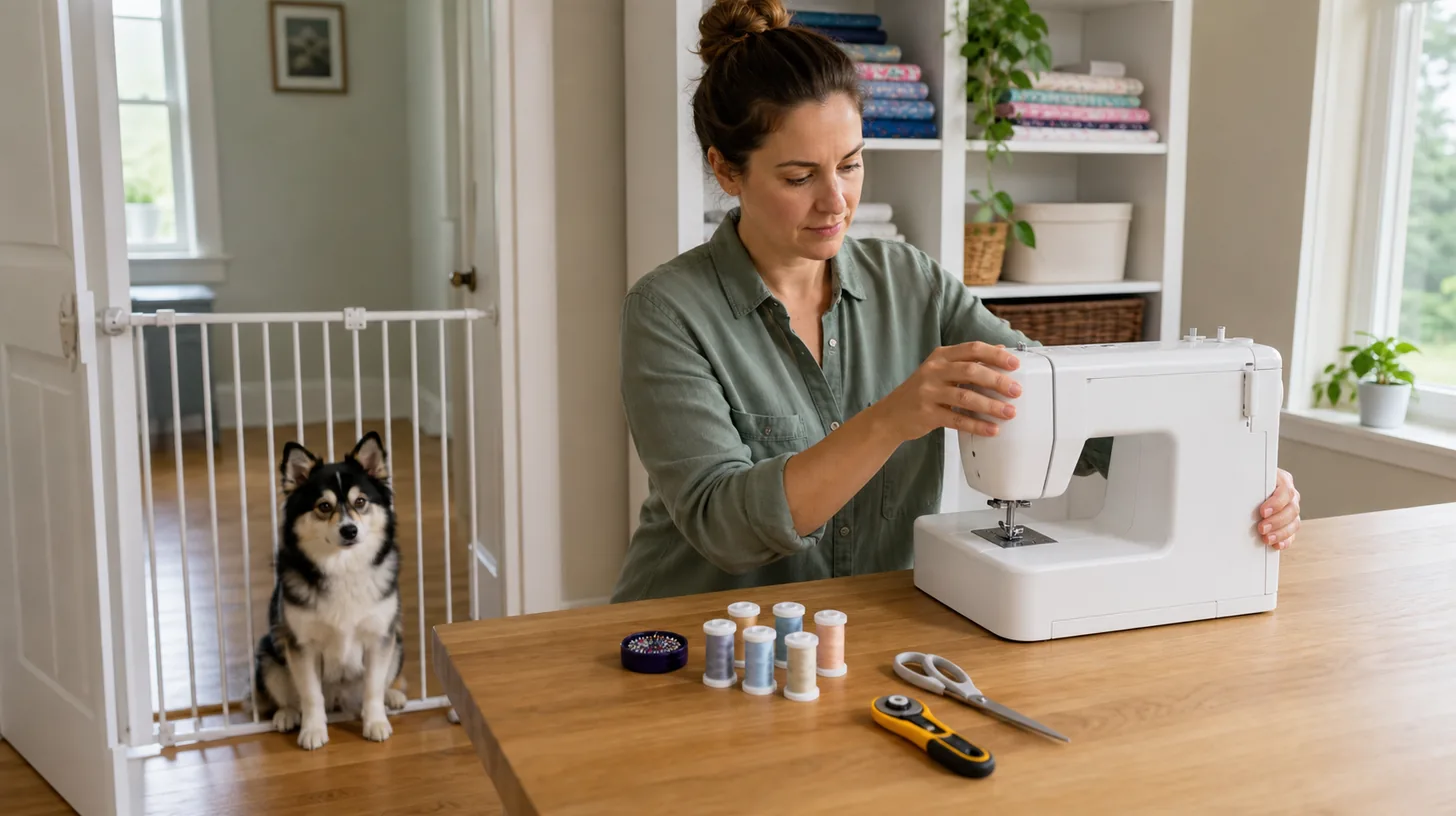
Direct answer: Secure the Pomsky outside the sewing room before unpacking tools. Inspect the machine, needle, presser foot, pedal and cord, and keep pins, bobbins, thread, cutters and scraps in counted containers. Stop and isolate power before adjustments. At the end, close every blade, remove the needle as directed, count all small items and inspect the dog-height floor before reopening the room.
A sewing project combines a powered needle, presser foot, moving feed system, pedal, cord, hot or moving machine parts, pins, hand needles, bobbins, thread, rotary cutters, scissors, clips and small fabric scraps. A Pomsky can encounter hazards even while the machine is idle. The dog should be secured outside the complete room before supplies are opened and remain excluded until every sharp, thread path, scrap and floor edge has been reconciled.
Exclude the Pomsky Before Unpacking
Close and test the room barrier before carrying in the machine, pedal, cord, fabric, pins, needles, cutters, scissors, bobbins, thread, clips, fasteners or waste container.
Pause long enough to inspect the result rather than assuming the action worked. Look at the dog, the physical boundary, and the next movement available to the caregiver. Continue only when the arrangement still supports one sewing task completed with the Pomsky excluded and the machine, needle, presser foot, pedal, cord, pins, cutters, thread, notions, scraps, shutdown, storage and floor reconciled. In this routine, step 1 is the exclude the pomsky before unpacking decision.
If the Pomsky cannot remain comfortable or the equipment and environment cannot remain controlled, end the attempt. Do not proceed through moving needle, presser-foot pinch, unexpected pedal activation, damaged cord, loose pin, hand needle, exposed rotary blade, scissor, swallowed thread, bobbin, clip, fabric scrap, hot component or premature reentry. Capture dog location, barrier, machine, needle, presser foot, pedal, cord, power, pins, hand needles, cutters, scissors, bobbins, thread, notions, scraps, shutdown, storage and floor before deciding what changes next. Record the result of exclude the pomsky before unpacking before continuing.
Retrieve Exact Machine and Tool Directions
Confirm threading, needle replacement, presser-foot use, pedal connection, cleaning, power isolation, cutter closure and storage requirements for the exact equipment.
A second capable adult can verify the boundary during early practice or higher-risk situations. That person should follow the same sequence and avoid adding prompts, handling, or access that changes the task. The shared standard remains one sewing task completed with the Pomsky excluded and the machine, needle, presser foot, pedal, cord, pins, cutters, thread, notions, scraps, shutdown, storage and floor reconciled. In this routine, step 2 is the retrieve exact machine and tool directions decision.
Do not convert this step into a stress test. The principal avoidable risks are moving needle, presser-foot pinch, unexpected pedal activation, damaged cord, loose pin, hand needle, exposed rotary blade, scissor, swallowed thread, bobbin, clip, fabric scrap, hot component or premature reentry. Write down dog location, barrier, machine, needle, presser foot, pedal, cord, power, pins, hand needles, cutters, scissors, bobbins, thread, notions, scraps, shutdown, storage and floor; a short factual note is more useful than a reassuring guess. Record the result of retrieve exact machine and tool directions before continuing.
Inspect the Machine Pedal and Cord
Check housing, table stability, needle plate, presser foot, controls, pedal, plug, insulation, lighting, ventilation, unusual heat, smell, noise, damage and service status.
Perform this check before adding the next variable. The target remains one sewing task completed with the Pomsky excluded and the machine, needle, presser foot, pedal, cord, pins, cutters, thread, notions, scraps, shutdown, storage and floor reconciled. Work in a bright dog-free sewing room with tested barrier, intact machine and directions, stable table, controlled pedal and cord, counted sharps, closed notions, scrap container and clear exit. If the setup cannot preserve that condition, simplify it or stop rather than relying on speed or physical control. In this routine, step 3 is the inspect the machine pedal and cord decision.
Stop when the expected condition is absent or the situation begins to depend on force, luck, or an open boundary. Specifically avoid moving needle, presser-foot pinch, unexpected pedal activation, damaged cord, loose pin, hand needle, exposed rotary blade, scissor, swallowed thread, bobbin, clip, fabric scrap, hot component or premature reentry. The follow-up record should cover dog location, barrier, machine, needle, presser foot, pedal, cord, power, pins, hand needles, cutters, scissors, bobbins, thread, notions, scraps, shutdown, storage and floor. Record the result of inspect the machine pedal and cord before continuing.
Create Counted Sharp-Item Control
Start with a known count of machine needles, hand needles, pins, clips, blades and small fasteners and use closed magnetic or rigid storage suited to the item.
Use an observable pass condition: the relevant item is checked, the boundary is closed, and the Pomsky can remain safe without being used as a test. This protects the main objective, one sewing task completed with the Pomsky excluded and the machine, needle, presser foot, pedal, cord, pins, cutters, thread, notions, scraps, shutdown, storage and floor reconciled, while leaving a clear point at which the caregiver can step back. In this routine, step 4 is the create counted sharp-item control decision.
The absence of an incident is not proof that the arrangement is sound. Recheck for moving needle, presser-foot pinch, unexpected pedal activation, damaged cord, loose pin, hand needle, exposed rotary blade, scissor, swallowed thread, bobbin, clip, fabric scrap, hot component or premature reentry. Document dog location, barrier, machine, needle, presser foot, pedal, cord, power, pins, hand needles, cutters, scissors, bobbins, thread, notions, scraps, shutdown, storage and floor so a later caregiver can distinguish a passed step from one that was skipped. Record the result of create counted sharp-item control before continuing.
Control Thread Bobbins and Scraps
Keep thread ends short and contained, close bobbin storage, collect selvage and offcuts immediately, and prevent loops or strips from reaching the floor.
Keep the sequence repeatable across caregivers. Say what is being checked, complete it, and return equipment and people to neutral before continuing. In this page's context, success means one sewing task completed with the Pomsky excluded and the machine, needle, presser foot, pedal, cord, pins, cutters, thread, notions, scraps, shutdown, storage and floor reconciled; it does not mean proving that a known risk can be tolerated. In this routine, step 5 is the control thread bobbins and scraps decision.
If the Pomsky cannot remain comfortable or the equipment and environment cannot remain controlled, end the attempt. Do not proceed through moving needle, presser-foot pinch, unexpected pedal activation, damaged cord, loose pin, hand needle, exposed rotary blade, scissor, swallowed thread, bobbin, clip, fabric scrap, hot component or premature reentry. Capture dog location, barrier, machine, needle, presser foot, pedal, cord, power, pins, hand needles, cutters, scissors, bobbins, thread, notions, scraps, shutdown, storage and floor before deciding what changes next. Record the result of control thread bobbins and scraps before continuing.
Operate Without Dog Access
Keep the barrier closed, hands and clothing positioned as directed, pedal clear of dropped objects, and attention on the machine without holding or supervising the Pomsky.
Treat this as one part of the complete routine, not an isolated trick. The surrounding setup is a bright dog-free sewing room with tested barrier, intact machine and directions, stable table, controlled pedal and cord, counted sharps, closed notions, scrap container and clear exit. A clean transition reduces ambiguity and makes it easier to notice when the dog, equipment, environment, or records differ from the previous attempt. In this routine, step 6 is the operate without dog access decision.
Do not convert this step into a stress test. The principal avoidable risks are moving needle, presser-foot pinch, unexpected pedal activation, damaged cord, loose pin, hand needle, exposed rotary blade, scissor, swallowed thread, bobbin, clip, fabric scrap, hot component or premature reentry. Write down dog location, barrier, machine, needle, presser foot, pedal, cord, power, pins, hand needles, cutters, scissors, bobbins, thread, notions, scraps, shutdown, storage and floor; a short factual note is more useful than a reassuring guess. Record the result of operate without dog access before continuing.
Stop Before Every Adjustment
Remove the foot from the pedal, stop movement, isolate power as directed and reach the required safe state before changing a needle, bobbin, thread, foot, plate or jammed fabric.
Pause long enough to inspect the result rather than assuming the action worked. Look at the dog, the physical boundary, and the next movement available to the caregiver. Continue only when the arrangement still supports one sewing task completed with the Pomsky excluded and the machine, needle, presser foot, pedal, cord, pins, cutters, thread, notions, scraps, shutdown, storage and floor reconciled. In this routine, step 7 is the stop before every adjustment decision.
Stop when the expected condition is absent or the situation begins to depend on force, luck, or an open boundary. Specifically avoid moving needle, presser-foot pinch, unexpected pedal activation, damaged cord, loose pin, hand needle, exposed rotary blade, scissor, swallowed thread, bobbin, clip, fabric scrap, hot component or premature reentry. The follow-up record should cover dog location, barrier, machine, needle, presser foot, pedal, cord, power, pins, hand needles, cutters, scissors, bobbins, thread, notions, scraps, shutdown, storage and floor. Record the result of stop before every adjustment before continuing.
Close Cutters and Recover Drops
Close or sheath scissors and rotary cutters immediately after use and stop the machine before retrieving any dropped pin, clip, tool, thread spool or fabric piece.
A second capable adult can verify the boundary during early practice or higher-risk situations. That person should follow the same sequence and avoid adding prompts, handling, or access that changes the task. The shared standard remains one sewing task completed with the Pomsky excluded and the machine, needle, presser foot, pedal, cord, pins, cutters, thread, notions, scraps, shutdown, storage and floor reconciled. In this routine, step 8 is the close cutters and recover drops decision.
The absence of an incident is not proof that the arrangement is sound. Recheck for moving needle, presser-foot pinch, unexpected pedal activation, damaged cord, loose pin, hand needle, exposed rotary blade, scissor, swallowed thread, bobbin, clip, fabric scrap, hot component or premature reentry. Document dog location, barrier, machine, needle, presser foot, pedal, cord, power, pins, hand needles, cutters, scissors, bobbins, thread, notions, scraps, shutdown, storage and floor so a later caregiver can distinguish a passed step from one that was skipped. Record the result of close cutters and recover drops before continuing.
Shut Down Clean and Store
Follow the directed shutdown and cleaning sequence, secure the pedal and cord, close blades, protect the needle area and return all tools and notions to inaccessible storage.
Perform this check before adding the next variable. The target remains one sewing task completed with the Pomsky excluded and the machine, needle, presser foot, pedal, cord, pins, cutters, thread, notions, scraps, shutdown, storage and floor reconciled. Work in a bright dog-free sewing room with tested barrier, intact machine and directions, stable table, controlled pedal and cord, counted sharps, closed notions, scrap container and clear exit. If the setup cannot preserve that condition, simplify it or stop rather than relying on speed or physical control. In this routine, step 9 is the shut down clean and store decision.
If the Pomsky cannot remain comfortable or the equipment and environment cannot remain controlled, end the attempt. Do not proceed through moving needle, presser-foot pinch, unexpected pedal activation, damaged cord, loose pin, hand needle, exposed rotary blade, scissor, swallowed thread, bobbin, clip, fabric scrap, hot component or premature reentry. Capture dog location, barrier, machine, needle, presser foot, pedal, cord, power, pins, hand needles, cutters, scissors, bobbins, thread, notions, scraps, shutdown, storage and floor before deciding what changes next. Record the result of shut down clean and store before continuing.
Complete a Floor-Level Count Audit
Reconcile the starting and ending sharp count, then inspect table edges, chair, clothing, fabric folds, waste, cords, storage, doorway and the entire dog-height floor before release.
Use an observable pass condition: the relevant item is checked, the boundary is closed, and the Pomsky can remain safe without being used as a test. This protects the main objective, one sewing task completed with the Pomsky excluded and the machine, needle, presser foot, pedal, cord, pins, cutters, thread, notions, scraps, shutdown, storage and floor reconciled, while leaving a clear point at which the caregiver can step back. In this routine, step 10 is the complete a floor-level count audit decision.
Do not convert this step into a stress test. The principal avoidable risks are moving needle, presser-foot pinch, unexpected pedal activation, damaged cord, loose pin, hand needle, exposed rotary blade, scissor, swallowed thread, bobbin, clip, fabric scrap, hot component or premature reentry. Write down dog location, barrier, machine, needle, presser foot, pedal, cord, power, pins, hand needles, cutters, scissors, bobbins, thread, notions, scraps, shutdown, storage and floor; a short factual note is more useful than a reassuring guess. Record the result of complete a floor-level count audit before continuing.
When to Stop and Escalate
Stop when the Pomsky, caregiver, equipment, records, or environment no longer supports one sewing task completed with the Pomsky excluded and the machine, needle, presser foot, pedal, cord, pins, cutters, thread, notions, scraps, shutdown, storage and floor reconciled. Do not improvise through moving needle, presser-foot pinch, unexpected pedal activation, damaged cord, loose pin, hand needle, exposed rotary blade, scissor, swallowed thread, bobbin, clip, fabric scrap, hot component or premature reentry. Seek the manufacturer or qualified service for machine and tool faults, emergency services for immediate electrical danger, and veterinary or emergency care for injury, suspected ingestion or concerning signs. Bring the factual observations already collected rather than recreating the event.
Before another attempt, review dog location, barrier, machine, needle, presser foot, pedal, cord, power, pins, hand needles, cutters, scissors, bobbins, thread, notions, scraps, shutdown, storage and floor. Resume only after the responsible person, physical setup, and controlling instructions are clear. A stop is part of the protocol: it preserves useful evidence and prevents uncertainty from becoming exposure.
Keep the Routine Current
Recheck the complete setup whenever the dog, household, product, instructions, environment, or purpose changes. The intended outcome remains one sewing task completed with the Pomsky excluded and the machine, needle, presser foot, pedal, cord, pins, cutters, thread, notions, scraps, shutdown, storage and floor reconciled, not a perfect-looking performance. Use the newest primary instruction, retain dated records, and retire superseded assumptions so every caregiver begins from the same current plan.
Sources reviewed
Each source is used only for the claim scopes listed below. None establishes a guaranteed Pomsky outcome or replaces individual professional assessment.
- U.S. Centers for Disease Control and Prevention: Dogs: Healthy Pets, Healthy People - Supports: supervision around young children; bite prevention; household hygiene and routine veterinary care. Limit: General prevention guidance does not assess an individual dog's behavior or replace pediatric, veterinary, or qualified behavior advice.
- American Animal Hospital Association: Lifestyle and Safety Assessment - Supports: appropriate confinement; leash, collar and harness planning; lifestyle-specific safety review. Limit: Equipment selection must account for the individual dog's anatomy, behavior, health, and environment.
- ASPCA: Emergency Care for Your Pet - Supports: heatstroke as a veterinary emergency; emergency clinic planning; professional escalation. Limit: A general article cannot assess stability or replace emergency veterinary examination and treatment.