Written and reviewed by A Pomsky Editorial Team. Originally published 2026-07-26; substantively reviewed July 26, 2026.
Training boundary: Use humane, reward-based methods and protect safety with management. Pain, panic, aggression, a bite history, or serious handling risk requires a veterinarian or qualified behavior professional. Read the editorial policy.
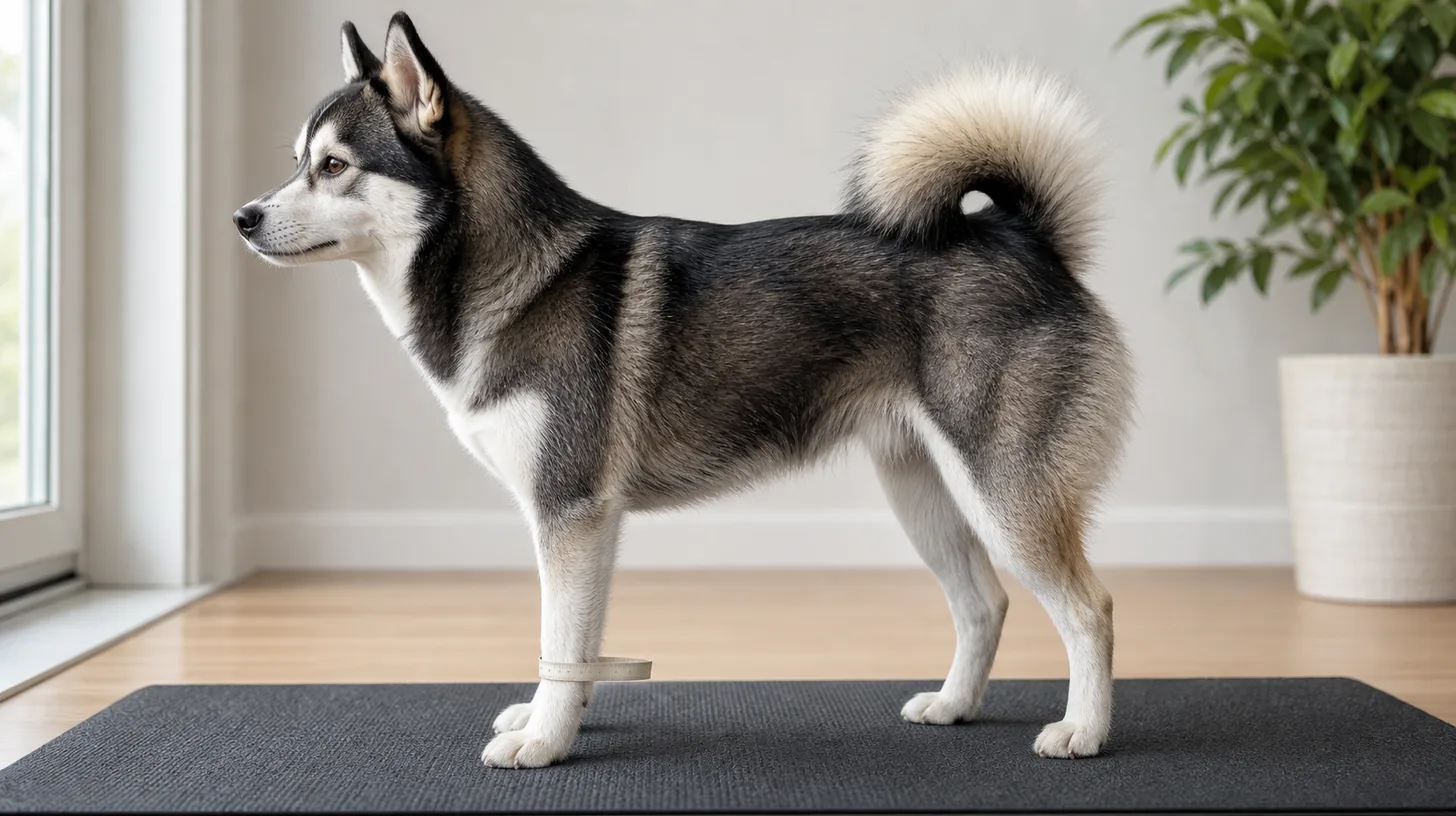
Direct answer: Read the current boot maker's cuff-measurement landmark before positioning the Pomsky on a level nonslip surface, wait for a voluntary square stand, identify the selected leg and exact stated height above the paw, place a flexible tape level around coat and leg with light contact but no compression, keep toes and joints in a neutral weight-bearing position, record side, landmark, posture, coat condition, tape, helper and date, release the dog and repeat only after a natural reset, reject readings taken while sitting, leaning, lifting, pulling the tape tight or using an unstated landmark, measure each required leg separately, and use the maker's current fit process rather than treating circumference as a size guarantee.
This page owns circumference at the manufacturer-defined lower-leg boot-cuff landmark; the paw-width owner measures side-to-side ground contact, the paw-length owner measures toe-to-pad distance, and the foreleg owner measures vertical elbow-to-floor length. The target is a bounded, source-backed workflow rather than a generic promise, visual guess, improvised repair, diagnosis, transaction endorsement, guaranteed fit, or substitute for responsible instructions.
Read the Current Boot Maker Landmark
For measure pomsky lower-leg circumference, complete read the current boot maker landmark against this page's exact source, item, condition, stop rule, separation boundary, and handoff.
Use an observable pass condition: the relevant item is checked, the boundary is closed, and the Pomsky can remain safe without being used as a test. This protects the main objective, Read the current boot maker's cuff-measurement landmark before positioning the Pomsky on a level nonslip surface, wait for a voluntary square stand, identify the selected leg and exact stated height above the paw, place a flexible tape level around coat and leg with light contact but no compression, keep toes and joints in a neutral weight-bearing position, record side, landmark, posture, coat condition, tape, helper and date, release the dog and repeat only after a natural reset, reject readings taken while sitting, leaning, lifting, pulling the tape tight or using an unstated landmark, measure each required leg separately, and use the maker's current fit process rather than treating circumference as a size guarantee., while leaving a clear point at which the caregiver can step back. In this routine, step 1 is the read the current boot maker landmark decision.
Do not convert this step into a stress test. The principal avoidable risks are skipping wait for a voluntary square stand, continuing through release and repeat after a natural reset, or treating identity conflicts, wet floors, damage, contamination, privacy exposure, puppy distress, archive errors, fit uncertainty, or missing supplies as resolved. Write down read the current boot maker landmark, use a level nonslip surface, wait for a voluntary square stand, identify the selected leg and exact height, place a flexible tape level with light contact, keep toes and joints neutral and weight bearing, record side landmark posture coat tool and date, release and repeat after a natural reset, reject compressed lifted leaning or unstated readings, measure required legs without a size guarantee; a short factual note is more useful than a reassuring guess. Record the result of read the current boot maker landmark before continuing.
Use a Level Nonslip Surface
For measure pomsky lower-leg circumference, complete use a level nonslip surface against this page's exact source, item, condition, stop rule, separation boundary, and handoff.
Keep the sequence repeatable across caregivers. Say what is being checked, complete it, and return equipment and people to neutral before continuing. In this page's context, success means Read the current boot maker's cuff-measurement landmark before positioning the Pomsky on a level nonslip surface, wait for a voluntary square stand, identify the selected leg and exact stated height above the paw, place a flexible tape level around coat and leg with light contact but no compression, keep toes and joints in a neutral weight-bearing position, record side, landmark, posture, coat condition, tape, helper and date, release the dog and repeat only after a natural reset, reject readings taken while sitting, leaning, lifting, pulling the tape tight or using an unstated landmark, measure each required leg separately, and use the maker's current fit process rather than treating circumference as a size guarantee.; it does not mean proving that a known risk can be tolerated. In this routine, step 2 is the use a level nonslip surface decision.
Stop when the expected condition is absent or the situation begins to depend on force, luck, or an open boundary. Specifically avoid skipping wait for a voluntary square stand, continuing through release and repeat after a natural reset, or treating identity conflicts, wet floors, damage, contamination, privacy exposure, puppy distress, archive errors, fit uncertainty, or missing supplies as resolved. The follow-up record should cover read the current boot maker landmark, use a level nonslip surface, wait for a voluntary square stand, identify the selected leg and exact height, place a flexible tape level with light contact, keep toes and joints neutral and weight bearing, record side landmark posture coat tool and date, release and repeat after a natural reset, reject compressed lifted leaning or unstated readings, measure required legs without a size guarantee. Record the result of use a level nonslip surface before continuing.
Wait for a Voluntary Square Stand
For measure pomsky lower-leg circumference, complete wait for a voluntary square stand against this page's exact source, item, condition, stop rule, separation boundary, and handoff.
Treat this as one part of the complete routine, not an isolated trick. The surrounding setup is a controlled setup for read the current boot maker landmark with the Pomsky separated whenever payment records, airport traffic, leash gear, grooming teeth, food-contact packaging, private veterinary records, moving household objects, archive media, measurement tools, or emergency sanitation supplies are present. A clean transition reduces ambiguity and makes it easier to notice when the dog, equipment, environment, or records differ from the previous attempt. In this routine, step 3 is the wait for a voluntary square stand decision.
The absence of an incident is not proof that the arrangement is sound. Recheck for skipping wait for a voluntary square stand, continuing through release and repeat after a natural reset, or treating identity conflicts, wet floors, damage, contamination, privacy exposure, puppy distress, archive errors, fit uncertainty, or missing supplies as resolved. Document read the current boot maker landmark, use a level nonslip surface, wait for a voluntary square stand, identify the selected leg and exact height, place a flexible tape level with light contact, keep toes and joints neutral and weight bearing, record side landmark posture coat tool and date, release and repeat after a natural reset, reject compressed lifted leaning or unstated readings, measure required legs without a size guarantee so a later caregiver can distinguish a passed step from one that was skipped. Record the result of wait for a voluntary square stand before continuing.
Identify the Selected Leg and Exact Height
For measure pomsky lower-leg circumference, complete identify the selected leg and exact height against this page's exact source, item, condition, stop rule, separation boundary, and handoff.
Pause long enough to inspect the result rather than assuming the action worked. Look at the dog, the physical boundary, and the next movement available to the caregiver. Continue only when the arrangement still supports Read the current boot maker's cuff-measurement landmark before positioning the Pomsky on a level nonslip surface, wait for a voluntary square stand, identify the selected leg and exact stated height above the paw, place a flexible tape level around coat and leg with light contact but no compression, keep toes and joints in a neutral weight-bearing position, record side, landmark, posture, coat condition, tape, helper and date, release the dog and repeat only after a natural reset, reject readings taken while sitting, leaning, lifting, pulling the tape tight or using an unstated landmark, measure each required leg separately, and use the maker's current fit process rather than treating circumference as a size guarantee.. In this routine, step 4 is the identify the selected leg and exact height decision.
If the Pomsky cannot remain comfortable or the equipment and environment cannot remain controlled, end the attempt. Do not proceed through skipping wait for a voluntary square stand, continuing through release and repeat after a natural reset, or treating identity conflicts, wet floors, damage, contamination, privacy exposure, puppy distress, archive errors, fit uncertainty, or missing supplies as resolved. Capture read the current boot maker landmark, use a level nonslip surface, wait for a voluntary square stand, identify the selected leg and exact height, place a flexible tape level with light contact, keep toes and joints neutral and weight bearing, record side landmark posture coat tool and date, release and repeat after a natural reset, reject compressed lifted leaning or unstated readings, measure required legs without a size guarantee before deciding what changes next. Record the result of identify the selected leg and exact height before continuing.
Place a Flexible Tape Level With Light Contact
For measure pomsky lower-leg circumference, complete place a flexible tape level with light contact against this page's exact source, item, condition, stop rule, separation boundary, and handoff.
A second capable adult can verify the boundary during early practice or higher-risk situations. That person should follow the same sequence and avoid adding prompts, handling, or access that changes the task. The shared standard remains Read the current boot maker's cuff-measurement landmark before positioning the Pomsky on a level nonslip surface, wait for a voluntary square stand, identify the selected leg and exact stated height above the paw, place a flexible tape level around coat and leg with light contact but no compression, keep toes and joints in a neutral weight-bearing position, record side, landmark, posture, coat condition, tape, helper and date, release the dog and repeat only after a natural reset, reject readings taken while sitting, leaning, lifting, pulling the tape tight or using an unstated landmark, measure each required leg separately, and use the maker's current fit process rather than treating circumference as a size guarantee.. In this routine, step 5 is the place a flexible tape level with light contact decision.
Do not convert this step into a stress test. The principal avoidable risks are skipping wait for a voluntary square stand, continuing through release and repeat after a natural reset, or treating identity conflicts, wet floors, damage, contamination, privacy exposure, puppy distress, archive errors, fit uncertainty, or missing supplies as resolved. Write down read the current boot maker landmark, use a level nonslip surface, wait for a voluntary square stand, identify the selected leg and exact height, place a flexible tape level with light contact, keep toes and joints neutral and weight bearing, record side landmark posture coat tool and date, release and repeat after a natural reset, reject compressed lifted leaning or unstated readings, measure required legs without a size guarantee; a short factual note is more useful than a reassuring guess. Record the result of place a flexible tape level with light contact before continuing.
Keep Toes and Joints Neutral and Weight Bearing
For measure pomsky lower-leg circumference, complete keep toes and joints neutral and weight bearing against this page's exact source, item, condition, stop rule, separation boundary, and handoff.
Perform this check before adding the next variable. The target remains Read the current boot maker's cuff-measurement landmark before positioning the Pomsky on a level nonslip surface, wait for a voluntary square stand, identify the selected leg and exact stated height above the paw, place a flexible tape level around coat and leg with light contact but no compression, keep toes and joints in a neutral weight-bearing position, record side, landmark, posture, coat condition, tape, helper and date, release the dog and repeat only after a natural reset, reject readings taken while sitting, leaning, lifting, pulling the tape tight or using an unstated landmark, measure each required leg separately, and use the maker's current fit process rather than treating circumference as a size guarantee.. Work in a controlled setup for read the current boot maker landmark with the Pomsky separated whenever payment records, airport traffic, leash gear, grooming teeth, food-contact packaging, private veterinary records, moving household objects, archive media, measurement tools, or emergency sanitation supplies are present. If the setup cannot preserve that condition, simplify it or stop rather than relying on speed or physical control. In this routine, step 6 is the keep toes and joints neutral and weight bearing decision.
Stop when the expected condition is absent or the situation begins to depend on force, luck, or an open boundary. Specifically avoid skipping wait for a voluntary square stand, continuing through release and repeat after a natural reset, or treating identity conflicts, wet floors, damage, contamination, privacy exposure, puppy distress, archive errors, fit uncertainty, or missing supplies as resolved. The follow-up record should cover read the current boot maker landmark, use a level nonslip surface, wait for a voluntary square stand, identify the selected leg and exact height, place a flexible tape level with light contact, keep toes and joints neutral and weight bearing, record side landmark posture coat tool and date, release and repeat after a natural reset, reject compressed lifted leaning or unstated readings, measure required legs without a size guarantee. Record the result of keep toes and joints neutral and weight bearing before continuing.
Record Side Landmark Posture Coat Tool and Date
For measure pomsky lower-leg circumference, complete record side landmark posture coat tool and date against this page's exact source, item, condition, stop rule, separation boundary, and handoff.
Use an observable pass condition: the relevant item is checked, the boundary is closed, and the Pomsky can remain safe without being used as a test. This protects the main objective, Read the current boot maker's cuff-measurement landmark before positioning the Pomsky on a level nonslip surface, wait for a voluntary square stand, identify the selected leg and exact stated height above the paw, place a flexible tape level around coat and leg with light contact but no compression, keep toes and joints in a neutral weight-bearing position, record side, landmark, posture, coat condition, tape, helper and date, release the dog and repeat only after a natural reset, reject readings taken while sitting, leaning, lifting, pulling the tape tight or using an unstated landmark, measure each required leg separately, and use the maker's current fit process rather than treating circumference as a size guarantee., while leaving a clear point at which the caregiver can step back. In this routine, step 7 is the record side landmark posture coat tool and date decision.
The absence of an incident is not proof that the arrangement is sound. Recheck for skipping wait for a voluntary square stand, continuing through release and repeat after a natural reset, or treating identity conflicts, wet floors, damage, contamination, privacy exposure, puppy distress, archive errors, fit uncertainty, or missing supplies as resolved. Document read the current boot maker landmark, use a level nonslip surface, wait for a voluntary square stand, identify the selected leg and exact height, place a flexible tape level with light contact, keep toes and joints neutral and weight bearing, record side landmark posture coat tool and date, release and repeat after a natural reset, reject compressed lifted leaning or unstated readings, measure required legs without a size guarantee so a later caregiver can distinguish a passed step from one that was skipped. Record the result of record side landmark posture coat tool and date before continuing.
Release and Repeat After a Natural Reset
For measure pomsky lower-leg circumference, complete release and repeat after a natural reset against this page's exact source, item, condition, stop rule, separation boundary, and handoff.
Keep the sequence repeatable across caregivers. Say what is being checked, complete it, and return equipment and people to neutral before continuing. In this page's context, success means Read the current boot maker's cuff-measurement landmark before positioning the Pomsky on a level nonslip surface, wait for a voluntary square stand, identify the selected leg and exact stated height above the paw, place a flexible tape level around coat and leg with light contact but no compression, keep toes and joints in a neutral weight-bearing position, record side, landmark, posture, coat condition, tape, helper and date, release the dog and repeat only after a natural reset, reject readings taken while sitting, leaning, lifting, pulling the tape tight or using an unstated landmark, measure each required leg separately, and use the maker's current fit process rather than treating circumference as a size guarantee.; it does not mean proving that a known risk can be tolerated. In this routine, step 8 is the release and repeat after a natural reset decision.
If the Pomsky cannot remain comfortable or the equipment and environment cannot remain controlled, end the attempt. Do not proceed through skipping wait for a voluntary square stand, continuing through release and repeat after a natural reset, or treating identity conflicts, wet floors, damage, contamination, privacy exposure, puppy distress, archive errors, fit uncertainty, or missing supplies as resolved. Capture read the current boot maker landmark, use a level nonslip surface, wait for a voluntary square stand, identify the selected leg and exact height, place a flexible tape level with light contact, keep toes and joints neutral and weight bearing, record side landmark posture coat tool and date, release and repeat after a natural reset, reject compressed lifted leaning or unstated readings, measure required legs without a size guarantee before deciding what changes next. Record the result of release and repeat after a natural reset before continuing.
Reject Compressed Lifted Leaning or Unstated Readings
For measure pomsky lower-leg circumference, complete reject compressed lifted leaning or unstated readings against this page's exact source, item, condition, stop rule, separation boundary, and handoff.
Treat this as one part of the complete routine, not an isolated trick. The surrounding setup is a controlled setup for read the current boot maker landmark with the Pomsky separated whenever payment records, airport traffic, leash gear, grooming teeth, food-contact packaging, private veterinary records, moving household objects, archive media, measurement tools, or emergency sanitation supplies are present. A clean transition reduces ambiguity and makes it easier to notice when the dog, equipment, environment, or records differ from the previous attempt. In this routine, step 9 is the reject compressed lifted leaning or unstated readings decision.
Do not convert this step into a stress test. The principal avoidable risks are skipping wait for a voluntary square stand, continuing through release and repeat after a natural reset, or treating identity conflicts, wet floors, damage, contamination, privacy exposure, puppy distress, archive errors, fit uncertainty, or missing supplies as resolved. Write down read the current boot maker landmark, use a level nonslip surface, wait for a voluntary square stand, identify the selected leg and exact height, place a flexible tape level with light contact, keep toes and joints neutral and weight bearing, record side landmark posture coat tool and date, release and repeat after a natural reset, reject compressed lifted leaning or unstated readings, measure required legs without a size guarantee; a short factual note is more useful than a reassuring guess. Record the result of reject compressed lifted leaning or unstated readings before continuing.
Measure Required Legs Without a Size Guarantee
For measure pomsky lower-leg circumference, complete measure required legs without a size guarantee against this page's exact source, item, condition, stop rule, separation boundary, and handoff.
Pause long enough to inspect the result rather than assuming the action worked. Look at the dog, the physical boundary, and the next movement available to the caregiver. Continue only when the arrangement still supports Read the current boot maker's cuff-measurement landmark before positioning the Pomsky on a level nonslip surface, wait for a voluntary square stand, identify the selected leg and exact stated height above the paw, place a flexible tape level around coat and leg with light contact but no compression, keep toes and joints in a neutral weight-bearing position, record side, landmark, posture, coat condition, tape, helper and date, release the dog and repeat only after a natural reset, reject readings taken while sitting, leaning, lifting, pulling the tape tight or using an unstated landmark, measure each required leg separately, and use the maker's current fit process rather than treating circumference as a size guarantee.. In this routine, step 10 is the measure required legs without a size guarantee decision.
Stop when the expected condition is absent or the situation begins to depend on force, luck, or an open boundary. Specifically avoid skipping wait for a voluntary square stand, continuing through release and repeat after a natural reset, or treating identity conflicts, wet floors, damage, contamination, privacy exposure, puppy distress, archive errors, fit uncertainty, or missing supplies as resolved. The follow-up record should cover read the current boot maker landmark, use a level nonslip surface, wait for a voluntary square stand, identify the selected leg and exact height, place a flexible tape level with light contact, keep toes and joints neutral and weight bearing, record side landmark posture coat tool and date, release and repeat after a natural reset, reject compressed lifted leaning or unstated readings, measure required legs without a size guarantee. Record the result of measure required legs without a size guarantee before continuing.
When to Stop and Escalate
Stop when the Pomsky, caregiver, equipment, records, or environment no longer supports Read the current boot maker's cuff-measurement landmark before positioning the Pomsky on a level nonslip surface, wait for a voluntary square stand, identify the selected leg and exact stated height above the paw, place a flexible tape level around coat and leg with light contact but no compression, keep toes and joints in a neutral weight-bearing position, record side, landmark, posture, coat condition, tape, helper and date, release the dog and repeat only after a natural reset, reject readings taken while sitting, leaning, lifting, pulling the tape tight or using an unstated landmark, measure each required leg separately, and use the maker's current fit process rather than treating circumference as a size guarantee.. Do not improvise through skipping wait for a voluntary square stand, continuing through release and repeat after a natural reset, or treating identity conflicts, wet floors, damage, contamination, privacy exposure, puppy distress, archive errors, fit uncertainty, or missing supplies as resolved. Seek the responsible veterinarian, practice privacy contact, manufacturer, airline or airport operator, emergency authority, qualified reward-based professional, payment provider, consumer-protection authority, or other official source. Bring the factual observations already collected rather than recreating the event.
Before another attempt, review read the current boot maker landmark, use a level nonslip surface, wait for a voluntary square stand, identify the selected leg and exact height, place a flexible tape level with light contact, keep toes and joints neutral and weight bearing, record side landmark posture coat tool and date, release and repeat after a natural reset, reject compressed lifted leaning or unstated readings, measure required legs without a size guarantee. Resume only after the responsible person, physical setup, and controlling instructions are clear. A stop is part of the protocol: it preserves useful evidence and prevents uncertainty from becoming exposure.
Keep the Routine Current
Recheck the complete setup whenever the dog, household, product, instructions, environment, or purpose changes. The intended outcome remains Read the current boot maker's cuff-measurement landmark before positioning the Pomsky on a level nonslip surface, wait for a voluntary square stand, identify the selected leg and exact stated height above the paw, place a flexible tape level around coat and leg with light contact but no compression, keep toes and joints in a neutral weight-bearing position, record side, landmark, posture, coat condition, tape, helper and date, release the dog and repeat only after a natural reset, reject readings taken while sitting, leaning, lifting, pulling the tape tight or using an unstated landmark, measure each required leg separately, and use the maker's current fit process rather than treating circumference as a size guarantee., not a perfect-looking performance. Use the newest primary instruction, retain dated records, and retire superseded assumptions so every caregiver begins from the same current plan.
Sources reviewed
Each source is used only for the claim scopes listed below. None establishes a guaranteed Pomsky outcome or replaces individual professional assessment.
- American Animal Hospital Association: AAHA-AVMA Canine Preventive Healthcare Guidelines - Supports: preventive exams; individual risk assessment; parasite and vaccination planning. Limit: The veterinarian sets the schedule for the individual dog and location.
- American Kennel Club: Pomeranian Dog Breed Information - Supports: Pomeranian size range; Pomeranian coat; Pomeranian temperament tendencies. Limit: Parent-breed context only; not direct Pomsky outcome evidence.
- American Kennel Club: Siberian Husky Dog Breed Information - Supports: Siberian Husky size range; Siberian Husky coat; Siberian Husky temperament tendencies. Limit: Parent-breed context only; not direct Pomsky outcome evidence.