Written and reviewed by A Pomsky Editorial Team. Originally published 2026-07-26; substantively reviewed July 26, 2026.
Training boundary: Use humane, reward-based methods and protect safety with management. Pain, panic, aggression, a bite history, or serious handling risk requires a veterinarian or qualified behavior professional. Read the editorial policy.
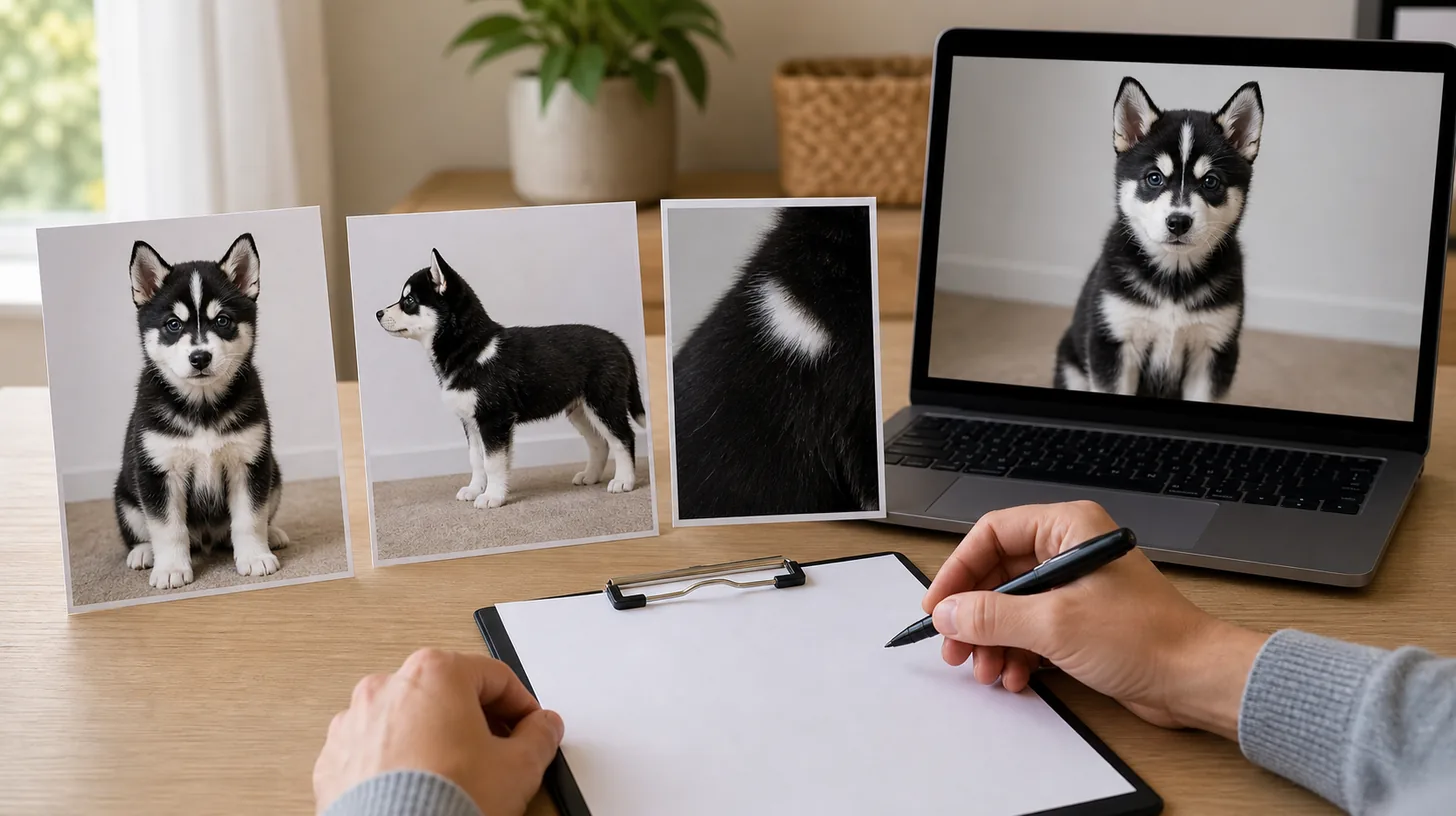
Direct answer: Request current dated front, side, and identifying-marking photographs plus a live video view. Compare stable visible details, age claims, background, seller identity, and names across documents without trusting metadata alone. Preserve originals and every inconsistency. Do not send more money under pressure when the seller will not reconcile the puppy's identity or the image timeline.
A listing may contain images from different dates, cameras, rooms or dogs. Some differences are ordinary; others require the seller to reconcile identity and timing. The check uses original files, stable visible markings, a live view and document names as independent layers. It does not turn image metadata or one facial pattern into conclusive authentication.
Capture the Original Listing
Save the full page, seller identity, date, price and all image positions before the listing changes.
Treat this as one part of the complete routine, not an isolated trick. The surrounding setup is a private evidence folder with listing capture, original files, seller messages, live-video notes, contract, receipt and a comparison table. A clean transition reduces ambiguity and makes it easier to notice when the dog, equipment, environment, or records differ from the previous attempt. In this routine, step 1 is the capture the original listing decision.
Do not convert this step into a stress test. The principal avoidable risks are thumbnail only, stock photo, filter, mirrored image, altered date, different puppy, changing seller name, pre-recorded video, urgency or new payment route. Write down file, source, received date, claimed capture date, puppy age, front, side, stable marking, background, seller, document name, live match and conflict; a short factual note is more useful than a reassuring guess. Record the result of capture the original listing before continuing.
Request Original Current Photos
Ask for new front, side and identifying-marking views rather than screenshots of existing images.
Pause long enough to inspect the result rather than assuming the action worked. Look at the dog, the physical boundary, and the next movement available to the caregiver. Continue only when the arrangement still supports one listing-photo set reconciled across originals, dates, stable visible details, live video, seller identity and documents before additional payment. In this routine, step 2 is the request original current photos decision.
Stop when the expected condition is absent or the situation begins to depend on force, luck, or an open boundary. Specifically avoid thumbnail only, stock photo, filter, mirrored image, altered date, different puppy, changing seller name, pre-recorded video, urgency or new payment route. The follow-up record should cover file, source, received date, claimed capture date, puppy age, front, side, stable marking, background, seller, document name, live match and conflict. Record the result of request original current photos before continuing.
Build an Image Timeline
Separate received date from claimed capture date and calculate whether age claims remain coherent.
A second capable adult can verify the boundary during early practice or higher-risk situations. That person should follow the same sequence and avoid adding prompts, handling, or access that changes the task. The shared standard remains one listing-photo set reconciled across originals, dates, stable visible details, live video, seller identity and documents before additional payment. In this routine, step 3 is the build an image timeline decision.
The absence of an incident is not proof that the arrangement is sound. Recheck for thumbnail only, stock photo, filter, mirrored image, altered date, different puppy, changing seller name, pre-recorded video, urgency or new payment route. Document file, source, received date, claimed capture date, puppy age, front, side, stable marking, background, seller, document name, live match and conflict so a later caregiver can distinguish a passed step from one that was skipped. Record the result of build an image timeline before continuing.
Compare Stable Visible Details
Review markings, blaze shape, socks and other visible features while allowing for coat and lighting change.
Perform this check before adding the next variable. The target remains one listing-photo set reconciled across originals, dates, stable visible details, live video, seller identity and documents before additional payment. Work in a private evidence folder with listing capture, original files, seller messages, live-video notes, contract, receipt and a comparison table. If the setup cannot preserve that condition, simplify it or stop rather than relying on speed or physical control. In this routine, step 4 is the compare stable visible details decision.
If the Pomsky cannot remain comfortable or the equipment and environment cannot remain controlled, end the attempt. Do not proceed through thumbnail only, stock photo, filter, mirrored image, altered date, different puppy, changing seller name, pre-recorded video, urgency or new payment route. Capture file, source, received date, claimed capture date, puppy age, front, side, stable marking, background, seller, document name, live match and conflict before deciding what changes next. Record the result of compare stable visible details before continuing.
Check Background and Handling Context
Record rooms, surfaces, people and objects without treating one repeated background as proof.
Use an observable pass condition: the relevant item is checked, the boundary is closed, and the Pomsky can remain safe without being used as a test. This protects the main objective, one listing-photo set reconciled across originals, dates, stable visible details, live video, seller identity and documents before additional payment, while leaving a clear point at which the caregiver can step back. In this routine, step 5 is the check background and handling context decision.
Do not convert this step into a stress test. The principal avoidable risks are thumbnail only, stock photo, filter, mirrored image, altered date, different puppy, changing seller name, pre-recorded video, urgency or new payment route. Write down file, source, received date, claimed capture date, puppy age, front, side, stable marking, background, seller, document name, live match and conflict; a short factual note is more useful than a reassuring guess. Record the result of check background and handling context before continuing.
Use Metadata as Supporting Evidence
Preserve available metadata but expect platforms to remove or alter it.
Keep the sequence repeatable across caregivers. Say what is being checked, complete it, and return equipment and people to neutral before continuing. In this page's context, success means one listing-photo set reconciled across originals, dates, stable visible details, live video, seller identity and documents before additional payment; it does not mean proving that a known risk can be tolerated. In this routine, step 6 is the use metadata as supporting evidence decision.
Stop when the expected condition is absent or the situation begins to depend on force, luck, or an open boundary. Specifically avoid thumbnail only, stock photo, filter, mirrored image, altered date, different puppy, changing seller name, pre-recorded video, urgency or new payment route. The follow-up record should cover file, source, received date, claimed capture date, puppy age, front, side, stable marking, background, seller, document name, live match and conflict. Record the result of use metadata as supporting evidence before continuing.
Run a Live Identity Check
Ask the seller to show the same puppy and current agreed views in real time.
Treat this as one part of the complete routine, not an isolated trick. The surrounding setup is a private evidence folder with listing capture, original files, seller messages, live-video notes, contract, receipt and a comparison table. A clean transition reduces ambiguity and makes it easier to notice when the dog, equipment, environment, or records differ from the previous attempt. In this routine, step 7 is the run a live identity check decision.
The absence of an incident is not proof that the arrangement is sound. Recheck for thumbnail only, stock photo, filter, mirrored image, altered date, different puppy, changing seller name, pre-recorded video, urgency or new payment route. Document file, source, received date, claimed capture date, puppy age, front, side, stable marking, background, seller, document name, live match and conflict so a later caregiver can distinguish a passed step from one that was skipped. Record the result of run a live identity check before continuing.
Reconcile Names Across Documents
Match seller, puppy, parent and clinic identifiers without accepting unexplained substitutions.
Pause long enough to inspect the result rather than assuming the action worked. Look at the dog, the physical boundary, and the next movement available to the caregiver. Continue only when the arrangement still supports one listing-photo set reconciled across originals, dates, stable visible details, live video, seller identity and documents before additional payment. In this routine, step 8 is the reconcile names across documents decision.
If the Pomsky cannot remain comfortable or the equipment and environment cannot remain controlled, end the attempt. Do not proceed through thumbnail only, stock photo, filter, mirrored image, altered date, different puppy, changing seller name, pre-recorded video, urgency or new payment route. Capture file, source, received date, claimed capture date, puppy age, front, side, stable marking, background, seller, document name, live match and conflict before deciding what changes next. Record the result of reconcile names across documents before continuing.
Preserve Every Inconsistency
Keep neutral notes and original messages instead of editing the evidence into a preferred story.
A second capable adult can verify the boundary during early practice or higher-risk situations. That person should follow the same sequence and avoid adding prompts, handling, or access that changes the task. The shared standard remains one listing-photo set reconciled across originals, dates, stable visible details, live video, seller identity and documents before additional payment. In this routine, step 9 is the preserve every inconsistency decision.
Do not convert this step into a stress test. The principal avoidable risks are thumbnail only, stock photo, filter, mirrored image, altered date, different puppy, changing seller name, pre-recorded video, urgency or new payment route. Write down file, source, received date, claimed capture date, puppy age, front, side, stable marking, background, seller, document name, live match and conflict; a short factual note is more useful than a reassuring guess. Record the result of preserve every inconsistency before continuing.
Stop Before Additional Payment
Pause when identity, timing or seller records remain unresolved or pressure increases.
Perform this check before adding the next variable. The target remains one listing-photo set reconciled across originals, dates, stable visible details, live video, seller identity and documents before additional payment. Work in a private evidence folder with listing capture, original files, seller messages, live-video notes, contract, receipt and a comparison table. If the setup cannot preserve that condition, simplify it or stop rather than relying on speed or physical control. In this routine, step 10 is the stop before additional payment decision.
Stop when the expected condition is absent or the situation begins to depend on force, luck, or an open boundary. Specifically avoid thumbnail only, stock photo, filter, mirrored image, altered date, different puppy, changing seller name, pre-recorded video, urgency or new payment route. The follow-up record should cover file, source, received date, claimed capture date, puppy age, front, side, stable marking, background, seller, document name, live match and conflict. Record the result of stop before additional payment before continuing.
When to Stop and Escalate
Stop when the Pomsky, caregiver, equipment, records, or environment no longer supports one listing-photo set reconciled across originals, dates, stable visible details, live video, seller identity and documents before additional payment. Do not improvise through thumbnail only, stock photo, filter, mirrored image, altered date, different puppy, changing seller name, pre-recorded video, urgency or new payment route. Seek the seller for reconciliation, record issuers for document confirmation and consumer, payment or legal authorities for suspected fraud. Bring the factual observations already collected rather than recreating the event.
Before another attempt, review file, source, received date, claimed capture date, puppy age, front, side, stable marking, background, seller, document name, live match and conflict. Resume only after the responsible person, physical setup, and controlling instructions are clear. A stop is part of the protocol: it preserves useful evidence and prevents uncertainty from becoming exposure.
Keep the Routine Current
Recheck the complete setup whenever the dog, household, product, instructions, environment, or purpose changes. The intended outcome remains one listing-photo set reconciled across originals, dates, stable visible details, live video, seller identity and documents before additional payment, not a perfect-looking performance. Use the newest primary instruction, retain dated records, and retire superseded assumptions so every caregiver begins from the same current plan.
Sources reviewed
Each source is used only for the claim scopes listed below. None establishes a guaranteed Pomsky outcome or replaces individual professional assessment.
- U.S. Federal Trade Commission: Animal lovers: learn to spot and avoid breed and pet scams - Supports: pet scam warning signs; payment risk; listing verification. Limit: Do not accuse a named seller without independently verified evidence.
- American Kennel Club: How to Spot a Puppy Scam - Supports: puppy scam red flags; seller verification; payment caution. Limit: Do not publish unverified allegations about individual sellers.
- American Kennel Club: Signs of a Responsible Breeder - Supports: breeder verification steps; visit and record checks; buyer safeguards. Limit: A checklist reduces risk but cannot guarantee a breeder or puppy.